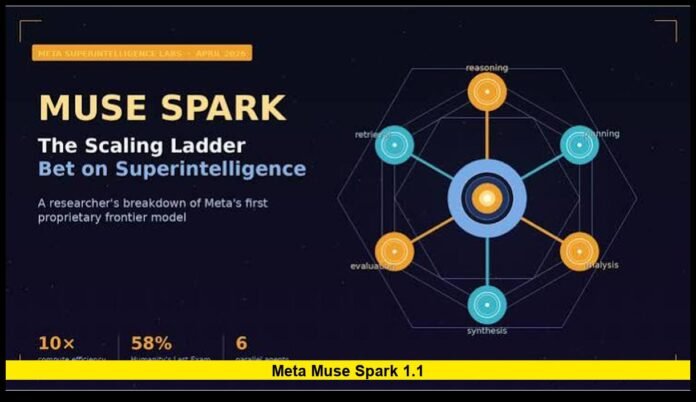

Meta Muse Spark 1.1 is making headlines after Meta officially introduced the latest version of its artificial intelligence model for developers and businesses. Released on July 9, 2026, the new AI model brings stronger coding capabilities, improved reasoning, multimodal understanding, and advanced agent features. Alongside the launch, Meta has also opened public developer access through its Model API, allowing software creators to begin building AI-powered applications with the company’s newest technology.
The announcement represents another major milestone in Meta’s growing AI strategy. Over the past year, the company has invested heavily in foundation models, AI infrastructure, and developer tools. Muse Spark 1.1 reflects that effort by delivering a more capable model designed for practical use across software development, enterprise productivity, automation, and consumer experiences.
What Is Meta Muse Spark 1.1?
Meta Muse Spark 1.1 is the newest release in Meta’s Muse Spark family of large language models. It has been designed to understand text, images, documents, and other forms of content while completing increasingly complex tasks.
The model serves multiple purposes. Developers can use it to write software, automate workflows, analyze documents, generate content, and create intelligent assistants capable of handling longer conversations and more advanced reasoning.
Unlike earlier AI systems that focused mainly on answering prompts, Muse Spark 1.1 emphasizes completing tasks from start to finish. This approach allows AI to function more like a digital assistant that can plan, organize, and execute multiple steps instead of responding one request at a time.
A Major Upgrade for Software Development
One of the biggest improvements in Muse Spark 1.1 is its performance in software engineering.
Programming has become one of the most valuable uses for generative AI, and Meta has focused heavily on this area. The updated model performs better across nearly every stage of software development.
Developers can use it to:
- Generate code in multiple programming languages
- Explain existing code
- Detect software bugs
- Suggest fixes
- Refactor older projects
- Create documentation
- Build application prototypes
- Improve code quality
These capabilities help developers spend less time on repetitive work while allowing them to focus on solving larger technical problems.
Whether someone is building a mobile app, enterprise software, or a personal project, Muse Spark 1.1 aims to become a reliable coding assistant.
Improved AI Reasoning
Reasoning remains one of the most important measurements for modern AI systems.
Meta has strengthened the model’s ability to analyze complicated requests before generating responses. Instead of treating each prompt independently, Muse Spark 1.1 can better understand context across longer conversations.
That improvement benefits users working on projects that require multiple connected steps.
For example, the model can:
- Analyze a problem
- Break it into manageable pieces
- Create a solution
- Revise the result
- Continue improving the output
Maintaining context over longer interactions makes the AI much more useful for professional work.
Agent Capabilities Continue to Grow
Artificial intelligence is moving beyond chatbots.
Meta has invested heavily in what many companies describe as agentic AI. Rather than waiting for individual instructions, these systems can plan actions and complete longer workflows with limited supervision.
Muse Spark 1.1 introduces stronger agent features that allow the model to organize tasks more efficiently.
Examples include:
- Managing software projects
- Performing research tasks
- Organizing documents
- Planning workflows
- Using connected tools
- Completing multi-step assignments
This shift reflects a broader trend throughout the AI industry as companies develop assistants capable of carrying out real work instead of simply producing text.
Multimodal Intelligence Expands Possibilities
Modern AI applications increasingly require more than text understanding.
Muse Spark 1.1 supports multimodal processing, allowing it to work with several different types of information.
These include:
- Text
- Images
- Documents
- Screenshots
- Visual interfaces
- Video inputs
Because the model can analyze different forms of content together, developers can build applications that solve a much wider variety of problems.
For instance, an AI assistant could examine a screenshot, understand written instructions, identify interface elements, and recommend solutions within a single interaction.
That flexibility opens opportunities across industries ranging from education and healthcare administration to customer service and software development.
Public Developer Access Marks an Important Step
One of the most significant announcements surrounding Muse Spark 1.1 is broader availability.
Meta has officially opened public developer preview access through its new Model API.
This means developers no longer need invitation-only access to begin testing the newest AI model.
The expanded availability allows:
- Independent developers
- Technology startups
- Enterprise software teams
- Researchers
- Product managers
- Educational organizations
to begin experimenting with Meta’s newest AI platform.
Opening access to a wider audience encourages innovation and helps developers evaluate how the model fits into their own products.
Meta Model API Simplifies Integration
The launch of the Meta Model API gives developers a direct way to connect Muse Spark 1.1 with their own software.
Instead of building AI infrastructure from scratch, organizations can integrate the model into existing applications.
Possible use cases include:
- Customer support platforms
- AI-powered search
- Internal company assistants
- Educational software
- Business productivity tools
- Coding assistants
- Content generation platforms
This approach reduces development time while allowing companies to focus on building unique user experiences.
Designed for Enterprise Applications
Businesses increasingly expect AI to improve productivity across multiple departments.
Muse Spark 1.1 addresses those needs by supporting enterprise workflows that involve large amounts of information and repetitive processes.
Organizations can use the model to:
- Summarize reports
- Organize internal documentation
- Assist software teams
- Improve customer interactions
- Process uploaded files
- Analyze business information
- Automate repetitive digital tasks
As AI adoption continues growing across American businesses, tools capable of handling professional workloads become increasingly valuable.
Longer Context Makes Conversations More Useful
Earlier generations of AI models sometimes struggled with long conversations.
Muse Spark 1.1 improves its ability to remember previous instructions while maintaining consistency throughout larger projects.
This means users can continue conversations without repeatedly explaining earlier information.
Longer context windows help during:
- Software development
- Research
- Technical writing
- Business planning
- Document analysis
- Project management
The result is a smoother experience for both developers and everyday users.
Built for Productivity Instead of Simple Conversations
Many AI products originally focused on answering questions.
Today’s models are expected to perform meaningful work.
Muse Spark 1.1 reflects this evolution by emphasizing productivity.
Instead of generating isolated responses, it helps users:
- Complete projects
- Organize information
- Solve technical problems
- Write code
- Analyze documents
- Automate business processes
This practical focus aligns with growing demand for AI systems that improve workplace efficiency.
Read More – Meta Layoffs: Hundreds of Jobs Reportedly at Risk in Ireland Amid Ongoing Restructuring
Benefits for Independent Developers
Smaller software teams often face limited budgets and fewer engineering resources.
Advanced AI tools can help level the playing field.
Independent developers using Muse Spark 1.1 may benefit from:
- Faster software development
- Automated debugging
- Improved documentation
- Rapid prototyping
- Better testing support
- More efficient project planning
Reducing development time allows creators to spend more effort refining products rather than handling repetitive coding tasks.
Opportunities for Startups
Startups frequently need to move quickly while managing limited resources.
AI models such as Muse Spark 1.1 can accelerate product development in several ways.
Potential startup applications include:
- AI assistants
- Scheduling tools
- Customer service automation
- Business intelligence platforms
- Educational technology
- Marketing software
- Internal workflow systems
Access through the Model API also simplifies experimentation before companies commit to larger deployments.
Supporting Creative Workflows
Although coding represents a major focus, Muse Spark 1.1 also supports creative tasks.
Teams may use the model for:
- Draft creation
- Brainstorming ideas
- Organizing research
- Content planning
- Writing summaries
- Reviewing documents
These capabilities make the model useful beyond software engineering.
Marketing departments, educators, analysts, and project managers can all benefit from AI-assisted productivity.
Improved User Experience Across Meta Products
Meta continues integrating advanced AI into many of its consumer services.
As Muse Spark 1.1 rolls out across the company’s ecosystem, users are expected to experience more capable AI interactions within Meta-powered applications.
The model supports faster responses, improved understanding, and stronger reasoning, creating a more natural experience for users interacting with AI throughout Meta’s products.
This broader integration also demonstrates how foundation models increasingly power everyday digital experiences rather than existing as standalone tools.
Growing Competition in Artificial Intelligence
Artificial intelligence remains one of the fastest-moving technology sectors.
Major technology companies continue introducing increasingly capable foundation models designed for professional and consumer use.
Competition now extends beyond chatbot conversations into areas such as:
- Software engineering
- Research
- Automation
- Productivity
- Business operations
- Digital assistants
Meta Muse Spark 1.1 enters this competitive landscape with a strong emphasis on developer accessibility, coding performance, and real-world applications.
Security and Responsible Deployment
As organizations deploy more AI systems, responsible implementation becomes increasingly important.
Businesses adopting Muse Spark 1.1 should establish internal guidelines covering:
- Data privacy
- Human review
- Security practices
- Output verification
- Appropriate use policies
Maintaining oversight helps organizations maximize AI benefits while ensuring high-quality results.
Responsible deployment remains an important consideration regardless of the AI platform being used.
How Muse Spark 1.1 Fits Into Meta’s AI Vision
Meta has consistently stated that artificial intelligence represents one of its highest long-term priorities.
The company continues investing in advanced research, computing infrastructure, foundation models, and developer platforms.
Muse Spark 1.1 demonstrates how that strategy is evolving beyond consumer chat experiences toward tools that help developers and organizations build practical AI applications.
By combining stronger reasoning, multimodal understanding, coding improvements, and broader API access, Meta aims to provide technology that supports a wide range of real-world workloads.
Why This Release Matters
The introduction of Meta Muse Spark 1.1 is more than a routine software update.
It expands access to one of Meta’s newest AI models while delivering meaningful improvements for developers, businesses, and organizations seeking advanced artificial intelligence capabilities.
The combination of stronger coding performance, improved reasoning, multimodal intelligence, longer context handling, and public API availability makes the release one of Meta’s most important AI announcements of 2026.
As AI adoption continues accelerating across the United States, Muse Spark 1.1 provides developers with another powerful option for building intelligent applications that solve practical business and consumer challenges.
What are your thoughts on Meta Muse Spark 1.1? Share your opinion in the comments and check back for more updates on the latest AI innovations.