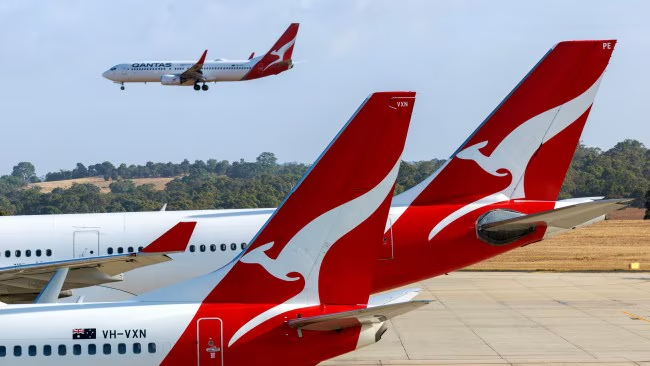

Passengers traveling aboard a Melbourne-US Qantas flight faced hours of uncertainty after an onboard altercation forced the aircraft to make an emergency diversion in the Pacific. The incident unfolded during a long-haul journey to Dallas when a passenger allegedly became aggressive toward crew members, creating a tense situation that required immediate intervention.
The disruption reportedly began several hours after departure from Melbourne. According to accounts from travelers onboard, cabin crew initially attempted to calm the individual after signs of erratic behavior became apparent. Witnesses described raised voices and visible concern among nearby passengers as the situation escalated inside the cabin.
Flight attendants are trained to manage difficult situations, but the confrontation allegedly intensified when the passenger physically attacked a crew member. Reports indicate the individual bit a staff member during the disturbance, prompting urgent action from both airline personnel and passengers seated nearby.
The aircraft was ultimately redirected to Tahiti, where local authorities met the plane upon landing.
Passengers Help Crew During Chaotic Scene
Several travelers onboard reportedly stepped in to assist cabin crew members as they worked to restrain the disruptive passenger. Some passengers later described the atmosphere as deeply unsettling, especially given the aircraft’s remote location over the Pacific Ocean at the time of the incident.
Witnesses said crew members maintained professionalism despite the mounting pressure inside the cabin. Some travelers praised the calm response shown by airline staff during the emergency, noting that communication from the cockpit and cabin remained steady throughout the diversion process.
The unscheduled landing added hours to the journey, leaving many passengers dealing with missed connections and revised travel plans after arriving in the United States later than expected.
Airlines operating ultra-long-haul routes often face complex challenges when onboard emergencies occur far from major airports. Diversions over oceanic routes can carry significant operational costs and logistical complications.
Emergency Landing Raises Safety Questions
The unexpected stop in Tahiti once again placed public attention on growing concerns surrounding disruptive passenger behavior in commercial aviation.
Industry experts say airlines around the world have experienced an increase in aggressive incidents involving travelers over recent years. While severe physical confrontations remain relatively uncommon, aviation authorities continue urging passengers to follow crew instructions at all times to maintain safety onboard.
In many cases, disruptive behavior can lead to permanent travel bans, criminal investigations, or financial penalties. Airlines also face major operational disruptions when flights are forced to divert unexpectedly due to security concerns.
Cabin crew members are trained extensively in de-escalation techniques, conflict management, and emergency response procedures. However, incidents involving physical violence create serious risks in confined aircraft environments where crews must maintain order while ensuring passenger safety.
Flight Continued After Delay
Following the emergency landing, authorities removed the passenger from the aircraft before the flight resumed its route to Dallas.
Passengers remained onboard during parts of the ground delay while airline teams coordinated refueling, security procedures, and clearance for departure. Despite the interruption, the aircraft later completed the journey without further incidents reported.
The airline confirmed that the traveler involved would no longer be permitted to fly with the carrier. Company representatives also expressed support for the crew members affected during the confrontation.
Although no major injuries were publicly reported, aviation analysts note that even isolated mid-air incidents can have lasting emotional effects on passengers and airline staff.
Air Rage Incidents Continue to Concern Airlines
The Melbourne-US Qantas flight incident has reignited debate over how airlines handle intoxicated or aggressive travelers before boarding international flights.
Some aviation experts argue that stricter alcohol monitoring inside airports and onboard aircraft may help reduce incidents involving unruly passengers. Others believe enhanced security screening and stronger enforcement measures are needed to discourage violent conduct during flights.
Airlines globally have continued reviewing safety protocols as passenger volumes rise across international travel routes. Crew assaults remain a serious concern for aviation unions and regulators, particularly on long-haul services where options for immediate intervention are limited.
Travelers increasingly expect airlines to respond quickly and decisively when safety concerns emerge during flights. Incidents that involve threats or violence can quickly spread online through passenger videos and social media posts, placing additional scrutiny on airline responses.
Long-Haul Travel Challenges Under Spotlight
Long-distance international flights can create unique pressures for both passengers and crew. Fatigue, alcohol consumption, anxiety, and confined spaces may all contribute to onboard tensions during journeys lasting more than a dozen hours.
Aviation specialists say airlines continue investing in crew training programs focused on identifying potentially disruptive behavior before situations escalate. Many carriers also work closely with airport authorities and security agencies to monitor incidents involving intoxication or aggressive conduct prior to boarding.
Despite occasional high-profile disturbances, experts stress that commercial aviation remains one of the safest forms of transportation globally. Most international flights operate without serious incidents, even across demanding long-haul routes.
Still, episodes involving violence onboard aircraft tend to attract significant public attention because of the potential risks involved at cruising altitude.
Investigation Ongoing
Authorities are continuing to examine the circumstances surrounding the onboard disturbance and the actions taken during the diversion. Legal proceedings could follow depending on the outcome of the investigation in French Polynesia.
Meanwhile, the event has renewed discussion across the aviation industry about passenger accountability, crew protection, and emergency response procedures during international flights.
For many travelers onboard, the incident transformed what should have been a routine overseas journey into a stressful and unforgettable experience thousands of miles from their intended destination.