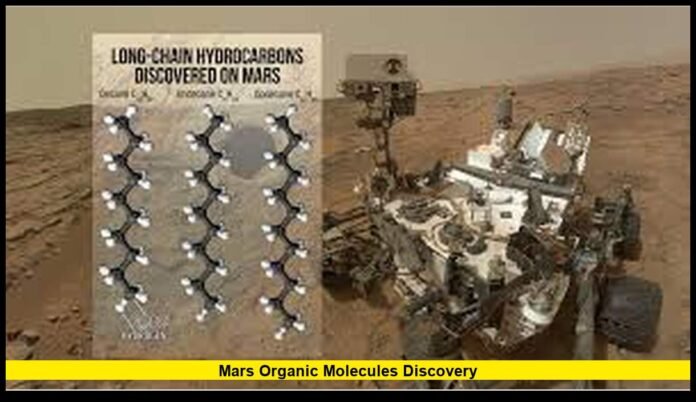

The Mars organic molecules discovery has reshaped scientific discussions about the Red Planet’s ancient environment, as researchers confirm that complex carbon compounds found in Martian rock samples cannot be fully explained by currently understood non-biological chemistry. The findings stem from detailed analysis of mudstone drilled by NASA’s Curiosity rover, revealing long-chain hydrocarbons preserved for billions of years.
This milestone represents one of the most significant developments in Mars exploration in recent history. While it does not confirm life once existed on Mars, it strengthens evidence that the planet once hosted rich chemical conditions capable of supporting prebiotic processes.
Complex Carbon Compounds Identified in Gale Crater
NASA’s Curiosity rover made the breakthrough while studying sedimentary rocks in Gale Crater. The rover drilled into a rock sample known as “Cumberland,” a mudstone formed roughly 3.7 billion years ago during a period when Mars had stable liquid water on its surface.
Using its onboard Sample Analysis at Mars (SAM) laboratory, Curiosity detected long-chain hydrocarbons including:
- Decane (C10)
- Undecane (C11)
- Dodecane (C12)
These molecules represent the largest organic compounds ever identified directly on Mars. Earlier missions had detected smaller organic molecules, but this marked a clear increase in molecular complexity.
Mudstone forms from fine sediments deposited in calm water, often lakes. The geological context suggests that ancient Gale Crater once held a long-lasting lake system. Such environments on Earth often preserve organic material for billions of years, which makes Gale Crater especially valuable for astrobiology research.
Why Organic Molecules Matter
Organic molecules contain carbon atoms bonded with hydrogen and sometimes oxygen, nitrogen, or sulfur. On Earth, these compounds form the basis of all known life. Proteins, lipids, and DNA all depend on complex carbon chemistry.
However, organic molecules can also form without life. Geological reactions between water and rock can produce hydrocarbons. Chemical interactions in a planet’s atmosphere can generate organic compounds. Meteorites can also deliver carbon-based molecules to planetary surfaces.
Because of these possibilities, scientists approach the Mars findings carefully. The discovery shows that carbon chemistry existed on Mars in the distant past. It does not confirm biological activity.
Still, the length of the carbon chains and their preservation inside ancient sedimentary rock raise new scientific questions. Current non-biological models do not fully account for the observed abundance of these compounds.
New Research Examines Chemical Limits
Recent laboratory modeling and radiation studies have focused on how organic molecules survive on Mars. The planet lacks a strong magnetic field and thick atmosphere, which means surface materials experience high levels of radiation.
Scientists simulated billions of years of radiation exposure to estimate how much organic material should remain detectable today. The results suggest that the preserved hydrocarbons in the Cumberland sample exceed expectations based on known abiotic processes alone.
Researchers emphasize that this does not prove life existed. Instead, it highlights gaps in current chemical explanations. The data suggests either that Mars once generated more organic material than previously thought or that preservation mechanisms were more efficient than models predict.
Both conclusions point to a chemically dynamic early Mars.
Evidence of Ancient Water and Habitability
Gale Crater provides one of the strongest cases for ancient Martian habitability. Over more than a decade of exploration, Curiosity has confirmed several key environmental factors:
- Long-lived liquid water
- Neutral to mildly alkaline lake chemistry
- Essential elements such as carbon, hydrogen, oxygen, nitrogen, phosphorus, and sulfur
- Clay minerals formed in water
Together, these findings show that early Mars once offered conditions similar to those that supported microbial life on early Earth.
The newly detected hydrocarbons add another critical component: complex organic chemistry preserved in sediment.
Habitability does not mean life existed. It means the environment could have supported it. That distinction remains central to ongoing research.
Complementary Findings from Jezero Crater
NASA’s Perseverance rover, operating in Jezero Crater, has also detected organic-carbon-bearing materials within Martian rocks. Jezero Crater once hosted a river delta that fed into an ancient lake, making it another promising site for studying past environments.
Perseverance identified mineral patterns and chemical signatures associated with organic processes. Scientists continue to analyze those samples as part of a broader effort to understand Mars’ geological and chemical evolution.
The combination of findings from Gale and Jezero strengthens the view that organic chemistry was widespread on ancient Mars rather than limited to one location.
What Makes These Molecules Unique
The hydrocarbons detected by Curiosity resemble fragments of fatty acids, which are common in biological membranes on Earth. Fatty acids typically contain even-numbered carbon chains, though odd-numbered chains also occur.
The presence of mid-length carbon chains on Mars suggests that either:
- Geological reactions created more complex molecules than expected
- Ancient Martian environments concentrated and preserved organic material efficiently
Scientists continue to study isotopic signatures and mineral associations to determine how these molecules formed. Isotopic analysis can help distinguish between biological and non-biological origins, though definitive answers may require laboratory testing on Earth.
Mars Sample Return and Future Research
NASA and international partners have long planned to return Martian rock samples to Earth for advanced laboratory study. Earth-based instruments can detect subtle chemical signatures that rovers cannot measure directly.
Returned samples could allow scientists to:
- Analyze isotopic ratios with high precision
- Examine molecular structures in detail
- Search for microscopic textures that suggest biological influence
- Test competing formation models
While the timeline for sample return continues to evolve, the importance of these missions has grown following the Mars organic molecules discovery.
Advanced laboratory analysis could provide clarity about how these hydrocarbons formed and whether biological processes played any role.
Implications for Planetary Science
The discovery influences more than just Mars research. It affects broader planetary science and astrobiology studies.
1. Understanding Early Planetary Chemistry
Early Mars and early Earth share similarities in age and initial formation conditions. Studying Martian organics helps scientists understand how carbon chemistry develops on rocky planets.
2. Refining Life Detection Strategies
The findings guide the design of future missions searching for biosignatures. Scientists now know that complex organic molecules can survive in Martian sedimentary rock for billions of years.
3. Expanding Astrobiology Beyond Earth
If complex organic chemistry occurred naturally on Mars, similar processes may happen on other worlds with past water activity, such as icy moons or exoplanets.
Caution Remains Central
Despite the excitement, researchers continue to stress restraint. No confirmed biological signature has been identified. No direct fossil evidence has been observed. The hydrocarbons alone cannot establish life.
Scientific progress depends on eliminating alternative explanations. That process takes time, modeling, and additional data.
The current findings show that Mars preserved organic molecules at levels that challenge existing non-biological models. Whether those models evolve or new explanations emerge remains to be seen.
A Transformative Moment in Mars Exploration
The Mars organic molecules discovery marks a turning point in the exploration of our neighboring planet. For decades, scientists searched for signs that Mars once had the ingredients for life. Now, complex hydrocarbons preserved in ancient lakebed sediments confirm that Mars hosted advanced carbon chemistry billions of years ago.
Curiosity continues to operate in Gale Crater, extending one of the most successful planetary missions in history. Perseverance continues collecting samples in Jezero Crater, adding new layers of evidence.
Together, these missions are reshaping our understanding of Mars’ past.
The Red Planet no longer appears as a chemically barren world. Instead, it reveals a history that includes water, essential elements, and preserved organic compounds.
Whether those ingredients ever assembled into living organisms remains an open scientific question. What is certain is that Mars’ ancient environment was far more complex than once believed.
As new data continues to arrive, the story of Mars is still unfolding—stay engaged and join the conversation about what these discoveries could mean for the future of space exploration.