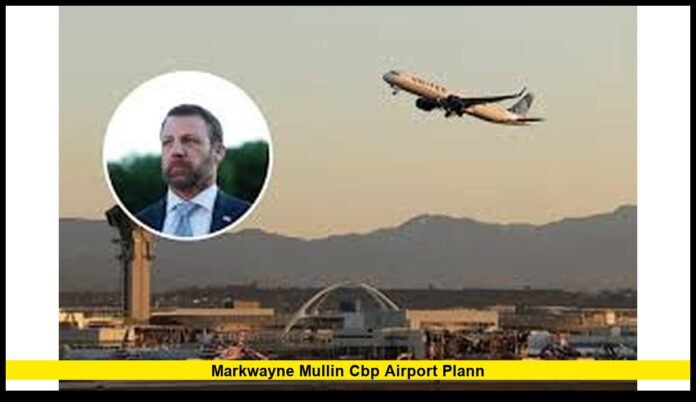

The markwayne mullin cbp airport plan has emerged as one of the most discussed policy proposals involving U.S. airports, immigration enforcement, and federal authority in 2026. The proposal centers on whether Customs and Border Protection resources should continue operating at the same level in cities that maintain sanctuary policies, a debate that has quickly expanded into a broader national conversation about transportation, border security, and local government cooperation.
The discussion gained momentum after Homeland Security Secretary Markwayne Mullin suggested that federal resources could be reassigned if local jurisdictions refuse to cooperate with immigration enforcement efforts. While no airport has lost international customs services, the proposal has triggered reactions from lawmakers, airport officials, airline executives, business organizations, and travelers across the country.
As federal officials continue reviewing policy options, the issue remains a major topic in Washington and among communities that depend heavily on international travel and global commerce.
A New Flashpoint in the Immigration Debate
Immigration policy has remained one of the most influential issues in American politics, and airport operations have now become part of that larger discussion.
For years, sanctuary city policies have been the subject of disagreements between federal and local officials. Supporters of sanctuary policies argue that local law enforcement should focus on community safety rather than immigration enforcement. Opponents contend that local governments should fully cooperate with federal immigration authorities.
The current debate has brought those long-running tensions into the transportation sector. Instead of focusing solely on law enforcement cooperation, attention has shifted toward federal services that support international travel.
That shift has significantly raised the stakes because millions of passengers pass through international airports every month.
Why CBP Operations Matter at Airports
Every traveler arriving from an international destination must go through customs and immigration inspection before entering the country. CBP officers verify travel documents, enforce federal laws, inspect goods, identify security threats, and facilitate legal travel.
Without those services, an airport cannot operate normally as an international arrival point.
The agency also plays a major role in processing cargo shipments that enter the United States through commercial airports. Everything from medical supplies and electronics to consumer products and industrial equipment may pass through customs inspections before reaching businesses and consumers.
Because of these responsibilities, any discussion involving CBP staffing immediately attracts attention from airlines, travelers, and economic development leaders.
How the Proposal Entered the National Spotlight
The issue gained widespread attention after comments made by Mullin regarding the allocation of federal personnel.
The secretary indicated that his department was evaluating ways to prioritize federal resources and suggested that jurisdictions unwilling to cooperate with immigration enforcement could face consequences related to federal services.
Although no official policy change was announced, the comments generated immediate interest because they touched on airports that serve as major gateways for international travel.
Travel industry leaders quickly began analyzing the potential implications of shifting customs resources away from high-volume airports.
The discussion soon expanded beyond transportation circles and became a national political story.
Newark Became the Center of the Conversation
Much of the attention surrounding the proposal focused on Newark Liberty International Airport.
Newark is among the busiest airports in the United States and serves millions of domestic and international passengers each year. It is also a critical hub for business travelers, international visitors, and cargo operations.
The airport became part of the discussion after federal officials raised concerns about resource allocation and security-related priorities.
The possibility that customs personnel could be reassigned created concern among airline operators and travelers who rely on Newark for international connections.
However, federal officials later indicated that cooperation from state and local authorities had reduced the likelihood of immediate action affecting airport operations.
That development helped calm concerns about near-term disruptions while keeping the broader policy debate alive.
Major Airports Are Watching Closely
The conversation extends far beyond Newark.
Several major metropolitan areas have closely monitored developments because they operate some of the nation’s busiest international airports.
Cities frequently mentioned during discussions about sanctuary policies include New York, Los Angeles, Chicago, San Francisco, Seattle, Boston, Denver, and Philadelphia.
These regions collectively account for a significant share of international air traffic entering the United States.
Their airports connect America to destinations throughout Europe, Asia, Latin America, the Middle East, and Africa.
Any changes affecting customs processing at those facilities would influence airlines, travelers, and businesses on a national scale.
That reality explains why transportation leaders continue to follow the situation closely.
Airlines Raise Operational Concerns
The airline industry has emphasized the importance of maintaining stable customs operations at major airports.
International routes are planned months or even years in advance. Airlines invest substantial resources in aircraft scheduling, staffing, route development, terminal agreements, and passenger connections.
Because international travel depends heavily on customs infrastructure, significant changes cannot be implemented without operational consequences.
Airport authorities have also noted that international terminals are designed around existing customs procedures.
A sudden reduction in customs staffing could create challenges involving passenger processing, flight scheduling, baggage handling, and terminal management.
For airlines operating large international networks, predictability remains essential.
Industry stakeholders argue that maintaining reliable airport operations benefits travelers, businesses, and local economies alike.
Economic Implications Reach Beyond Air Travel
The impact of customs operations extends well beyond passenger transportation.
International airports serve as economic engines for surrounding regions. They support jobs in hospitality, tourism, logistics, retail, transportation, and professional services.
Many metropolitan economies rely heavily on international visitors who spend money at hotels, restaurants, convention centers, entertainment venues, and local businesses.
International business travelers also contribute significantly to economic activity through conferences, corporate meetings, and investment-related travel.
A reduction in customs services could potentially affect these economic relationships if international routes become less efficient or less attractive to airlines.
As a result, business organizations have paid close attention to discussions involving federal airport policy.
Cargo Processing Remains a Critical Factor
Cargo transportation represents another important part of the debate.
Modern supply chains depend on efficient customs processing.
Many products entering the United States arrive through airports before being distributed across the country. High-value shipments often rely on air transportation because of speed and reliability.
Pharmaceutical products, technology equipment, medical devices, and time-sensitive goods frequently move through international airport facilities.
Businesses depend on predictable customs operations to maintain inventory levels and meet customer demand.
Even modest disruptions can affect delivery schedules and create challenges for manufacturers, retailers, and logistics providers.
For that reason, cargo stakeholders are monitoring the situation as carefully as passenger airlines.
The World Cup and Global Tourism Factor
Another reason the issue has attracted national attention is the approaching FIFA World Cup.
The United States is expected to welcome large numbers of international visitors during the tournament.
Several host cities rely on airports that have been part of the broader sanctuary-city discussion.
Tourism officials have emphasized the importance of efficient international arrivals as the country prepares for increased travel demand.
Large sporting events require extensive coordination among federal agencies, airports, airlines, local governments, and hospitality providers.
The possibility of policy changes involving customs operations has therefore become relevant to tourism planning and event preparation.
Industry leaders continue emphasizing the need for smooth airport operations during periods of elevated international travel.
Political Reactions Continue to Grow
The proposal has generated responses from elected officials at every level of government.
Supporters argue that the federal government should have flexibility when allocating resources and should encourage cooperation with immigration enforcement priorities.
Critics counter that airports are essential public infrastructure and should not become leverage in disputes involving local immigration policies.
Some lawmakers have called for greater clarity regarding how any future policy would be implemented.
Others have urged federal officials to provide assurances that international travel networks will remain stable.
The range of reactions highlights how the issue intersects with transportation policy, economic development, immigration enforcement, and federal-state relations.
What the Administration Has Said So Far
Administration officials have repeatedly stated that no final action has been taken.
While discussions continue regarding federal resource allocation, international airports currently remain operational under existing customs procedures.
Travelers arriving from overseas continue to pass through standard immigration and customs inspections.
Airlines continue operating scheduled international routes without broad changes tied to the proposal.
Federal officials have indicated that multiple options remain under review and that future decisions will depend on broader policy considerations.
For now, the focus remains on evaluation and planning rather than implementation.
What Travelers Should Expect
Passengers planning international trips should know that airport operations continue as normal.
Customs processing remains in place at major international gateways throughout the country.
Travel experts recommend monitoring official airline communications and airport announcements for any future updates, particularly during busy travel seasons.
At present, there are no widespread operational changes affecting international arrivals as a result of the debate.
Travelers can continue making plans based on current airport procedures.
However, because the issue remains under discussion, many observers expect additional announcements and policy updates in the months ahead.
Why the Markwayne Mullin CBP Airport Plan Matters
The markwayne mullin cbp airport plan represents more than a dispute about airport staffing.
It reflects broader questions about the relationship between federal and local governments, the role of immigration enforcement in public policy, and the importance of international transportation infrastructure.
Airports serve as gateways for tourism, trade, investment, and cultural exchange. Decisions affecting customs operations have implications that extend far beyond individual cities.
Whether the proposal ultimately results in policy changes or remains part of a larger political debate, it has already sparked significant discussion across multiple sectors of American life.
With immigration continuing to shape national politics and international travel remaining a cornerstone of economic activity, the issue is likely to remain in the spotlight for the foreseeable future.
What are your thoughts on the future of airport customs operations? Share your perspective and stay tuned for further developments as this story continues to unfold.