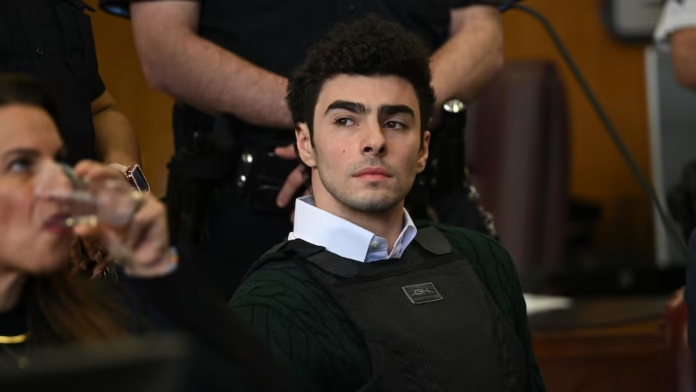

The criminal case surrounding the killing of UnitedHealthcare CEO Brian Thompson has entered a decisive phase, with Luigi Mangione fake ID backpack evidence now standing at the heart of a fierce legal showdown that could reshape the prosecution’s strategy. As pretrial hearings continue in New York, newly confirmed testimony and official records have clarified what investigators recovered at the time of Mangione’s arrest and why those items are now the focus of intense constitutional scrutiny.
The outcome of this evidentiary fight may determine what jurors ultimately see — and what they never hear — when the case moves to trial.
A High-Profile Killing That Shocked the Business World
Brian Thompson, the chief executive of one of the nation’s largest health insurance companies, was fatally shot on a Manhattan street in December 2024. The killing sent shockwaves through corporate America and triggered an immediate response from local, state, and federal authorities.
Investigators quickly described the shooting as targeted. Surveillance images released in the days that followed showed a masked suspect fleeing the scene, prompting a nationwide manhunt. Law enforcement agencies across multiple states coordinated efforts as public tips poured in.
Within days, attention turned to central Pennsylvania.
Arrest at a Restaurant Ends the Manhunt
On December 9, 2024, police arrested Luigi Nicholas Mangione inside a McDonald’s restaurant in Altoona, Pennsylvania. Employees at the location recognized him from widely circulated images and contacted authorities.
Officers approached Mangione while he was seated inside the restaurant. According to confirmed court testimony, he cooperated physically but immediately raised suspicion by providing a false name. He also presented a New Jersey driver’s license that investigators later determined was not legitimate.
That moment — the use of a fake identity during a routine police encounter — would become the legal trigger for everything that followed.
Identity Fraud and the Legal Basis for Detention
Police detained Mangione on suspicion of identity fraud after discovering inconsistencies between his statements and the identification card he produced. Officers warned him that providing false information could result in additional charges.
Prosecutors argue this interaction established probable cause for arrest under Pennsylvania law. From that point, they contend, officers were legally authorized to search Mangione and the items immediately associated with him.
Defense attorneys do not dispute that Mangione provided a false name. Instead, they challenge what happened next.
Inside the Backpack That Changed the Case
The backpack Mangione carried at the time of his arrest has become one of the most consequential pieces of physical evidence in the case. According to verified inventories and sworn testimony, officers recovered a collection of items that prosecutors say point directly to planning and intent.
Those items include a partially assembled 3D-printed handgun, a detachable silencer, loaded ammunition magazines, and handwritten notes that prosecutors describe as ideological in nature. Investigators also documented large sums of cash, foreign currency, a handwritten cryptocurrency recovery phrase, and a map marked with travel routes and notes.
Personal items such as clothing and toiletries were also cataloged.
Prosecutors argue the combination of weapons, written materials, and travel planning forms a cohesive narrative of preparation. Defense attorneys argue the contents are irrelevant unless the search itself was lawful.
Why the Search Is Being Fought in Court
The central legal question is not what officers found, but how and when they found it.
Defense attorneys have filed motions seeking to suppress nearly all evidence recovered from the backpack. Their argument rests on the claim that police searched the bag without a warrant after Mangione was already detained and posed no immediate threat.
According to testimony, officers discussed whether a warrant was needed before opening the backpack. Body camera footage introduced in court shows uncertainty among officers and supervisors during the early moments of the arrest.
Defense lawyers argue that once Mangione was secured, officers were required to obtain a warrant before examining closed containers. They maintain that any evidence obtained before that step violated constitutional protections against unreasonable searches.
Prosecutors counter that the search was lawful under arrest-related search authority and justified by officer safety concerns. They also argue that the search was later validated through formal legal processes.
The Judge’s Decision Could Reshape the Trial
Because the arrest occurred in Pennsylvania while the murder charges are being prosecuted in New York, the court must decide which legal standards govern the admissibility of the evidence.
This jurisdictional complexity has elevated the stakes of the suppression hearing. A ruling excluding key items could significantly weaken the prosecution’s case. A ruling admitting them could allow jurors to see physical evidence that prosecutors believe ties Mangione directly to the crime.
The judge overseeing the hearing has emphasized that the decision will rest strictly on constitutional principles and established law, not public interest or media attention.
Body Camera Footage Adds New Context
Recently presented body camera footage has provided jurors and the public with a clearer view of the arrest itself. The video shows Mangione seated inside the restaurant, wearing a face covering and using a laptop when officers approached.
The footage captures officers questioning him about his identity, warning him about the consequences of lying, and discussing next steps among themselves. The recorded conversations have become a focal point for the defense, which argues the footage demonstrates hesitation and procedural uncertainty.
Prosecutors maintain that caution and discussion among officers do not invalidate the legality of the search.
Federal Charges and Potential Consequences
In addition to state murder charges, Mangione faces federal charges related to weapons possession and identity fraud. Federal prosecutors have indicated that the case qualifies for the most severe penalties available under the law.
While no sentencing decisions have been made, the presence or absence of physical evidence recovered during the arrest could influence both state and federal proceedings.
Mangione has pleaded not guilty to all charges.
Public Reaction and the Weight of Evidence
As details of the arrest and evidence have emerged, public reaction has ranged from shock to intense debate. Legal analysts note that high-profile cases often generate emotional responses, but courtroom decisions ultimately hinge on procedure and precedent.
The dispute over the Luigi Mangione fake ID backpack evidence highlights broader questions about police authority, individual rights, and the balance between public safety and constitutional protections.
What Comes Next
The suppression hearing is expected to conclude soon, after which the court will issue rulings on which evidence may be presented at trial. No trial date has been finalized, but both sides are preparing for an extended legal battle regardless of the outcome.
The judge’s decision will shape not only this case, but potentially future cases involving cross-state arrests and evidence collection during fast-moving investigations.
As the courtroom fight over evidence unfolds, the coming rulings will determine how this case is remembered — and whether the most controversial materials ever reach a jury. Stay engaged as this story continues to develop.