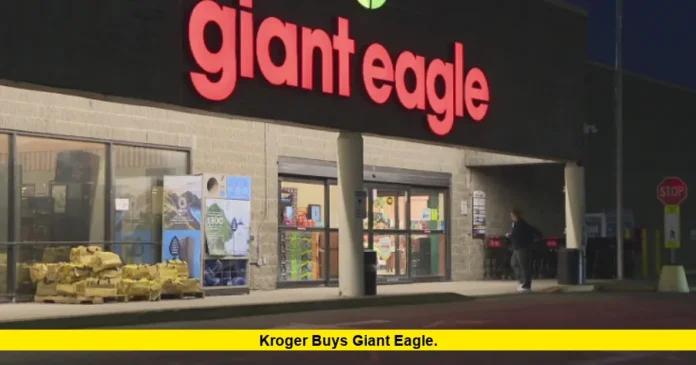

The grocery industry landscape shifted dramatically on July 1, 2026, when news broke that Kroger buys Giant Eagle in a definitive agreement valued at approximately $1.65 billion. The Cincinnati-based grocery giant announced it will acquire the family-owned Pennsylvania grocer in a deal that combines cash payments with assumed liabilities, marking one of the most significant grocery industry acquisitions in recent years. The announcement has sent ripples through the retail world, raising questions about pricing, store operations, jobs, and what shoppers across five states can expect in the coming months.
What Happened: Kroger Buys Giant Eagle
On July 1, 2026, The Kroger Co. and Giant Eagle, Inc. jointly announced a definitive merger agreement under which Kroger will acquire the privately held grocery chain. The purchase price of $1.65 billion consists of $1.25 billion in cash consideration and approximately $400 million in outstanding liabilities that Kroger will assume as part of the transaction. Kroger’s Board of Directors unanimously approved the deal, and the company plans to finance the acquisition entirely with cash on hand rather than taking on new debt through equity issuance.
Kroger CEO Greg Foran described Giant Eagle as a well-run, high-quality regional grocer with a strong reputation for fresh products, pharmacy operations, private label offerings, and customer loyalty. He noted that the strategic fit between the two companies was clear after careful evaluation, and that Giant Eagle expands Kroger’s footprint into attractive adjacent markets. Giant Eagle CEO Bill Artman echoed that sentiment, calling the announcement an exciting next chapter for the company’s team members, customers, vendors, and community partners.
Background on Giant Eagle
Giant Eagle is a family-owned food and pharmacy retailer headquartered in Pennsylvania, with a business history spanning decades in the region. The company built its reputation on fresh grocery offerings, an extensive pharmacy network, and a loyal customer base concentrated in the northeastern and midwestern United States. At the time of the acquisition announcement, Giant Eagle operated approximately 197 supermarkets and 11 standalone pharmacies, generating roughly $9 billion in annual sales.
The chain’s footprint spans northern Ohio, western Pennsylvania, West Virginia, Maryland, and Indiana, making it one of the largest privately held grocery operators in the country. Giant Eagle has long been known for its GetGo fuel and convenience store brand, its private label products, and a loyalty rewards program that resonated strongly with customers throughout the Rust Belt and Mid-Atlantic regions. The company’s regional focus and family ownership structure set it apart from larger publicly traded grocery chains, which is part of what made it an attractive acquisition target for Kroger.
Why Kroger Is Making This Move
Kroger’s decision to acquire Giant Eagle fits into a broader pattern of strategic growth through acquisition rather than solely organic expansion. By purchasing Giant Eagle, Kroger gains immediate access to a well-established network of stores, pharmacies, and a loyal customer base across states where its own footprint has historically been more limited. This approach allows Kroger to expand into adjacent markets efficiently, leveraging Giant Eagle’s existing infrastructure, vendor relationships, and brand recognition rather than building a presence from the ground up.
The deal is also consistent with Kroger’s stated disciplined approach to capital allocation. Company leadership emphasized that the transaction supports Kroger’s broader financial strategy, with the company targeting a net debt to adjusted EBITDA ratio of 2.3 to 2.5 times following the acquisition. Kroger has confirmed it intends to maintain its existing dividend program and continue its $2 billion share repurchase program even after completing the purchase, signaling confidence in the company’s overall financial position.
Kroger also indicated that once the transaction closes, the company plans to extend several of its existing operational programs to Giant Eagle locations. This includes Kroger’s Zero Hunger, Zero Waste impact initiative, which focuses on reducing food insecurity and minimizing waste across the communities it serves. Bringing this program into Giant Eagle’s footprint suggests Kroger intends to integrate the acquired chain into its broader corporate responsibility and community engagement efforts rather than operating it as a fully separate entity.
Regulatory Review and Expected Timeline
Despite the definitive agreement being signed, the Kroger and Giant Eagle deal is far from finalized. The transaction remains subject to regulatory clearance under the Hart-Scott-Rodino Antitrust Improvements Act, a federal law requiring companies to notify antitrust regulators before completing large mergers or acquisitions. Given the scale of both companies and their overlapping presence in states like Ohio and Pennsylvania, regulators are expected to scrutinize the deal closely.
Both companies have already acknowledged that some divestitures will likely be necessary to satisfy regulatory requirements. Kroger and Giant Eagle stated they expect to make limited divestitures of certain Giant Eagle store locations to obtain the necessary clearance, a common practice in large grocery mergers where overlapping markets could otherwise raise competition concerns. The exact number and location of stores that may need to be sold or closed as part of this process has not yet been disclosed.
Assuming the deal clears regulatory review, Kroger and Giant Eagle expect the transaction to fully close sometime in 2027. This extended timeline reflects the complexity of merging two large grocery operations and the thorough antitrust review process that accompanies deals of this size. Until the transaction closes, both companies will continue operating independently under their current structures.
What It Means for Giant Eagle Stores and Shoppers
One of the most common questions surrounding the announcement involves the future of the Giant Eagle brand itself. At this stage, there has been no official confirmation on whether Giant Eagle stores will continue operating under their existing name or eventually transition to the Kroger banner. Grocery mergers of this scale sometimes preserve regional brand names to maintain customer loyalty, while other deals eventually consolidate everything under the parent company’s identity. Until Kroger and Giant Eagle release further details, shoppers should not assume any immediate changes to store names, branding, or day-to-day shopping experiences.
Similarly, questions about pricing, product selection, and loyalty programs remain unanswered at this early stage. Kroger has a well-established loyalty rewards system of its own, and how that might eventually integrate with Giant Eagle’s existing customer loyalty program has not been detailed publicly. Shoppers in Ohio, Pennsylvania, West Virginia, Maryland, and Indiana are likely to see continuity in their shopping experience for the foreseeable future, at least until the deal closes and integration planning becomes clearer.
For Giant Eagle’s roughly thousands of team members across its supermarkets and pharmacies, the acquisition raises natural questions about job security and workplace changes. Both companies have emphasized that the deal is intended to create growth opportunities for Giant Eagle’s dedicated team members, though specific details about staffing, management structure, or operational changes following the close of the deal have not been made public.
Public and Market Reaction
News that Kroger buys Giant Eagle generated significant attention across financial markets and within the communities Giant Eagle serves. Kroger’s stock saw a modest downward movement following the announcement, a common short-term reaction to large acquisition news as investors weigh the costs and integration risks against the long-term strategic benefits. Reaction among peer grocery and retail stocks was mixed, suggesting the market viewed this as a company-specific development rather than a signal about the broader grocery sector.
Beyond Wall Street, the announcement has generated considerable interest among residents of the communities Giant Eagle has served for generations. Given the chain’s long-standing regional identity, particularly in the Pittsburgh area where Giant Eagle has deep roots, many customers and employees are watching closely for further updates on what the acquisition will mean in practice.
Latest Updates
As of the announcement date, both Kroger and Giant Eagle have confirmed the definitive merger agreement, the purchase price, and the expected 2027 closing timeline. The deal has been approved by Kroger’s Board of Directors, and the companies have begun the process of seeking regulatory clearance. No further details have been released regarding specific store divestitures, brand integration plans, or workforce changes. Readers should treat any claims beyond what has been officially confirmed by Kroger and Giant Eagle as unverified until the companies provide additional updates.
Final Thoughts
The news that Kroger buys Giant Eagle marks a major moment in the American grocery industry, bringing together a national retail powerhouse and one of the country’s most recognized regional grocery brands. While the $1.65 billion deal has been formally announced and approved by Kroger’s board, the path to completion still involves regulatory review, potential store divestitures, and an extended timeline stretching into 2027. For now, shoppers across Ohio, Pennsylvania, West Virginia, Maryland, and Indiana can expect business as usual at their local Giant Eagle stores, with more clarity likely to emerge as the acquisition moves through the regulatory process. As details continue to develop, this remains one of the grocery sector’s most closely watched deals of the year.
Stay tuned for more updates on this developing story, and share your thoughts on what the Kroger and Giant Eagle merger could mean for your local grocery shopping experience.