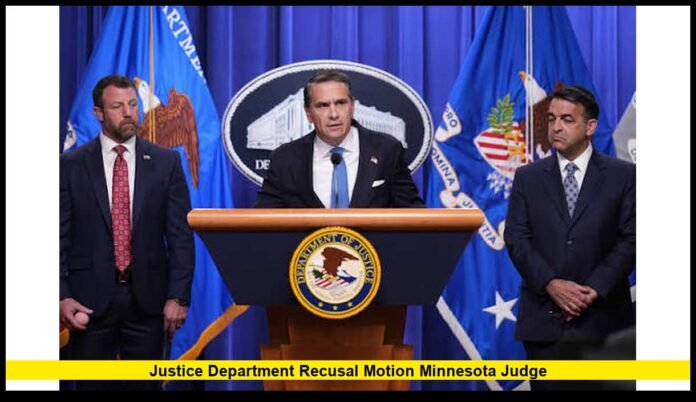

The Justice department recusal motion minnesota judges dispute has intensified after the U.S. Department of Justice asked two federal judges in Minnesota to step aside from separate cases, citing public comments they made about the Trump administration’s immigration enforcement operations. The latest development, reported on October 21, 2026, centers on Judges Patrick J. Schiltz and John R. Tunheim and raises important questions about judicial impartiality, courtroom independence, and the standards governing federal judges.
The motions follow a September judicial misconduct complaint involving Minnesota’s federal judiciary. The department argues that remarks published in a September 17 New York Times report create reasonable doubts about whether the two judges can remain impartial in cases involving the federal government’s immigration policies. The judges’ comments concerned the impact of immigration enforcement on Minnesota’s federal courts and the handling of court orders.
The recusal requests do not establish that either judge committed misconduct or demonstrated actual bias. They ask the courts to determine whether the judges should continue presiding over the specific cases identified by the Justice Department.
Latest Update on the Justice Department Recusal Motion Minnesota Judges Dispute
The latest development is the Justice Department’s filing of separate recusal motions on October 20, 2026, seeking the removal of two Minnesota federal judges from individual cases. The filings became public through reporting on October 21.
The department’s position is that the judges’ public remarks about immigration enforcement have created legitimate concerns about their ability to hear cases involving the administration’s policies fairly. The motions focus on two different proceedings rather than automatically removing the judges from every case before them.
Judge Patrick J. Schiltz is presiding over a denaturalization case involving Salah Osman Ahmed. Judge John R. Tunheim is overseeing a separate case involving a South African woman accused of illegal voting.
These cases involve different allegations and legal questions. The Justice Department nevertheless argues that the judges’ comments about immigration enforcement raise concerns about impartiality in their respective proceedings.
A hearing on Schiltz’s recusal motion is scheduled for November 23, 2026, according to reporting available as of the latest update. The scheduling information does not mean the judge has agreed to recuse himself or that the motion will succeed.
The outcome of each motion depends on the applicable legal standards and the court’s assessment of the arguments. Until a ruling establishes otherwise, both judges remain subject to the ordinary procedures governing their cases.
Why the Justice Department Wants Two Minnesota Judges to Recuse Themselves
The Justice Department bases its requests on public statements that appeared in a September 17 report about the effects of the Trump administration’s immigration enforcement operations in Minnesota.
The report examined the pressures facing federal courts during the previous winter’s immigration enforcement surge, known as Operation Metro Surge. Federal judges described the effects of a substantial increase in immigration-related proceedings and discussed concerns about government compliance with judicial orders.
The department contends that the judges crossed an ethical boundary by discussing cases and government conduct publicly. It argues that their remarks could lead a reasonable observer to question their neutrality in proceedings involving the Department of Homeland Security.
Associate Attorney General Stanley E. Woodward Jr. submitted the recusal requests, according to reporting on the filings. The department maintains that a judge who has publicly expressed views on immigration enforcement should not oversee a case closely connected to that policy area.
However, public criticism of government conduct does not automatically prove that a judge cannot decide a particular case fairly. The relevant question is whether the statements and surrounding circumstances satisfy the legal standard for disqualification.
The judges’ public comments, the department’s allegations, and any eventual judicial findings must therefore remain distinct. A motion presents one party’s legal argument; it does not constitute a final decision.
What the Department Says About Judge Patrick J. Schiltz
Judge Patrick J. Schiltz is one of the central figures in the dispute. He serves on the U.S. District Court for the District of Minnesota and was nominated to the federal bench by President George W. Bush.
Schiltz drew national attention earlier in 2026 for his criticism of government compliance with court orders during the immigration enforcement surge. In January, he raised serious concerns about Immigration and Customs Enforcement’s compliance with judicial directives.
His subsequent interview with The New York Times included comments about the consequences of the enforcement operation for the federal court system. The department now argues that those remarks undermine public confidence in his impartiality in a denaturalization proceeding.
The case involving Salah Osman Ahmed concerns the government’s effort to revoke citizenship through denaturalization proceedings. Such cases require courts to examine the government’s claims and the applicable legal requirements.
The recusal dispute does not itself resolve the allegations against Ahmed. Nor does it establish that Schiltz has prejudged the evidence or the legal issues before him.
Instead, the motion asks whether his public remarks provide sufficient grounds for another judge to take over the case. The court must evaluate that question separately from the underlying denaturalization allegations.
What the Department Says About Judge John R. Tunheim
Judge John R. Tunheim is the second judge targeted by the October recusal filings. He also serves on the U.S. District Court for the District of Minnesota.
Tunheim spoke with The New York Times about the pressures facing Minnesota’s federal judiciary during the immigration enforcement surge. The Justice Department argues that the public comments raise concerns about his ability to approach cases involving the administration’s immigration policies without bias.
His recusal motion concerns a separate proceeding involving a South African woman accused of illegal voting. The accusation remains an allegation unless established through the legal process.
The department contends that Tunheim’s public statements create an appearance of partiality that warrants his removal from the case. That argument must be assessed under the governing rules for federal judicial disqualification.
A recusal ruling would determine who presides over the particular proceeding. It would not, by itself, establish the defendant’s guilt or innocence, resolve the underlying allegations, or determine whether the judge violated judicial ethics rules.
The distinction matters because the recusal question and the merits of the underlying case involve different legal issues.
How the September Judicial Misconduct Complaint Connects to the New Motions
The October filings follow a broader action announced by the Justice Department on September 30, 2026.
On that date, the department filed a judicial misconduct complaint involving Judges Schiltz and Tunheim and other Minnesota federal judges who spoke with The New York Times. The complaint alleged that the judges’ public remarks violated their ethical responsibilities.
According to the department’s announcement, seven federal judges in Minnesota discussed the effects of the immigration enforcement surge with the newspaper. Schiltz participated in a lengthy interview, while other judges also provided comments, including some on an anonymous basis.
The complaint requested that judges who discussed immigration cases recuse themselves from matters involving the Department of Homeland Security. It also asked the U.S. Court of Appeals for the Eighth Circuit to investigate the alleged misconduct.
The September complaint and the October recusal motions serve related but distinct purposes.
- The misconduct complaint: Seeks review of the judges’ alleged ethical violations and requests an investigation.
- The recusal motions: Ask for particular judges to step aside from specific cases.
- The underlying cases: Continue to concern the legal claims and allegations before the respective district courts.
The filing of the complaint did not itself establish misconduct. Likewise, the October motions do not automatically disqualify the judges from the proceedings they currently oversee.
The distinction is essential to understanding the legal process. Each request must be considered through the procedures applicable to that type of proceeding.
What Federal Law Says About Judicial Recusal
Federal law establishes standards for determining when a judge should withdraw from a case. One important provision is 28 U.S.C. § 455, which addresses judicial disqualification.
Under that statute, a federal judge must disqualify himself or herself from a proceeding when impartiality might reasonably be questioned. The law also identifies specific circumstances that require disqualification, including certain financial interests and other conflicts.
The standard does not require proof of actual bias in every situation. A court may need to consider whether the circumstances would cause a reasonable observer to question the judge’s impartiality.
At the same time, disagreement with a judge’s ruling or criticism of government conduct does not automatically establish grounds for recusal. Courts must assess the particular facts and the connection between the alleged concern and the case at issue.
The Justice Department argues that the Minnesota judges’ public comments meet the applicable standard. The motions ask the court to accept that reasoning and remove the judges from the identified proceedings.
The judges’ continued participation, however, depends on the relevant judicial process and any resulting orders. The department cannot establish disqualification simply by requesting it.
This framework protects two important principles: litigants must receive impartial consideration, and judges must be able to perform their duties without inappropriate pressure.
Why the Minnesota Recusal Dispute Matters
The dispute has implications beyond the two cases named in the October filings. It raises questions about how federal judges may discuss their work publicly, particularly when government actions place unusual pressure on court operations.
Judges generally must avoid statements that could compromise their neutrality in pending proceedings. They also have responsibilities to explain the judicial system and protect public confidence in the administration of justice.
The challenge lies in distinguishing appropriate discussion of court operations from public comments that could suggest prejudgment of a particular dispute.
The Justice Department maintains that the judges’ remarks crossed that line. The broader controversy, however, does not eliminate the need to examine each statement and proceeding individually.
The outcome could also influence how litigants evaluate future recusal requests involving public comments by judges. A ruling based on the specific facts would help clarify how the legal standard applies to this dispute.
Nevertheless, any broader effect will depend on the reasoning adopted by the court and the procedural path that follows. The filing alone does not establish a new nationwide rule for judicial interviews.
Could the Recusal Motions Delay the Underlying Cases?
A recusal motion can affect the administration of a case because the court must determine whether the assigned judge should continue. The timing and practical consequences depend on the proceedings involved and any orders issued.
If a judge recuses himself or herself, the court must arrange for another judge to handle the case under the applicable assignment procedures. That change may require additional preparation or scheduling adjustments.
If the motion is denied, the original judge generally continues handling the proceeding unless another legal development changes the assignment.
Neither outcome automatically resolves the underlying legal dispute. The denaturalization case involving Ahmed and the illegal-voting case involving the South African defendant remain separate from the question of judicial disqualification.
As of the latest confirmed reporting, the Justice Department has filed the motions, and a November 23 hearing is scheduled for Schiltz’s motion. A final ruling on that request should not be assumed before the court issues one.
The available reporting does not establish a final outcome for either recusal request. Readers should distinguish announced hearings and filed motions from actual judicial decisions.
What Happens Next in the Minnesota Judges Dispute?
The immediate next step is the court’s consideration of the recusal requests. The parties may present their legal arguments, and the judge or court responsible for deciding each motion will evaluate the applicable standard.
Several developments could follow:
- The court could grant a motion and assign the case to another judge.
- The court could deny a motion and allow the current judge to continue.
- The proceedings could involve further briefing or other procedural steps before a decision.
- The separate judicial misconduct complaint could continue through its own review process.
These are procedural possibilities, not predictions about the outcome. The available evidence does not establish which course the courts will take.
The Eighth Circuit’s role in the separate misconduct process also remains distinct from the district-court proceedings concerning recusal. An investigation into alleged judicial misconduct and a ruling on whether a judge should hear a particular case address different questions.
The most important confirmed development is that the Justice Department has moved from its broader September complaint to requests targeting two judges in individual cases. The courts must now determine whether the department’s arguments satisfy the legal requirements for recusal.
What Readers Should Understand About the Recusal Requests
The Justice Department recusal motion Minnesota judges controversy involves competing concerns about judicial ethics, government accountability, and the appearance of impartiality.
The department says the judges’ public comments justify removing them from cases involving the administration’s immigration policies. The legal question is whether those remarks create a reasonable basis to question their impartiality in the proceedings identified by the motions.
The allegations against the judges remain allegations. Filing a complaint or recusal motion does not establish that a judge violated ethical rules, demonstrated actual bias, or improperly decided a case.
The underlying cases also remain separate from the recusal dispute. A decision about which judge should hear a proceeding does not determine the merits of the claims against the defendants.
The next meaningful updates will come from court orders, hearing developments, and any formal action on the misconduct complaint. Those developments will clarify whether the department’s arguments result in changes to the cases or further review of the judges’ conduct.
Follow the latest verified developments in the Minnesota judges recusal dispute and share your thoughts on how courts should balance judicial impartiality with independence.
Frequently Asked Questions
What is the Justice Department recusal motion Minnesota judges dispute about?
The dispute concerns the Justice Department’s requests for Judges Patrick J. Schiltz and John R. Tunheim to step aside from separate federal cases. The department argues that their public comments about immigration enforcement raise reasonable questions about their impartiality.
Which Minnesota judges are targeted by the October 2026 motions?
The motions target Patrick J. Schiltz and John R. Tunheim, judges on the U.S. District Court for the District of Minnesota.
Why does the Justice Department want Judge Schiltz removed?
The department argues that Schiltz’s public remarks about immigration enforcement and government compliance with court orders create concerns about his impartiality in a denaturalization case involving Salah Osman Ahmed.
Why is Judge Tunheim facing a recusal request?
The department argues that Tunheim’s public comments about the immigration enforcement surge raise impartiality concerns in a separate case involving a South African woman accused of illegal voting.
When is the hearing on Judge Schiltz’s recusal motion?
Reporting available on October 21, 2026, identified November 23, 2026, as the scheduled hearing date for Schiltz’s motion. The scheduling information does not indicate how the court will rule.
Has the Justice Department proved that the judges acted improperly?
No. The recusal motions and September misconduct complaint contain allegations and legal arguments. Filing them does not establish that the judges violated ethical rules or demonstrated actual bias.
What law governs federal judicial recusal?
One central provision is 28 U.S.C. § 455. It requires disqualification when a judge’s impartiality might reasonably be questioned and identifies additional circumstances requiring disqualification.
Does a recusal motion automatically remove a judge?
No. A motion requests judicial action but does not itself remove the assigned judge. The applicable court must address the request through the relevant legal process.
What happens if a recusal motion is granted?
The case can be reassigned to another judge under the applicable court procedures. The reassignment does not decide the underlying allegations or determine the defendant’s liability or guilt.
What is the difference between a misconduct complaint and a recusal motion?
A misconduct complaint seeks review of alleged violations of judicial ethics. A recusal motion asks for a judge to withdraw from a particular proceeding because of concerns about impartiality. The two processes can be related without producing the same outcome.