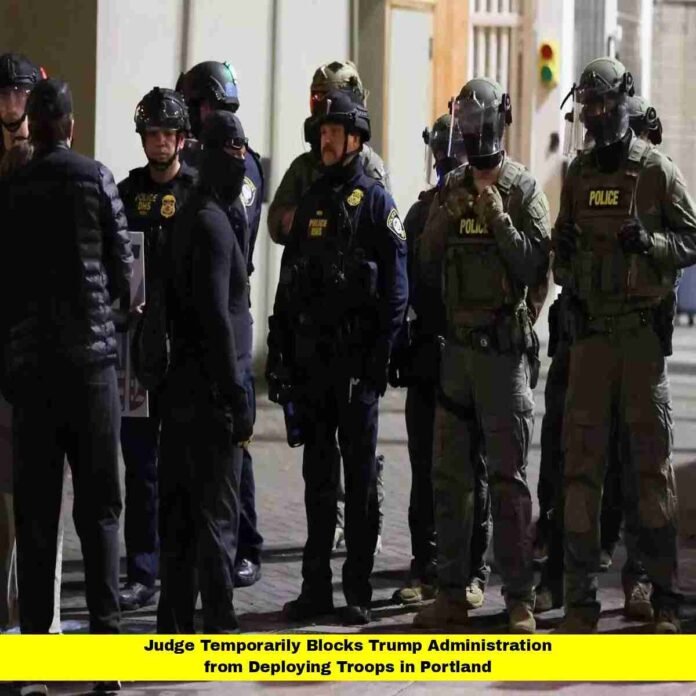

A federal judge has temporarily blocked the Trump administration from deploying troops in Portland, citing concerns over state sovereignty and the lack of justification for federal intervention. This ruling comes amid heightened tensions over protests in Portland and legal debates regarding the federal government’s authority to mobilize military forces in domestic situations.
Background of the Federal Deployment
The Trump administration planned to send National Guard troops to Portland in response to ongoing protests in the city.
- Officials argued that federal intervention was necessary to protect federal property and ensure public safety.
- Oregon state leaders, including the governor, opposed the deployment, citing constitutional limits and the Posse Comitatus Act, which restricts the use of federal forces in domestic law enforcement.
- Legal challenges quickly followed, with the state arguing that the protests were largely peaceful and did not warrant military involvement.
The conflict highlighted tensions between federal authority and state rights in managing civil unrest.
The Judge’s Ruling
U.S. District Judge Karin Immergut issued a temporary restraining order halting the troop deployment.
- The ruling emphasized that the federal government failed to provide sufficient evidence to justify intervention.
- Judge Immergut noted that the protests had not escalated to levels that would constitute a threat requiring federal military action.
- The decision reinforced the principle that states maintain control over their National Guard units unless clear legal criteria for federal action are met.
This decision marked a significant judicial check on executive power in domestic affairs.
Legal Basis and Implications
The ruling rested on several legal principles governing federal and state authority.
- The Posse Comitatus Act limits the use of federal troops in law enforcement within U.S. borders.
- State sovereignty grants governors authority over their National Guard units, preventing unilateral federal deployment without state consent.
- The judge highlighted that any federal action must be supported by clear evidence of imminent threat or insurrection.
This sets a precedent affirming the judiciary’s role in reviewing executive actions to ensure compliance with constitutional limits.
Response from the Trump Administration
Following the ruling, the administration explored alternative avenues to deploy troops.
- Attempts to mobilize National Guard units from neighboring states were also blocked by additional court orders.
- Officials expressed concerns about maintaining security for federal property amid ongoing protests.
- The administration emphasized that its goal was to protect citizens and property, not to infringe on state authority.
The legal challenges forced a reconsideration of federal intervention strategies in Portland.
State Officials React
Oregon’s leadership praised the judge’s decision.
- The governor and local authorities argued that the ruling upheld state rights and limited unnecessary federal intervention.
- They emphasized the largely peaceful nature of the protests and the state’s capability to maintain order.
- Officials highlighted that federal overreach could escalate tensions rather than mitigate them.
The ruling was seen as a win for state sovereignty and civil liberties.
Public and Political Reactions
The decision has sparked debate across political and public spheres.
- Supporters of the ruling see it as a safeguard against militarization of domestic law enforcement.
- Critics argue that federal intervention was needed to protect property and maintain public order.
- The case has become a focal point in discussions about executive power, civil liberties, and the proper use of military forces domestically.
The differing opinions illustrate the complexity and sensitivity of deploying military forces in civilian contexts.
Next Steps in the Legal Process
The court has scheduled further proceedings to assess the broader implications of the deployment.
- A trial is set to examine whether federal action could be justified under existing laws and constitutional provisions.
- Both the state and federal government will present additional evidence regarding the protests and the necessity of military deployment.
- The outcome could influence future federal-state interactions and clarify legal limits on domestic troop deployments.
This ongoing process underscores the judiciary’s critical role in balancing federal authority and state sovereignty.
Broader Implications of the Case
The temporary block has far-reaching consequences beyond Portland.
- It reinforces the boundaries of executive power, especially in politically sensitive situations.
- The ruling highlights the importance of judicial oversight in preventing federal overreach.
- It may serve as a reference point for future cases involving the deployment of military or federal forces within U.S. states.
Legal experts view the case as a landmark in defining the limits of federal intervention in domestic affairs.
The judge’s temporary block on the Trump administration’s troop deployment in Portland highlights the ongoing tension between federal authority and state rights. The ruling protects the principle of state sovereignty while underscoring the judiciary’s role in ensuring that executive actions remain within legal bounds. As legal proceedings continue, the outcome will have lasting implications for federal-state relations, civil liberties, and the use of military forces in domestic settings.