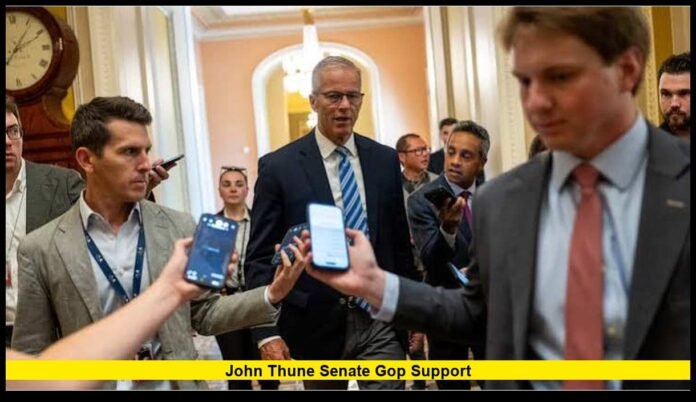

John Thune Senate GOP support remains significant as the Senate majority leader faces continued pressure from President Donald Trump over the stalled SAVE America Act and other Republican priorities. Thune remains in charge of the Senate Republican majority, even after senators left Washington for the August recess without completing Trump’s voting legislation.
The latest developments show that the disagreement between Trump and Thune has not resulted in a change in Senate Republican leadership. Thune continues to manage the Republican conference and oversee the Senate’s legislative schedule.
The dispute has centered heavily on the SAVE America Act. Trump has pushed Republicans to approve stricter voting requirements, while Thune has faced the practical challenge of securing enough Senate votes to move the legislation.
That difference has produced one of the most visible disagreements between the White House and Senate Republicans this year.
Thune Continues as Senate Majority Leader
John Thune remains the Senate majority leader in the 119th Congress. Republicans hold 53 seats in the 100-member Senate, giving the party control of the chamber but not enough votes to overcome the legislative filibuster on their own.
That distinction has shaped Thune’s approach to Trump’s priorities.
Most major Senate legislation requires 60 votes to end debate. Republicans therefore need either Democratic support or a change in Senate rules to move many bills through the chamber.
Thune has continued to work within those existing rules.
His position has frustrated some supporters of the White House agenda, particularly on the SAVE America Act. However, the disagreement has not led Senate Republicans to remove him from leadership.
Instead, Thune has continued to direct the Senate Republican agenda while balancing demands from Trump with the views of individual senators.
Trump’s Pressure on Thune Intensified
The relationship between Trump and Thune became increasingly tense in July.
Trump repeatedly demanded that the Senate move forward with the SAVE America Act. He also urged Thune to keep senators in Washington rather than allowing them to begin their scheduled August recess before completing the legislation.
Trump specifically called for the Senate to remain in session until the voting measure passed. He also criticized the Senate’s use of the legislative filibuster and urged Republicans to eliminate the procedural obstacle.
Thune did not agree to those demands.
The Senate eventually adjourned for its August recess without passing the SAVE America Act.
That outcome was a setback for Trump’s immediate legislative goal, but it did not produce a leadership crisis for Thune.
The SAVE America Act Is at the Center of the Dispute
The SAVE America Act has become the main test of the relationship between Thune, Senate Republicans and the White House.
The legislation seeks to establish stricter federal requirements involving voter registration and proof of citizenship. Trump has made the measure a major election-related priority.
The House previously passed the legislation, but Senate Republicans have faced difficulty assembling the votes needed for Senate passage.
The problem is not simply the size of the Republican majority.
With 53 Republicans, the party remains short of the 60 votes generally required to overcome a filibuster. Democratic senators have opposed the legislation, leaving Republicans with an additional hurdle.
Some Republican senators have also resisted the legislation or disagreed with the strategy for moving it forward.
That has left Thune in a difficult position.
He can schedule a vote, but Senate rules and the vote count ultimately determine whether legislation can advance.
Thune Refused to Eliminate the Filibuster
One of the biggest disagreements between Trump and Thune involves the Senate filibuster.
Trump has repeatedly encouraged Republicans to eliminate the legislative filibuster so the party can pass major legislation with a simple majority.
Thune has rejected that approach.
His position reflects a long-standing concern among many senators that changing the Senate’s legislative rules could have consequences beyond the current Congress.
For Thune, the issue also involves the immediate mathematics of the Republican majority.
Republicans control the Senate, but they do not have the 60 votes needed to overcome a filibuster on many bills. Eliminating the filibuster would change that calculation.
Trump has argued that Republicans should use their majority more aggressively.
Thune has continued working within the existing Senate framework.
That disagreement has become a defining feature of the current debate over his leadership.
Republican Senators Have Continued Working With Thune
Despite Trump’s criticism, Senate Republicans have continued to work with Thune on major legislative matters.
The clearest indication is that Thune remains Senate majority leader and continues to control the Republican legislative schedule.
There has been no confirmed Republican leadership change.
Republican senators have also continued advancing other priorities through the Senate, even when the White House and congressional Republicans have disagreed over individual measures.
That distinction matters.
Support for Thune does not mean every Republican senator agrees with every decision he makes. Senate Republicans have different policy priorities, political concerns and views about how closely Congress should follow the White House.
However, those disagreements have not produced a successful effort to replace Thune.
His continued position demonstrates that the Senate Republican conference still operates under his leadership.
The August Recess Became a Major Test
The fight over the August recess brought the disagreement into sharper focus.
Trump wanted senators to remain in Washington until they passed the SAVE America Act. Thune instead worked toward completing other Senate business before lawmakers left for their scheduled break.
The Senate ultimately adjourned in the early hours of Saturday after a lengthy session.
Lawmakers left without passing Trump’s priority voting bill.
The Senate did, however, complete several other important matters during the final stretch before recess. Those included a short-term government funding measure, confirmation of nominees and other legislation.
The result highlighted Thune’s priorities as majority leader.
He had to balance Trump’s demand for action on the voting bill against other deadlines facing the Senate.
The Senate’s decision to leave Washington therefore became an important measure of Thune’s independence from the White House.
Read More – Senate GOP Voting Bill Failure Leaves SAVE America Act at a Standstill
The Funding Bill Added Pressure to the Senate Schedule
Government funding was another major issue competing for Senate attention.
The Senate passed a short-term funding measure shortly before the August recess. The vote allowed lawmakers to address an important government spending deadline while avoiding an immediate shutdown threat.
That work required bipartisan cooperation.
The funding issue also demonstrated why Thune has to manage more than one Republican priority at a time.
Trump’s voting legislation was politically important to the administration, but funding the federal government was an unavoidable responsibility for the Senate.
Thune’s ability to move the funding legislation while other priorities remained unresolved shows the competing demands placed on Senate leadership.
Thune Is Still Advancing Trump’s Broader Agenda
The disagreements over the SAVE America Act have sometimes overshadowed areas where Thune and Trump remain aligned.
Thune has continued to advance presidential nominees through the Senate confirmation process.
Republican leaders also continue to work on legislation that supports other parts of Trump’s agenda.
That includes measures involving government spending, national security and economic policy.
Thune’s record therefore cannot be reduced to his disagreement with Trump over the voting bill.
The Senate majority leader has continued to help move significant administration priorities while maintaining his position on Senate rules and vote requirements.
That balance is central to understanding why Republican support for Thune has remained in place.
The Clarity Act Shows Another Side of Thune’s Leadership
The Senate’s work on cryptocurrency legislation provides another recent example.
Thune filed a procedural motion involving the Clarity Act before the August recess. The legislation seeks to establish a federal regulatory framework for digital assets and clarify the roles of federal financial regulators.
The Senate is expected to return to the measure after the recess, with a procedural vote scheduled for September 15.
The legislation requires bipartisan cooperation because Republicans do not have 60 votes on their own.
Thune’s decision to move the bill forward shows his willingness to pursue legislation that requires negotiations across party lines.
That approach is different from simply following a party-line strategy on every issue.
It also illustrates the broader responsibilities of the majority leader.
Why Senate Republicans Continue to Back Thune
The current situation suggests that many Senate Republicans see value in Thune’s ability to manage a closely divided chamber.
A Senate majority leader must coordinate dozens of senators with different political interests.
Republicans have a numerical majority, but the margin is narrow.
That means every Republican senator can have significant influence over legislation.
Thune’s leadership approach allows senators to express disagreements while still working toward broader Republican objectives.
This can frustrate the White House when the administration wants immediate action.
It can also help Senate Republicans avoid votes that lack enough support to succeed.
The distinction between party loyalty and legislative practicality is important in the current debate.
Trump Has Not Endorsed Thune’s Future Leadership
Questions about Thune’s long-term political standing intensified after Trump declined to commit to supporting him for another term as Republican leader.
Trump has continued to criticize Thune over the SAVE America Act while also describing his relationship with the senator as positive.
That leaves the future leadership question open.
However, there is an important difference between Trump declining to endorse Thune and Senate Republicans voting to remove him.
No confirmed leadership change has taken place.
Thune remains majority leader.
Senate Republicans continue to conduct their business under his leadership.
The immediate political dispute therefore remains focused on legislative strategy rather than a completed leadership transition.
The Republican Conference Is Not Completely Unified
It would be inaccurate to describe Senate Republicans as completely unified behind every Thune decision.
Several Republican senators have pressed for a more aggressive response to Trump’s demands.
Others have expressed concerns about changing Senate rules or advancing legislation without sufficient support.
The SAVE America Act has exposed those differences.
The Senate’s failure to advance the measure before recess showed that Republican control of the chamber does not automatically guarantee passage of every Republican-backed bill.
Thune must manage those divisions while preserving enough unity for the party to govern.
That is one of the central responsibilities of his position.
What Happens When Senators Return
The Senate is scheduled to return from the August recess with several major issues still unresolved.
The SAVE America Act remains one of the most important items.
Republican lawmakers have indicated that voting legislation could return to the Senate in September.
The Clarity Act is also scheduled for additional Senate action.
Government funding will remain another important concern as lawmakers move toward the December deadline created by the short-term funding measure.
These issues will give Thune additional opportunities to demonstrate whether he can maintain Republican support while dealing with pressure from the White House.
The outcome of those debates could influence the broader relationship between Trump and Senate Republicans.
Thune’s Immediate Position Remains Secure
As of August 11, 2026, the available evidence does not show that Senate Republicans have abandoned Thune.
He remains majority leader.
He continues to schedule votes, negotiate legislation and manage the Republican conference.
Trump’s criticism has increased pressure on him, but that pressure has not resulted in a confirmed leadership change.
The biggest challenge remains the difference between what the White House wants the Senate to accomplish and what Senate Republicans can actually pass under current rules.
Thune has chosen to work within the Senate’s existing procedures.
Trump has pushed for a faster and more aggressive approach.
The disagreement is likely to remain visible when senators return from recess.
John Thune Senate GOP Support Remains a Key Political Story
The current status of John Thune Senate GOP support is defined by a combination of continued Republican backing and growing pressure from President Trump.
Thune has not secured agreement from every Republican senator on every major issue. He has, however, retained the Senate majority leadership position and continued to conduct the chamber’s business.
The failure to pass the SAVE America Act before the August recess represents a major unresolved issue. Trump wanted the legislation completed, while Thune faced the reality of insufficient votes and resistance to changing the Senate filibuster.
At the same time, Thune helped Senate Republicans complete other important work before leaving Washington.
The next phase will begin when senators return in September. The voting bill, cryptocurrency legislation and government funding will all test Thune’s ability to maintain Republican unity while managing a demanding Senate agenda.
For now, Thune remains firmly in charge of the Senate Republican majority, with the next major test coming when lawmakers return to Washington.