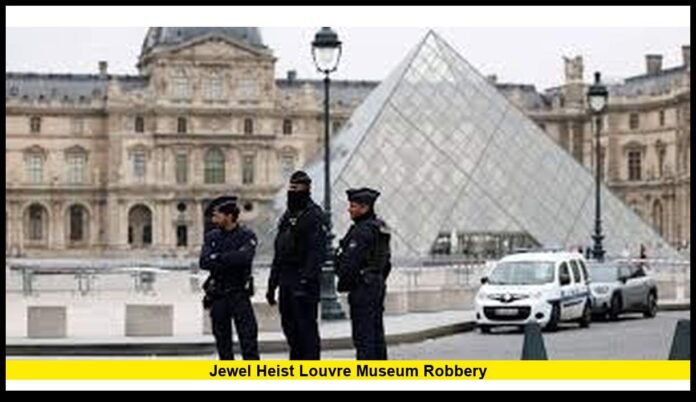

The world remains captivated by the jewel heist Louvre Museum robbery, one of the most daring art crimes of the decade. French authorities have deepened their investigation following five new arrests, bringing the total number of detained suspects to seven. As the probe expands, new details reveal how an operation executed in less than ten minutes managed to shake one of the world’s most secure museums — and leave priceless royal jewels still missing.
The Crime That Stunned the World
In the early morning hours of October 19, 2025, the serenity of the Louvre Museum in Paris was shattered by an audacious theft that played out like a movie. Around 9:30 a.m., four men disguised as construction workers arrived in a stolen utility truck equipped with a hydraulic lift.
The group maneuvered the lift to the museum’s Galerie d’Apollon, which houses the French crown jewels — among them, some of the most valuable artifacts in European history. Within minutes, they used power tools to slice open a window, smashed two reinforced glass display cases, and fled with eight pieces of jewelry estimated to be worth more than $100 million.
Witnesses outside the museum reported hearing alarms and seeing the suspects descend the lift, jump onto waiting motorbikes, and vanish into the narrow Parisian streets before police arrived. The entire operation took less than seven minutes, according to investigators.
What Was Stolen in the Louvre Robbery
The stolen artifacts were not only valuable — they carried immense historical and cultural significance. They included crown jewels once worn by French royalty, each piece representing centuries of European craftsmanship.
Among the missing treasures:
- A diamond tiara created for Empress Eugénie, wife of Napoleon III.
- A sapphire and emerald necklace believed to have belonged to Queen Marie-Amélie.
- A pair of emerald earrings and brooch linked to Marie-Louise, Napoleon’s second wife.
- A sapphire diadem originally designed for Queen Hortense, the stepdaughter of Napoleon Bonaparte.
Experts say that the true loss is irreplaceable, since these jewels were part of France’s national heritage — pieces that tell the story of its imperial past. While their gem value is extraordinary, the historic and artistic worth is beyond calculation.
How the Investigation Unfolded
The jewel heist Louvre Museum robbery immediately triggered one of the largest manhunts in French history. Over 100 officers were assigned to the case, including specialists from the country’s art-crime division.
The First Leads
Investigators quickly recovered several crucial pieces of evidence at the scene, including a pair of gloves, cutting tools, and a discarded safety helmet. DNA samples found on the items helped police identify suspects connected to known jewel-smuggling and art-theft networks operating across Europe.
Within a week, authorities detained two primary suspects, both in their thirties, during coordinated raids across Paris. One was caught attempting to flee the country.
The New Arrests
In late October, police confirmed five additional arrests. These individuals are believed to have provided logistical and financial support to the heist — including sourcing the truck, surveillance information, and possibly facilitating the transportation of the jewels out of France.
While the suspects remain unnamed due to ongoing judicial proceedings, investigators believe the group is part of a larger criminal organization known for targeting museums and luxury galleries.
Security Failures at the Louvre
The Louvre, the world’s most visited museum, is renowned for its cutting-edge security — making this theft even more shocking. However, the investigation revealed serious security lapses that the thieves exploited.
Identified Weaknesses
- Camera blind spots: Several cameras in the Galerie d’Apollon were undergoing maintenance at the time of the theft.
- Delayed response: The alarm system was triggered, but security personnel took several minutes to reach the location, by which time the thieves were already gone.
- Insufficient staffing: Only a limited number of guards were on duty early that morning, and none were stationed near the jewels’ gallery.
Following the incident, the French Ministry of Culture ordered a full review of museum security across the country. The Louvre has since implemented emergency upgrades, including new infrared motion sensors, expanded surveillance coverage, and additional overnight guards.
Where Are the Jewels Now?
Despite multiple arrests, none of the stolen jewels have yet been recovered. Authorities suspect that the pieces may already be dismantled or smuggled abroad.
Experts warn that high-profile jewels like these are extremely difficult to sell intact due to their notoriety. Instead, thieves often separate the stones from their settings, melting down metals and recutting gems to make them untraceable.
Interpol has added the missing items to its Stolen Works of Art database, alerting international law enforcement and customs agencies. French investigators have also reached out to counterparts in Belgium, Switzerland, and the United Arab Emirates, known hubs for luxury jewelry trading.
While hopes remain that the jewels could eventually be recovered, art historians fear their cultural identity may already be lost forever.
Global Reaction and Public Outcry
The Louvre robbery has provoked outrage and disbelief worldwide. For France, the theft represents more than a security breach — it is an emotional blow to national pride.
President Emmanuel Macron called the heist “an attack on France’s heritage,” promising full government support for the investigation and recovery of the jewels. The French Culture Minister described the event as “a painful reminder that cultural treasures remain vulnerable even in the safest institutions.”
In the United States, museum directors and security consultants have been following the case closely. The incident has prompted American institutions — such as the Metropolitan Museum of Art and the Smithsonian — to re-evaluate their security frameworks. Many have already increased guard rotations and installed additional monitoring technology.
The international art community, meanwhile, continues to call for greater collaboration between museums and law enforcement to combat organized cultural theft.
A Look Inside the Criminal Network
Authorities now believe the Louvre Museum jewel heist was orchestrated by a professional European syndicate specializing in high-value art crimes.
Key findings so far suggest:
- The operation required months of planning, including studying the museum’s layout and staff routines.
- The thieves likely used encrypted communication apps to coordinate movements.
- Several suspects have previous connections to high-profile jewel robberies in Monaco and Milan.
- At least one suspect may have served as a museum contractor, providing insider knowledge.
The scale and sophistication of the crime have drawn comparisons to other legendary art heists — including the Isabella Stewart Gardner Museum theft in Boston and the Hatton Garden jewel robbery in London.
Cultural and Economic Fallout
The loss of the crown jewels has profound implications beyond the Louvre itself.
Economic Impact
- Tourism in Paris briefly dipped following the robbery as security concerns grew.
- Insurance claims for the stolen jewels are expected to exceed $100 million, one of the highest in European history.
- Museums across Europe are now facing pressure to reassess budgets to prioritize security upgrades.
Cultural Impact
- The jewels were part of France’s imperial identity, symbolizing power, artistry, and history. Their theft represents a rupture in the connection between modern France and its royal legacy.
- Art historians emphasize that while replicas can be displayed, the original craftsmanship and provenance cannot be replaced.
What Happens Next
As of now, investigators are focusing on three critical areas:
- Recovering the jewels — tracking possible smuggling routes through Europe and the Middle East.
- Identifying the ringleader — believed to be an international art trafficker coordinating operations across borders.
- Restoring public confidence — ensuring the Louvre and other museums regain trust as secure guardians of cultural history.
The court proceedings for the arrested suspects are expected to begin in early 2026, where prosecutors will outline the full timeline of the heist and unveil digital evidence collected from encrypted messages and surveillance footage.
A Crime That Redefined Museum Security
The jewel heist Louvre Museum robbery has become a turning point in the fight against art and heritage crime. It demonstrates that even the most protected cultural sites are not immune to breaches — especially when planning, precision, and timing align perfectly.
While France mourns the loss of its historic treasures, the case serves as a wake-up call for institutions worldwide: in an era of digital surveillance and advanced technology, human error remains the weakest link.
The story of the Louvre jewel heist is far from over. With new arrests and an expanding international investigation, the world waits to see whether France can recover its royal treasures — or whether they will forever remain lost to history. Share your thoughts below on how museums can better protect priceless artifacts in the future.