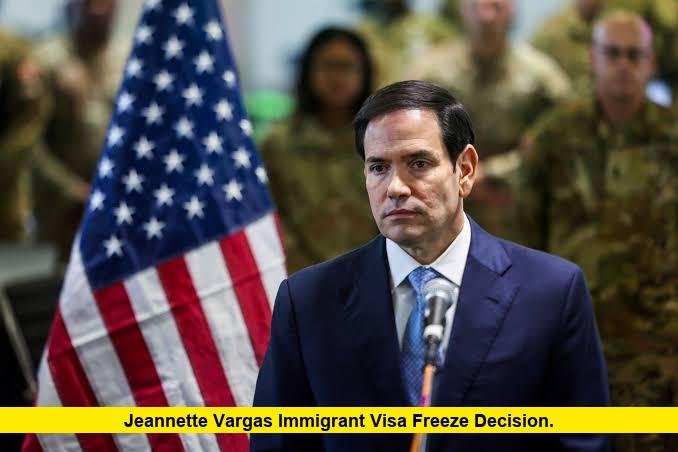

Jeannette Vargas immigrant visa freeze decision has ended the State Department policy that suspended immigrant visa issuance for nationals of 75 countries. On August 21, 2026, U.S. District Judge Jeannette A. Vargas ruled that the policy was contrary to federal law and exceeded Secretary of State Marco Rubio’s statutory authority. The court vacated the policy and set aside immigrant visa refusals based solely on it.
The ruling represents a major change for applicants whose family-based or employment-based immigrant visa cases were affected by the suspension. It does not automatically approve every affected visa application. Instead, the decision restores the requirement for individualized adjudication under federal immigration law.
What Judge Jeannette Vargas Decided
Judge Vargas issued the decision in Catholic Legal Immigration Network, Inc. v. Rubio, a case filed in the U.S. District Court for the Southern District of New York.
The lawsuit challenged a State Department policy announced in January 2026. The policy instructed U.S. consular posts to pause immigrant visa issuance for nationals of 75 designated countries.
Vargas concluded that the policy went beyond the authority Congress gave the secretary of state. She also found that it conflicted with provisions of the Immigration and Nationality Act governing immigrant visa processing.
The judge’s ruling characterized the policy as unlawful because it effectively required visa refusals based on nationality rather than an individualized assessment of each applicant.
That distinction became central to the case.
Under the immigration system established by Congress, consular officers review individual visa applicants and determine whether statutory grounds of inadmissibility apply. Vargas found that the challenged policy improperly displaced that process with a categorical nationality-based restriction.
Why the 75-Country Immigrant Visa Freeze Was Created
The State Department announced the immigrant visa suspension in January 2026. The administration justified the policy through concerns about applicants potentially becoming dependent on public assistance in the United States.
The directive focused on nationals of countries that the administration classified as having a high risk of producing immigrants who could become public charges.
The policy took effect January 21, 2026, and affected immigrant visa applicants from 75 countries. It applied to immigrant visas rather than ordinary temporary travel categories such as tourist and student visas.
The government’s position relied on the public-charge provisions of immigration law. However, the court concluded that those provisions require individualized consideration rather than an automatic presumption based solely on nationality.
The difference was significant. An applicant’s financial circumstances, family situation, age, health, education, skills and other factors can be relevant to a public-charge determination.
Vargas found that the challenged policy instead created a blanket restriction for people from designated countries.
The Legal Problem Identified by Vargas
The court’s central concern involved the statutory role of consular officers.
Federal immigration law assigns consular officers responsibility for reviewing immigrant visa applications. The court concluded that the State Department directive improperly took that individualized decision-making process away from officers.
The ruling also addressed federal protections against nationality-based discrimination in immigrant visa issuance.
Vargas determined that the policy categorically prohibited immigrant visa issuance based on an applicant’s nationality. That approach conflicted with the statutory framework Congress established for immigrant visa adjudication.
The judge therefore rejected the government’s attempt to treat nationality as a sufficient basis for the blanket suspension.
Instead, each applicant must be evaluated under the immigration laws that apply to that person’s individual circumstances.
What Happens to Visa Refusals Based on the Freeze
One of the most important parts of the ruling concerns applicants who had already received refusals because of the 75-country policy.
The court did not merely declare the policy unlawful going forward. It also vacated immigrant visa refusals that were based solely on the challenged policy and sent those cases back for further consideration.
That means an applicant who was refused exclusively because the applicant came from one of the designated countries is not required to treat that policy-based refusal as the final determination of eligibility.
The case must instead return to the appropriate consular process for adjudication without applying the invalidated freeze.
However, the ruling does not mean every affected applicant will receive an immigrant visa.
A person can still face refusal under another valid provision of U.S. immigration law. The court’s decision removes the nationality-based freeze as a legal basis for refusing the visa.
That distinction is important for families and employment-based applicants who have been waiting for their cases to move forward.
Who Could Be Affected by the Decision
The ruling affects the State Department’s 75-country immigrant visa policy rather than a single nationality.
The designated countries included nations across several regions, including Latin America, Africa, the Middle East, South Asia, the Caribbean and other parts of the world.
Reported examples included Brazil, Colombia, Egypt, Haiti, Iran, Iraq, Nigeria, Pakistan, Somalia, Thailand and Yemen.
The policy covered people seeking immigrant visas, including individuals immigrating through family relationships or employment-based pathways.
For U.S. citizens and lawful permanent residents with relatives affected by the suspension, the ruling could be especially significant because it removes the categorical policy that had prevented covered applicants from receiving immigrant visas solely because of nationality.
Employment-based immigrant visa applicants could also be affected where the freeze had blocked otherwise eligible cases.
The Difference Between Reopening a Case and Approving a Visa
The latest decision should not be interpreted as an automatic visa approval order.
The court restored individualized adjudication. Consular officers still must determine whether applicants satisfy the requirements for an immigrant visa.
An applicant can still encounter other legal issues, including separate grounds of inadmissibility or missing documentation.
The significance of Vargas’s decision is that an applicant’s nationality alone cannot serve as the substitute for the individualized review required by the governing immigration framework.
This means affected applicants may see their cases move back into ordinary adjudication, but the ultimate outcome will depend on the facts and legal requirements of each case.
Why the Decision Matters for Families
The 75-country freeze created uncertainty for families with relatives waiting outside the United States.
Some applicants had already completed substantial portions of the immigration process before the suspension affected their cases. Others had reached consular processing stages but could not obtain an immigrant visa because of the blanket policy.
The court’s decision removes that categorical obstacle.
For family-based immigration, the ruling is particularly important because it returns the focus to the individual applicant rather than the applicant’s country of nationality.
Judge Vargas’s reasoning emphasized the role Congress assigned to consular officers. The court rejected the idea that the executive branch could replace those individualized determinations with a nationality-wide prohibition.
How the Case Reached the Court
The lawsuit was brought by immigrant advocacy organizations and individual plaintiffs affected by the policy.
The plaintiffs included people whose family members were impacted by the visa suspension as well as individuals pursuing employment-related immigration.
The litigation challenged the State Department’s authority to impose a categorical immigrant visa freeze and argued that the policy conflicted with federal immigration statutes.
Earlier lawsuits had also challenged the same State Department directive in other federal courts.
For example, a July decision in the District of Columbia involved a separate challenge to the 75-country policy. That case was dismissed without prejudice because the plaintiffs had not sufficiently established standing at that stage.
Other federal litigation had also questioned the policy before Vargas issued the August 21 ruling.
The Southern District of New York case ultimately produced the decision that vacated the policy itself.
What the Jeannette Vargas Immigrant Visa Freeze Decision Means Now
The immediate legal significance is straightforward: the 75-country immigrant visa freeze has been vacated by the federal district court.
The policy is no longer the legal basis for refusing affected immigrant visa applicants.
Cases refused solely under that policy are subject to further processing under the court’s order.
Yet the ruling does not eliminate the rest of the U.S. immigration system. Applicants must continue to satisfy all applicable statutory requirements.
The State Department and consular posts also must implement the ruling. The practical timing for individual cases can vary because each application may require additional review.
The government also has the ability to seek further judicial review. News reports have noted that an appeal remains possible.
Until any higher court changes the situation, the August 21 decision is the most significant current development concerning the 75-country immigrant visa freeze.
What Affected Applicants Should Understand
People whose applications were affected should distinguish between three different situations.
- A case blocked solely by the 75-country policy: The court’s order provides a basis for that policy-based refusal to be vacated and the case to return for further processing.
- A case with another immigration issue: The court’s ruling does not erase separate grounds of inadmissibility or other legal problems.
- A case that was never subject to the freeze: The decision does not create a general immigrant visa approval rule for applicants outside the challenged policy.
Applicants should also keep copies of prior correspondence and refusal notices connected to the suspension. Those records can help establish whether the freeze was the sole reason for a previous refusal.
The most important point is that the court restored individualized consideration. The ruling does not promise a particular outcome for every applicant.
Latest Status of the Visa Freeze
As of the latest verified developments on August 23, 2026, Judge Jeannette A. Vargas’s August 21 ruling has vacated the State Department’s 75-country immigrant visa policy.
The court found that the policy was contrary to law and exceeded Secretary of State Marco Rubio’s statutory authority.
The decision also vacated visa refusals that rested solely on the challenged policy and required those cases to return to consular officers for processing without applying the freeze.
That makes the ruling a major development for immigrant visa applicants from the affected countries. It shifts the process away from a categorical nationality-based suspension and back toward individualized review under federal immigration law.
The situation could still develop if the federal government seeks an appeal or requests a stay. At present, however, the latest confirmed court decision is the August 21 order vacating the policy.
The Bottom Line
The Jeannette Vargas ruling has removed the 75-country immigrant visa freeze that had prevented covered applicants from receiving immigrant visas based solely on their nationality. The court found that the State Department exceeded its legal authority and violated the individualized framework required by federal immigration law.
For applicants affected by the freeze, the decision creates an important path back to ordinary consular processing. It does not guarantee approval, but it eliminates the challenged blanket policy as a reason for refusal.
What do you think about the latest immigrant visa ruling? Share your thoughts below and stay informed as the legal situation develops.