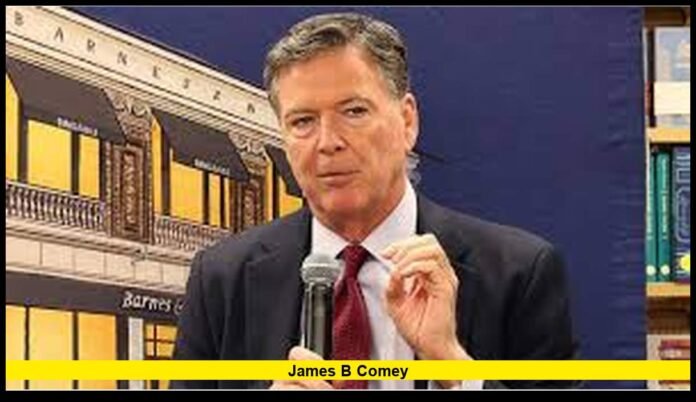

James B Comey is once again dominating headlines after federal prosecutors moved forward with criminal charges connected to a controversial social media post that triggered intense political backlash across the United States. The former FBI director, already one of the most debated figures in modern American politics, now faces another major legal fight that has sparked nationwide discussion about free speech, presidential security, and the role of federal law enforcement.
The case quickly became one of the biggest political stories in America because it involves a former FBI chief and President Donald Trump, whose public conflict has shaped years of national political debate. Court filings, television coverage, and online reactions have pushed the controversy into the center of public attention as legal experts and political commentators continue to analyze the situation from every angle.
James B Comey Faces Federal Charges
Federal prosecutors recently announced that a grand jury indicted James B Comey on charges tied to an Instagram image shared during a beach walk in North Carolina. The image showed seashells arranged into the numbers “8647,” which prosecutors claim carried a threatening message directed at President Trump.
Authorities argue the numbers represented a call for violence against the president because Trump is the 47th president of the United States. Investigators spent months reviewing the situation before presenting evidence to a federal grand jury.
Comey denied any violent intent and later removed the post after criticism exploded online. He stated publicly that he opposes political violence and did not believe the image would be interpreted as a threat.
The controversy spread rapidly across social media platforms and cable news programs. Politicians, former federal officials, legal scholars, and commentators all weighed in as debate intensified over whether the government had enough evidence to justify criminal charges.
The Social Media Post That Triggered the Investigation
The case centers on a beach photograph uploaded to Instagram in May 2025. The image displayed seashells arranged into numerical form. Comey included a short caption that initially appeared casual and harmless to some viewers.
Reaction changed quickly after critics connected the numbers to violent slang interpretations involving the president. Conservative media personalities and Trump allies accused Comey of encouraging harm against Trump.
Federal agencies soon began reviewing the situation. Homeland Security officials and investigators from the Justice Department reportedly analyzed the post, online reactions, and surrounding context before prosecutors decided to pursue charges.
Supporters of Comey argued the numbers had multiple meanings in American slang and claimed the interpretation promoted by prosecutors stretched beyond the image itself. Critics disagreed and said public figures should understand how coded language can be interpreted in a politically charged environment.
The disagreement transformed a single social media upload into a major national controversy.
Why the Case Drew Immediate National Attention
The legal action became front-page news partly because of Comey’s unique political history. Few former government officials remain as recognizable or controversial years after leaving office.
Comey served as FBI director during one of the most turbulent periods in modern U.S. politics. His involvement in the Hillary Clinton email investigation and later inquiries involving Russian election interference placed him at the center of historic political battles.
His firing by President Trump in 2017 created shockwaves throughout Washington and eventually contributed to the appointment of Special Counsel Robert Mueller.
Because of that history, the latest legal fight carries political significance far beyond a typical federal prosecution.
Many Americans already hold strong opinions about Comey. Some see him as a defender of institutional independence. Others believe he represented political bias inside federal law enforcement agencies.
Those long-standing views have shaped public reaction to the current case.
Court Proceedings and Legal Developments
After the indictment became public, James B Comey surrendered to federal authorities and appeared before a judge in Virginia. The court later released him while proceedings continued.
Additional hearings were planned in North Carolina because prosecutors claim the original Instagram upload originated there. Comey’s legal team later requested cancellation of one scheduled appearance, arguing it was unnecessary because he had already appeared before another federal court.
The request gained support from prosecutors, which added another layer of attention to the unusual case.
Legal analysts expect aggressive courtroom arguments from both sides in the coming months.
Defense attorneys are expected to focus heavily on constitutional protections involving free speech and online expression. Prosecutors, meanwhile, will likely argue the totality of evidence demonstrates criminal intent.
The outcome could carry major legal implications for future cases involving social media content and public officials.
Legal Experts Split Over the Charges
The prosecution of James B Comey has sharply divided legal experts across the country.
Some former prosecutors believe the case deserves serious review because authorities claim investigators uncovered additional evidence beyond the Instagram image itself. Others argue the government faces enormous obstacles proving criminal intent.
Constitutional scholars have also entered the debate. Several legal analysts warned the case could test the limits of protected political speech under the First Amendment.
Courts generally require prosecutors to prove a defendant intended to communicate a serious threat of violence. That standard becomes more difficult when statements contain slang, coded references, or ambiguous meanings.
Critics of the prosecution argue the case risks criminalizing vague online communication. Supporters counter that public figures should face accountability when messages can reasonably be interpreted as threats against elected officials.
The disagreement highlights how difficult it has become for courts to evaluate online speech in the digital era.
James B Comey and Donald Trump’s Long Political Conflict
The latest controversy cannot be separated from the years-long battle between James B Comey and Donald Trump.
Trump initially praised Comey during the 2016 presidential campaign, especially after Comey publicly discussed the FBI investigation involving Hillary Clinton’s emails. That relationship collapsed after Trump entered office.
Tensions exploded when Comey confirmed the FBI was investigating Russian interference in the 2016 election and examining possible connections involving Trump associates.
Trump fired Comey in May 2017, creating one of the defining political moments of his presidency.
The dismissal sparked intense backlash in Washington and led directly to the appointment of Special Counsel Robert Mueller. Since then, the two men have repeatedly criticized one another through interviews, books, speeches, and online statements.
That history explains why many observers see the current prosecution through a political lens.
Supporters of Comey argue the case reflects retaliation connected to past conflicts with Trump. Critics reject that argument and insist the case centers entirely on the social media image.
Read More – Judge tosses indictments against James Comey and Letitia James
Public Reaction Across the United States
Reaction to the indictment has been deeply divided along political lines.
Trump supporters argued the government acted appropriately because threats against a sitting president must be treated seriously. Many conservatives insisted ordinary Americans would face consequences for similar conduct.
Others within conservative circles expressed concern about the broader political impact of prosecuting a former FBI director.
Democrats and civil liberties advocates largely criticized the case. Several public figures argued the prosecution could damage trust in federal institutions and raise concerns about political influence inside the Justice Department.
Online reaction became especially intense.
Hashtags connected to James B Comey trended across major social media platforms after news of the indictment spread nationwide. Video commentary flooded YouTube, TikTok, X, and Facebook as users debated whether the charges represented legitimate law enforcement or political overreach.
The story quickly became one of the most discussed political topics in America.
Questions Surrounding Free Speech
The controversy surrounding James B Comey has reignited broader debate about free speech protections in the United States.
American courts recognize strong constitutional protections for political expression, criticism of government officials, satire, and controversial speech. At the same time, federal law prohibits true threats against public officials.
The challenge lies in determining where courts should draw the line.
Legal experts note that online communication often lacks context and can easily be interpreted differently by different audiences. Slang terms, memes, coded references, and internet humor complicate matters further.
The Comey case may therefore become an important legal example for future disputes involving digital speech.
Some analysts believe judges could eventually dismiss the charges if prosecutors fail to demonstrate clear intent. Others think the government may possess evidence that has not yet become public.
For now, the constitutional debate continues to dominate legal discussions.
Renewed Focus on the Justice Department
The case has also increased scrutiny of the Justice Department itself.
Critics argue the department risks appearing politically motivated because the prosecution involves a longtime Trump critic. Others believe federal officials had little choice but to investigate given the public attention surrounding the Instagram image.
Former Justice Department officials and legal observers continue debating whether the evidence supports criminal charges.
Questions about prosecutorial discretion, political pressure, and institutional independence have all surfaced during public discussions of the case.
The controversy arrives during an already tense political environment in Washington, where public confidence in federal institutions remains deeply divided.
As a result, the case carries importance beyond Comey personally.
Many analysts believe the outcome could influence how future administrations handle politically sensitive investigations involving public figures.
James B Comey’s Legacy Remains Divisive
Even years after leaving the FBI, James B Comey remains one of the most controversial law enforcement officials in modern American history.
His decisions during the 2016 election continue to influence political debates nearly a decade later.
Some Democrats still blame Comey’s public comments about Hillary Clinton’s emails for damaging her campaign during the final weeks of the election. Many Republicans continue criticizing his role in investigations connected to Trump.
Supporters view Comey as an official who defended institutional independence during a period of enormous political pressure.
Critics argue he damaged public trust in federal law enforcement and inserted the FBI too deeply into partisan politics.
The latest prosecution has revived all of those debates once again.
Public opinion about Comey often depends heavily on political affiliation, making him one of the most polarizing figures in Washington’s modern history.
Political Impact Ahead of Future Elections
The indictment has already become part of broader political discussions ahead of upcoming elections.
Republican strategists argue the controversy highlights concerns about political double standards inside federal institutions. Democrats and civil liberties advocates warn the case could normalize aggressive prosecutions involving controversial speech.
Political commentators believe the situation may influence voter attitudes toward the Justice Department, federal law enforcement, and presidential power.
The story also reflects a larger national conversation about how social media affects politics and public discourse.
Modern political controversies now unfold simultaneously inside courtrooms and across digital platforms. Public reaction spreads instantly online, often shaping political narratives before legal proceedings even begin.
The James B Comey case demonstrates how quickly online activity can transform into a national political crisis.
What Comes Next for James B Comey
The next stage of the case will likely involve major legal challenges from Comey’s defense team.
Attorneys are expected to file motions questioning whether the indictment satisfies constitutional standards involving criminal threats and protected speech.
Prosecutors will continue arguing that the broader context surrounding the Instagram image supports their case.
Federal judges overseeing the proceedings could eventually decide whether the prosecution moves forward toward trial or faces dismissal before reaching a jury.
If the case continues, it may become one of the most closely watched federal legal battles involving political speech in recent years.
The outcome could influence how future courts evaluate social media posts tied to public figures and political controversies.
Why Americans Continue Following the Story
The James B Comey case combines several issues that dominate American politics today: presidential security, social media, free speech, political retaliation, and public trust in federal institutions.
That combination explains why the controversy continues generating nonstop discussion across television networks, podcasts, websites, and online platforms.
The case also involves two nationally recognized political figures whose public conflict has shaped years of American political discourse.
Every new court filing, hearing, and public statement continues drawing intense public attention.
For many Americans, the story represents more than a legal case involving a former FBI director. It has become a larger debate about politics, law enforcement, constitutional rights, and the future of political speech in the digital age.
As proceedings continue, the national spotlight surrounding James B Comey is unlikely to fade anytime soon.
What are your thoughts on the latest developments involving James B Comey? Share your opinion and stay tuned for more updates as the legal battle continues.