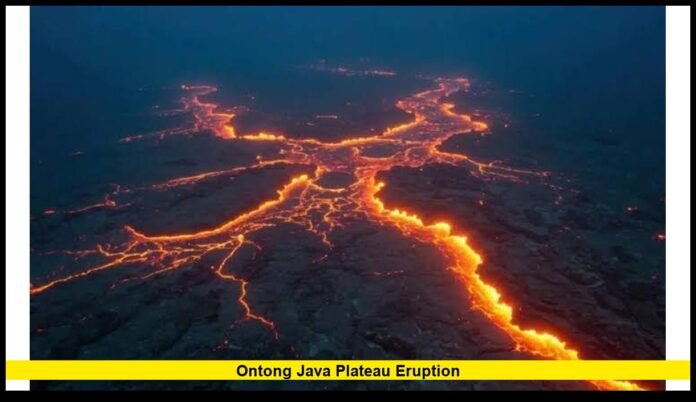

Ontong Java Plateau eruption remains one of the most fascinating topics in Earth science as new geological research continues to improve scientists’ understanding of how the largest known oceanic volcanic province formed more than 120 million years ago. While there is no active eruption taking place today, recent scientific findings have provided stronger evidence about the deep-Earth processes that created this enormous underwater volcanic region and permanently changed the Pacific Ocean’s crust.
Unlike modern volcanic eruptions that attract global attention because of immediate hazards, the Ontong Java Plateau tells the story of an event from Earth’s distant past. Researchers continue to examine rock samples, seismic data, and computer models to understand how such an immense volume of lava erupted beneath the Pacific Ocean in a relatively short geological period. Every new discovery helps explain how the planet evolved and why this underwater plateau remains unlike anything else found on Earth.
Understanding the Ontong Java Plateau
The Ontong Java Plateau is the world’s largest preserved oceanic plateau. Located beneath the southwestern Pacific Ocean, it stretches across an enormous section of the seafloor north of the Solomon Islands and east of Papua New Guinea.
Unlike mountain-shaped volcanoes such as Mount St. Helens or Kilauea, this geological feature formed beneath the ocean through repeated outpourings of basaltic lava. Instead of producing a single volcanic cone, the eruptions created an immense layer of volcanic rock covering a vast area of the Pacific seabed.
Scientists classify the plateau as a Large Igneous Province, a term used for regions where tremendous amounts of magma reached Earth’s surface over a relatively brief period in geological history. Among all known oceanic examples, the Ontong Java Plateau stands as the largest preserved formation.
Latest Scientific Developments
Research published during 2026 has provided new information about how the plateau formed and why it remains one of the most unusual geological structures on the planet.
One of the most significant developments supports the theory that an exceptionally large thermochemical mantle plume rose from deep within Earth’s mantle. Researchers found that this explanation best matches the plateau’s size, composition, and unusually thick volcanic crust.
Scientists have also improved their understanding of the plateau’s underground structure through advanced seismic imaging. These studies revealed that the ancient volcanic system altered the Pacific Plate far more extensively than previously believed.
Instead of simply covering the seafloor with lava, the volcanic activity penetrated deep into the oceanic crust, creating networks of magma-filled structures that can still be detected today.
These discoveries continue to reshape scientific understanding of ancient volcanic events.
A Geological Event Unlike Modern Volcanoes
The word “eruption” often brings to mind explosive volcanic mountains sending ash into the sky.
The Ontong Java Plateau formed in a very different way.
Most modern volcanoes release magma through a central crater or vent. The plateau developed through widespread submarine volcanic activity, where enormous quantities of molten basalt spread across the ocean floor through extensive fissures and volcanic openings.
This process produced layer upon layer of lava over a broad region instead of building a single mountain.
Because the activity occurred beneath the ocean, much of the volcanic history remained hidden until modern marine exploration began revealing its remarkable scale.
How Old Is the Plateau?
Geological evidence places the formation of the Ontong Java Plateau approximately 120 to 125 million years ago during the Early Cretaceous Period.
Radiometric dating of basalt samples collected from drilling expeditions has consistently supported this timeframe.
Although millions of years have passed since the eruptions ended, the volcanic rocks remain preserved beneath the Pacific Ocean, giving scientists a rare opportunity to study one of Earth’s greatest volcanic episodes.
Why the Event Was So Extraordinary
Several characteristics make this volcanic province unique among known geological formations.
The plateau combines exceptional size, enormous lava volume, and unusually thick oceanic crust.
Its volcanic rocks extend across hundreds of thousands of square kilometers beneath the Pacific Ocean.
The crust beneath the plateau is also much thicker than ordinary oceanic crust, demonstrating that extraordinary amounts of magma accumulated during its formation.
These features continue to distinguish it from every modern volcanic system.
The Mantle Plume Explanation
For decades, scientists debated the source of the magma responsible for the plateau.
Recent research increasingly favors the mantle plume model.
A mantle plume is an enormous column of unusually hot material rising from deep inside Earth’s mantle toward the surface.
As the plume approaches the base of Earth’s crust, pressure decreases, allowing large amounts of rock to melt into magma.
Researchers now believe an exceptionally powerful thermochemical mantle plume generated enough magma to produce the immense volcanic plateau observed today.
This explanation accounts for the plateau’s remarkable thickness, chemical composition, and broad geographic extent more successfully than competing theories.
Alternative Ideas and Ongoing Research
Earlier studies explored whether unusually rapid movement of tectonic plates could have produced sufficient melting beneath the Pacific Ocean.
While this idea explained some observations, more recent computer simulations indicate that plate motion alone cannot fully account for the immense volume of volcanic rock.
Scientists therefore continue to favor deep mantle processes as the primary driver behind the plateau’s formation.
Although many questions have been answered, researchers still investigate exactly how long the volcanic activity lasted and how magma moved through Earth’s interior before reaching the seafloor.
What Lies Beneath the Plateau
Modern seismic technology has transformed scientists’ understanding of the plateau’s internal structure.
Instead of finding a simple block of volcanic rock, researchers discovered a highly complex system beneath the seafloor.
The underground structure contains thick horizontal lava layers along with numerous vertical magma pathways that once transported molten rock upward.
These ancient conduits remain visible through differences in seismic wave behavior.
Scientists also identified evidence that magma chemically altered surrounding rocks as it traveled through the crust.
These observations show that the volcanic system reshaped the Pacific Plate both internally and at the surface.
Why the Plateau Remained Underwater
One question has challenged geologists for many years.
If such enormous quantities of lava erupted, why did the plateau not permanently rise above sea level?
Current scientific models suggest that the answer lies in the properties of the mantle plume itself.
Researchers believe the plume contained material that allowed exceptional volcanic production while still leaving much of the newly formed plateau beneath the ocean after cooling.
This explanation matches modern geological observations more closely than previous theories.
Today, nearly the entire plateau remains submerged beneath the Pacific Ocean.
Connection to Earth’s Ancient Environment
Large volcanic events can influence the planet far beyond the immediate eruption site.
Scientists have long investigated whether the formation of the Ontong Java Plateau affected ancient oceans and global environmental conditions.
Volcanic eruptions release gases, minerals, and other materials that can alter ocean chemistry over long periods.
Because the plateau formed during the Early Cretaceous Period, researchers continue comparing its age with environmental changes preserved in marine sediments.
Although scientists continue refining these relationships, the plateau remains one of the most important geological formations for studying Earth’s ancient climate and ocean history.
How Scientists Continue Their Investigation
Research on the Ontong Java Plateau depends on a combination of advanced technologies.
Scientists collect information through:
- Deep-sea drilling programs
- Seismic imaging
- Laboratory analysis of basalt samples
- Geochemical testing
- Marine geophysical surveys
- Computer simulations
Each method contributes different pieces of the geological puzzle.
Rock samples reveal chemical composition and age.
Seismic studies show underground structures.
Computer models help explain the conditions that produced such extraordinary volcanic activity.
Together, these approaches continue improving scientific knowledge year after year.
Comparing the Plateau With Modern Volcanic Systems
Although modern volcanoes remain active around the world, none approach the scale of the ancient Ontong Java volcanic event.
A typical volcanic eruption may build a mountain or produce lava flows extending several miles.
The Ontong Java Plateau involved volcanic activity over an enormous region beneath the Pacific Ocean.
Modern eruptions are usually measured in days, weeks, or months.
The plateau formed over a much longer interval, yet it remains geologically brief considering Earth’s history.
This difference explains why geologists classify it separately from ordinary volcanic eruptions.
No Evidence of a Current Eruption
Public interest occasionally increases whenever new scientific studies mention the Ontong Java Plateau.
However, these reports concern ancient geological history rather than present-day volcanic activity.
There is no confirmed evidence that the plateau is erupting today.
The recent attention comes from improved scientific analysis, not from renewed volcanism beneath the Pacific Ocean.
Researchers continue studying rocks that formed more than 120 million years ago to better understand the processes that shaped Earth’s crust.
Why This Ancient Event Still Matters
The Ontong Java Plateau continues to play a major role in geological research because it offers an unmatched record of large-scale volcanism.
By studying this formation, scientists gain valuable insights into how Earth’s mantle behaves, how tectonic plates evolve, and how enormous volcanic provinces develop.
The plateau also helps researchers test computer models describing heat transfer inside the planet.
Each new discovery improves understanding not only of this ancient volcanic event but also of Earth’s internal processes as a whole.
As marine technology becomes more advanced, scientists expect future investigations to reveal even more information hidden beneath the Pacific Ocean.
Although the eruptions ended millions of years ago, the geological evidence remains remarkably well preserved.
That enduring record ensures the Ontong Java Plateau will remain one of the world’s most important natural laboratories for understanding Earth’s volcanic history and the forces that continue shaping our planet from deep below the surface.
Have thoughts about this remarkable geological discovery? Share your perspective in the comments and stay informed about the latest developments in Earth science and ancient volcanic research.