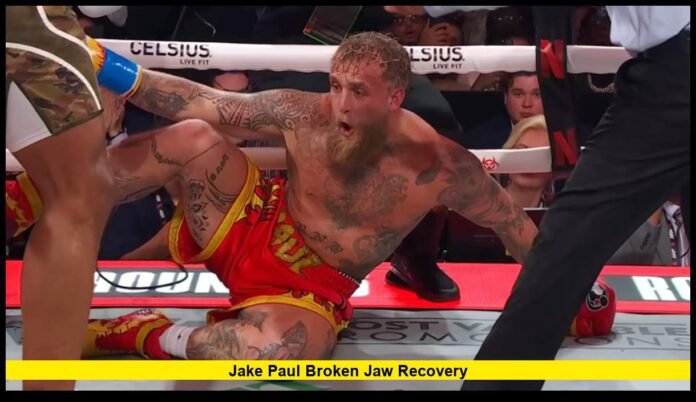

The fallout from the “jake paul broken jaw” injury continues to dominate combat sports headlines as the social media star turned professional boxer faces one of the most difficult stretches of his career. Months after suffering a devastating knockout loss to Anthony Joshua, Paul is still dealing with recovery challenges that have raised serious questions about whether he will ever compete inside a boxing ring again.
What initially appeared to be another blockbuster crossover event has now become a story about health, long-term recovery, and the physical risks that come with stepping into the ring against elite heavyweight fighters. The injury has changed the tone around Paul’s career dramatically, shifting attention away from viral moments and pay-per-view success toward concerns about his future.
Paul built his reputation on confidence, controversy, and relentless ambition. However, the damage sustained during the Joshua fight has created uncertainty unlike anything he has faced before. Fans, fighters, analysts, and promoters are all watching closely as new details continue emerging about the extent of the injury and the lengthy recovery process.
The situation has also reignited debate across the boxing world regarding crossover fights, matchmaking, and the increasing popularity of entertainment-driven combat sports events. While Paul succeeded in bringing millions of new viewers into boxing, the consequences of facing one of the hardest punchers in the heavyweight division may permanently reshape the direction of his career.
A Fight That Changed the Narrative Around Jake Paul
Before the Anthony Joshua fight, Jake Paul was riding enormous momentum in the combat sports industry.
He had transformed himself from a YouTube personality into one of boxing’s biggest financial attractions. His fights generated massive online engagement, strong pay-per-view numbers, and constant media coverage. Despite criticism from traditional boxing audiences, Paul consistently proved capable of selling events and creating mainstream attention.
The Joshua matchup represented the biggest challenge of his career.
Unlike previous opponents, Joshua brought elite heavyweight credentials, championship experience, Olympic success, and devastating knockout power into the ring. Many boxing experts questioned whether Paul was taking too large a leap by agreeing to face a former unified heavyweight champion.
Still, Paul embraced the challenge publicly.
Leading into the fight, he spoke confidently about proving doubters wrong and continuing his rapid evolution as a professional boxer. He insisted that years of training and prior victories had prepared him for the biggest stage of his combat sports journey.
That confidence lasted until the fight turned violent.
Joshua gradually imposed his size, power, and technical advantages throughout the bout. While Paul showed determination and toughness early, the gap in experience became increasingly clear as the rounds progressed.
Everything changed in the sixth round.
Joshua landed a crushing shot that dropped Paul hard and ended the contest immediately. The knockout itself generated massive online reaction, but the medical aftermath quickly became even more serious.
Doctors later determined that Paul had suffered significant jaw damage requiring surgical intervention and an extended recovery timeline.
Recovery Became More Complicated Than Expected
In the weeks following the fight, Paul began revealing details about the severity of the injury.
The broken jaw reportedly required surgery involving metal plates and stabilization procedures designed to repair fractures caused during the knockout. Recovery proved physically exhausting and emotionally draining.
Paul later explained that everyday activities became difficult after the surgery.
Eating solid food reportedly became impossible during portions of recovery, forcing him onto restricted diets while swelling and pain slowly decreased. Speaking comfortably also became challenging during certain stages of healing.
The situation reportedly became even more frustrating when follow-up medical evaluations revealed lingering complications.
According to Paul, some parts of the recovery process took longer than initially expected. He continued requiring monitoring from specialists to ensure the jaw healed correctly and maintained proper structural stability.
For fighters, jaw injuries create unique concerns because the face absorbs repeated impact during competition. Even after fractures heal, the fear of reinjury often becomes part of the equation when considering a comeback.
That concern now surrounds Paul’s future.
While he has continued maintaining fitness and staying active publicly, he has not resumed full-contact sparring or intense boxing preparation. Medical evaluations remain ongoing, and no official timeline for a return has been announced.
The Mental Side of Recovery Has Also Been Difficult
Physical healing tells only part of the story.
Paul has openly discussed how the injury forced him to think differently about risk, ambition, and long-term health. For years, he built his public image around fearlessness and confidence. The Joshua defeat changed that dynamic significantly.
The knockout became one of the most replayed combat sports moments of the year.
For any fighter, recovering mentally after a brutal stoppage presents enormous challenges. Fighters must rebuild confidence while simultaneously trusting that their bodies can withstand future punishment.
Paul acknowledged in recent appearances that the experience affected him emotionally as well as physically.
He admitted that conversations about retirement have become more serious than ever before. Earlier in his career, Paul often dismissed criticism aggressively and focused entirely on future fights. Now, his tone has become more reflective and cautious.
The injury forced him to confront realities many fighters eventually face.
Boxing remains one of the most physically dangerous sports in the world. While celebrity crossover events sometimes emphasize entertainment and spectacle, the risks become very real once elite-level power enters the equation.
Paul learned that firsthand against Joshua.
Anthony Joshua’s Performance Sent a Message
Joshua’s victory also carried major implications for the wider boxing world.
Some fans viewed the matchup as entertainment designed to generate headlines and revenue. Others saw it as an opportunity to measure whether Paul’s boxing development had reached legitimate competitive levels.
Joshua removed most doubt quickly.
From the opening rounds, the former champion controlled distance effectively and used his experience to neutralize Paul’s offense. While Paul showed courage and remained aggressive at times, Joshua’s composure and physical advantages ultimately proved overwhelming.
The knockout reinforced how large the gap remains between crossover fighters and elite heavyweight professionals.
Even so, some boxing figures gave Paul credit for accepting such a dangerous challenge.
Several fighters acknowledged that many celebrities or influencers would never agree to face an opponent with Joshua’s power and pedigree. Regardless of the result, Paul demonstrated willingness to test himself against one of the sport’s biggest names.
Joshua himself spoke respectfully about Paul after the fight.
He praised Paul’s commitment to boxing and recognized the attention he has brought to the sport. However, the dominant nature of the victory also reminded viewers how dangerous elite heavyweight boxing can be.
How Jake Paul Changed Modern Boxing
Even with uncertainty surrounding his future, Paul’s impact on combat sports remains impossible to ignore.
Over the past several years, he helped redefine how boxing events attract audiences. His combination of social media reach, online marketing skills, and headline-generating rivalries brought millions of younger viewers into combat sports.
Traditional boxing promoters took notice quickly.
Paul demonstrated that internet personalities could become legitimate pay-per-view attractions if marketed effectively. His events consistently generated viral clips, online discussions, and massive digital engagement.
He also played a major role in expanding crossover boxing.
Fights involving influencers, former MMA stars, celebrities, and entertainers became increasingly common as promoters recognized the commercial potential of these events. Paul stood at the center of that movement.
Outside the ring, he continued building his business empire.
Through promotional ventures and entertainment projects, Paul expanded his influence beyond simply being a fighter. His company became involved in major combat sports events while also supporting rising fighters and women’s boxing.
That business success may now become even more important if medical concerns ultimately prevent him from returning to active competition.
Fans Remain Divided About His Future
Public reaction to Paul’s injury updates has been mixed.
Supporters argue that he already exceeded expectations by developing into a legitimate boxer capable of drawing enormous audiences and competing professionally. They believe protecting his long-term health should now become the priority.
Others hope he eventually stages a comeback.
Some fans believe Paul still has unfinished business in boxing and could continue competing successfully against carefully selected opponents outside the elite heavyweight level.
Critics, however, view the Joshua fight as evidence that celebrity boxing has dangerous limits.
They argue that crossover events can become risky when entertainers face highly accomplished professional fighters with major size and experience advantages.
The debate has intensified as more information about the injury recovery becomes public.
Jaw fractures represent serious medical situations for combat athletes. Beyond pain and surgery, fighters may face long-term concerns involving dental damage, nerve sensitivity, speech issues, and vulnerability to future impact trauma.
Because of those factors, many observers believe Paul’s medical team will take an extremely cautious approach before approving any return.
Life Outside the Ring Still Offers Massive Opportunities
One reason Paul can approach recovery patiently is because his career extends far beyond boxing.
Unlike many professional fighters who depend entirely on competition income, Paul built multiple successful businesses and entertainment ventures outside sports. His online audience remains enormous, and his ability to generate attention has not disappeared.
That flexibility gives him options.
If doctors eventually determine that returning to boxing carries excessive risk, Paul could still remain deeply involved in combat sports through promotion, commentary, content creation, and event production.
His promotional company continues growing in visibility and influence.
Paul has also shown strong interest in helping shape the future of sports entertainment, particularly in areas where digital creators intersect with traditional athletics.
For many fans, that entrepreneurial side of his career has become just as significant as the fights themselves.
Still, competition clearly remains important to him personally.
Throughout interviews following the injury, Paul repeatedly emphasized that he still loves boxing despite the pain and setbacks associated with the Joshua loss.
Whether passion alone will outweigh medical concerns remains unknown.
The Jake Paul Broken Jaw Story Continues to Evolve
As recovery continues, the “jake paul broken jaw” situation remains one of the most closely followed stories in combat sports.
Every update sparks new speculation about whether Paul will eventually return or walk away from fighting permanently. While he has avoided making definitive statements, the seriousness of the injury has changed expectations significantly.
The coming months will likely determine the direction of his future.
Additional scans, evaluations, and medical opinions are expected to guide any final decision regarding a comeback. Until then, Paul appears focused primarily on healing and rebuilding physically.
Regardless of the outcome, the injury already marks a defining moment in his career.
It transformed him from a controversial entertainer chasing ambitious fights into an athlete confronting the genuine dangers of professional boxing. That shift has made many observers view his journey differently than before.
The Joshua fight may ultimately become remembered as both the boldest and most costly decision of Paul’s boxing career.
Whether it also becomes the final chapter remains uncertain.
For now, fans across the sports world continue waiting for the next update as one of boxing’s most polarizing figures navigates the toughest challenge he has faced since stepping into the ring.
What do you think Jake Paul’s next move should be after this devastating injury? Stay tuned for more updates and join the conversation with fellow boxing fans.