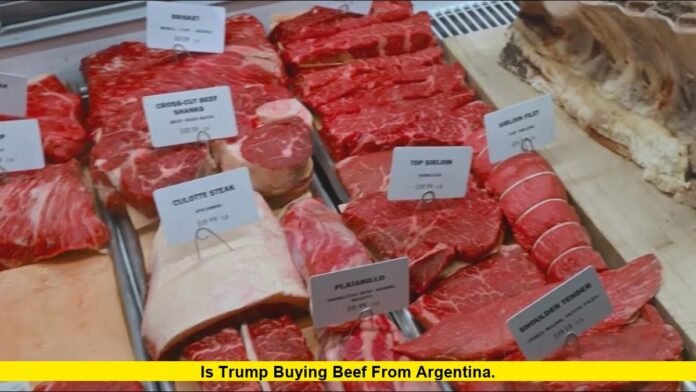

Is Trump buying beef from Argentina? The answer is partly yes, but the latest 300,000-metric-ton beef plan announced by President Donald Trump does not officially identify Argentina as the source of all that meat. The Trump administration already expanded U.S. access for Argentine beef earlier this year, while a separate August plan calls for up to 300,000 metric tons of foreign ground-beef products to enter the United States over 90 days.
The distinction matters because social media posts have recently connected Trump’s new beef-import announcement directly to Argentina. However, Agriculture Secretary Brooke Rollins said August 25 that discussions over the countries participating in the latest arrangement were still underway. No final list of suppliers had been publicly confirmed.
That means Americans asking whether Trump is buying beef from Argentina should separate two developments: the confirmed Argentina-specific import expansion announced in February and the new, broader 300,000-metric-ton import plan announced in August.
What Trump Has Actually Authorized From Argentina
In February 2026, Trump signed a presidential proclamation increasing the U.S. tariff-rate quota for certain lean beef trimmings from Argentina.
The action added 80,000 metric tons of tariff-rate-quota access for Argentine lean beef trimmings during 2026. The additional quantity was divided into four quarterly allocations of 20,000 metric tons.
The measure specifically covers lean beef trimmings. These products are important because they can be blended with fattier domestic beef trimmings to produce ground beef.
The additional Argentine allocation was structured as follows:
| 2026 period | Additional Argentine allocation |
|---|---|
| First quarter | 20,000 metric tons |
| Second quarter | 20,000 metric tons |
| Third quarter | 20,000 metric tons |
| Fourth quarter | 20,000 metric tons |
| Total | 80,000 metric tons |
The White House said the measure was intended to increase the supply of ground beef available to American consumers while domestic cattle supplies remained tight.
The existing Argentine quota was separate from this additional allocation. The February action therefore represented a significant increase in the amount of Argentine lean beef that could enter the U.S. under the more favorable tariff treatment.
So, Is Argentina Already Sending Beef to the U.S.?
Yes. Argentine beef has been entering the U.S. market, and the Trump administration’s February policy specifically increased the amount of certain Argentine beef products eligible for the U.S. tariff-rate quota.
The beef trade between the two countries is not a brand-new development created by the August announcement.
Argentine beef is particularly relevant to the U.S. ground-beef market because the country can supply lean beef trimmings. U.S. processors can use those lean components in ground-beef production.
Trade data also showed a substantial increase in Argentine beef shipments to the United States during the first part of 2026. Industry reporting based on trade figures showed imports from Argentina rising sharply compared with the same period in 2025.
That increase occurred before Trump’s latest 300,000-metric-ton announcement.
What Is the New 300,000-Metric-Ton Beef Plan?
On August 21, Trump announced a separate temporary initiative designed to increase foreign beef supplies in the United States.
The plan would allow up to 300,000 metric tons of product for ground beef to enter the U.S. over a 90-day period without the usual out-of-quota tariff.
Trump also said the imported beef would be sold at 25% below current market prices.
The stated objective is to bring down the price of ground beef for American consumers while giving the domestic cattle industry additional time to rebuild its herd.
The announcement came as U.S. beef prices remained unusually high and the national cattle inventory remained historically low.
However, the August announcement did not identify Argentina as the sole supplier.
Trump said several countries would participate but did not publicly name them. That created immediate questions about where the additional beef would actually come from.
Has the Trump Administration Confirmed Argentina as Part of the 300,000-Metric-Ton Deal?
Not yet.
This is the most important fact for anyone searching for the latest answer to whether Trump is buying beef from Argentina.
As of the latest confirmed information available August 26, the administration has not publicly finalized the countries that will supply the entire 300,000 metric tons under the new 90-day arrangement.
Agriculture Secretary Brooke Rollins said August 25 that discussions were still continuing. She indicated that U.S. Trade Representative Jamieson Greer and Trump were involved in determining the details.
Rollins did not provide a definitive list of participating countries.
Therefore, it would be inaccurate to state as a confirmed fact that the entire 300,000-metric-ton supply is coming from Argentina.
Argentina is already an important part of the U.S. beef-import picture because of the separate February quota expansion. But the August plan is broader and remains distinct from that earlier Argentina-specific decision.
Why Argentina Became Part of the Beef Debate
Argentina has become closely associated with Trump’s beef policy because of the administration’s decision earlier this year to increase its access to the U.S. market.
The country is one of the world’s major beef producers and exporters. Its beef industry can supply lean beef products that are useful for U.S. ground-beef production.
The February decision was made against the backdrop of declining U.S. cattle supplies and elevated beef prices.
The White House said U.S. consumers continued to demand beef even as domestic supplies became more constrained.
That combination created pressure to find additional supplies from abroad.
Argentina was one of the countries positioned to provide some of that supply.
Why Does the U.S. Need More Imported Beef?
The central issue is the size of the American cattle herd.
U.S. cattle inventories have fallen to historically low levels following years of difficult production conditions, including drought and higher costs.
At the same time, consumer demand for beef has remained strong.
Rebuilding cattle numbers takes time. A rancher cannot immediately replace a depleted herd simply because retail prices have increased.
That creates a gap between current consumer demand and the amount of beef domestic producers can supply.
Imported beef can help fill part of that gap.
The Trump administration has therefore pursued two goals at the same time: increase short-term beef availability for consumers and encourage long-term rebuilding of the domestic cattle herd.
Those goals have created a major policy debate.
Why Are American Ranchers Angry About the Import Plan?
Many U.S. cattle producers argue that increasing foreign beef imports could work against herd rebuilding.
Their concern is straightforward.
If cheaper imported beef enters the market in large quantities, domestic cattle prices could face downward pressure. Lower prices could reduce the financial incentive for ranchers to retain animals and expand their herds.
Ranching organizations and lawmakers from major cattle-producing states have criticized the new plan for that reason.
Several Republican senators have also questioned the decision, even though Trump is their party’s president.
Their argument is that temporary consumer relief should not come at the expense of America’s long-term cattle-producing capacity.
The disagreement has become particularly notable because cattle producers are traditionally an important constituency for Republicans.
Will Argentine Beef Replace American Beef?
No. Imported Argentine beef does not simply replace the entire U.S. beef supply.
The United States remains a major beef producer, and most beef consumed domestically comes from cattle raised within the country.
Argentine imports represent only a portion of the overall U.S. market.
The products involved are also important to understand. The Argentine quota expansion focuses on lean beef trimmings, rather than suggesting that American supermarkets will suddenly replace steaks and other premium cuts with Argentine products.
Lean imported beef can become an ingredient in ground-beef blends.
For consumers, that means the origin of the beef in a hamburger can involve a more complicated supply chain than the country where the final product is packaged.
Is Trump Personally Buying Beef From Argentina?
No.
The phrase “Trump buying beef from Argentina” can be misleading.
Trump is not personally purchasing cattle or beef for his own account. The issue concerns U.S. government trade policy and import access.
The administration determines tariff-rate quotas, import rules and trade arrangements. Private companies, importers, processors and retailers conduct the commercial transactions involved in bringing beef into the United States.
The February policy specifically increased the amount of Argentine beef that could receive favorable tariff treatment.
The August plan would create additional access for foreign ground-beef products, but the administration has not publicly finalized all participating suppliers.
What About Claims That Trump Paid Argentina Billions for Beef?
Some social media posts have also linked the beef story to claims that the United States paid Argentina billions of dollars for beef.
Those claims should not be confused with the actual beef-import policy.
The U.S. government has established trade and financial arrangements with Argentina, but that does not mean the federal government simply wrote Argentina a multibillion-dollar check to purchase 300,000 metric tons of beef.
The latest beef initiative concerns import access, tariffs and commercial purchases by the private sector.
It is therefore more accurate to describe the policy as an effort to allow more foreign beef into the U.S. market under favorable tariff conditions, rather than saying Trump personally purchased hundreds of thousands of tons of Argentine beef.
Why the 25% Price Claim Matters
Trump has said the foreign beef covered by the latest arrangement will be sold at 25% below current market prices.
That promise is central to the administration’s argument for the policy.
The goal is to give consumers relief at grocery stores while domestic cattle supplies remain tight.
However, the final effect on supermarket prices will depend on several factors, including how quickly the imported beef arrives, which countries provide it, how much processors purchase, transportation costs and how retailers pass savings to consumers.
The administration’s announcement therefore sets a policy direction rather than guaranteeing that every American shopper will immediately see a 25% reduction in ground-beef prices.
What Happens Next?
The next major step is formal implementation of the August beef-import arrangement.
The administration has indicated that an executive order will establish the new 90-day framework.
The details still matter.
Americans will need to know which countries qualify, how the 300,000-metric-ton amount will be allocated, which products qualify and how the government will administer the tariff treatment.
Those details will determine how much additional beef actually reaches U.S. processors and retailers.
For Argentina specifically, the February policy remains the clearest confirmed action. The United States has already authorized an additional 80,000 metric tons of Argentine lean beef trimmings for 2026, divided across quarterly periods.
That is separate from the newly announced 300,000-metric-ton initiative.
The Bottom Line on Trump’s Argentina Beef Policy
So, is Trump buying beef from Argentina?
The factual answer is that the United States is importing Argentine beef, and Trump expanded Argentina’s tariff-rate quota by 80,000 metric tons in February 2026. But the administration has not confirmed that Argentina will supply the entire 300,000 metric tons covered by the latest August plan.
The distinction is important because online discussions have combined two separate announcements.
The February measure specifically names Argentina and provides an additional 80,000 metric tons of tariff-rate-quota access for lean beef trimmings.
The August announcement covers up to 300,000 metric tons of ground-beef products over 90 days, but the participating countries have not yet been fully identified.
As of August 26, the Trump administration is still working on the details of the latest arrangement. Until those details are formally released, claims that all 300,000 metric tons will come from Argentina remain unconfirmed.
The broader policy is part of Trump’s effort to address high beef prices while the U.S. cattle industry works to rebuild a historically depleted herd. It has also created an unusually sharp disagreement between the administration and some American ranchers who fear that increased imports could weaken domestic producers.
The latest confirmed details will determine how much Argentine beef ultimately enters the U.S. market, so stay informed as the administration finalizes the new import arrangement.