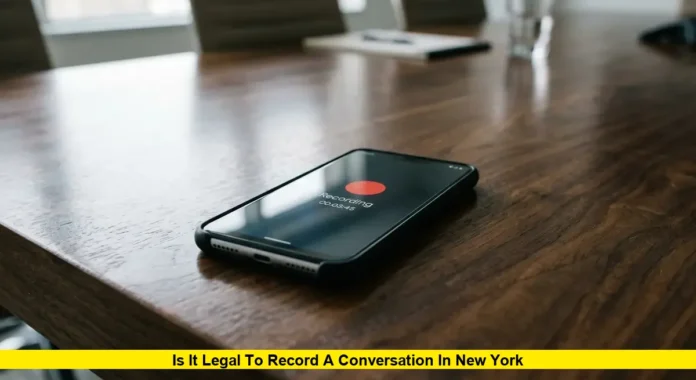

Recording a conversation can feel like a smart way to protect yourself, whether you’re dealing with a difficult landlord, a workplace dispute, or just want to keep a personal record of an important talk. But before you hit “record” in New York, it’s worth knowing exactly where the law draws the line. The short answer is yes, it’s generally legal, but the details matter a lot more than most people realize.
New York Is a One-Party Consent State
New York follows what’s known as a “one-party consent” rule for recording conversations. This means that as long as you are personally taking part in a conversation, whether in person, over the phone, or through an electronic communication, you’re legally allowed to record it without telling the other person or asking for their permission.
This rule comes directly from New York Penal Law §§ 250.00 and 250.05, which define eavesdropping as overhearing or recording a conversation without the consent of at least one participant. New York’s wiretapping law makes it a crime to record or eavesdrop on an in-person or telephone conversation unless one party to the conversation consents. Since you yourself count as a “party” when you’re part of the discussion, your own consent is enough to make the recording lawful.
This was confirmed decades ago by New York’s highest court. In People v. McGee, the Court of Appeals held that a participating recorder satisfies the consent requirement under the statute. In plain terms, if you’re talking to someone, you can legally press record.
When Recording Becomes Illegal
The one-party consent rule has a hard limit: it only protects you if you’re actually part of the conversation. The moment you record a conversation you’re not involved in, without permission from at least one participant, you cross into criminal territory.
If you record a conversation you are not party to, for example two coworkers talking in a different office or a meeting in a room you do not attend, that likely violates the law and can constitute unlawful eavesdropping. Hiding a phone or planting a microphone to capture someone else’s private conversation falls squarely into this category, regardless of your intentions.
There’s also the question of privacy expectations. A loud conversation between two people on a crowded street or in a packed café generally isn’t protected, since there’s no reasonable expectation of privacy in public. But a hushed discussion in a restaurant booth, or a conversation inside someone’s home, is much more likely to be considered private, and recording it without consent could be illegal.
Penalties for Illegal Recording in New York
New York doesn’t treat illegal recording lightly. Eavesdropping under section 250.05, meaning recording a conversation you’re not part of without any participant’s consent, is a Class E felony carrying up to four years in prison. Conviction can also bring a fine of up to $5,000.
New York’s hidden camera law carries similarly steep consequences. Violations are also felonies with the same potential penalties, and there are enhanced penalties for anyone with a prior conviction within the past ten years. Repeat unlawful-surveillance offenses can be charged as a Class D felony, carrying up to seven years and mandatory sex-offender registration.
One important note: there is no separate civil lawsuit built into Penal Law § 250.05 itself. However, victims aren’t without options. A federal remedy exists under 18 U.S.C. § 2520, allowing actual damages or statutory damages of the greater of $100 per day or $10,000, plus attorney fees. If intimate images are involved, New York Civil Rights Law § 52-b provides a separate state cause of action for actual, statutory, and punitive damages.
Recording at Work: What Employees Should Know
Workplace disputes are one of the most common reasons people consider recording a conversation. The good news is the same one-party rule applies. You generally may record a conversation in person or by phone if you are a participant in it, since New York follows the one-party consent rule under its wiretapping and eavesdropping statutes.
That said, legal does not always mean risk-free. A recording can provide strong, contemporaneous evidence when it captures harassment, discriminatory remarks, retaliation threats, or instructions to falsify records. But there are real tradeoffs to weigh. If you record a conversation you’re not actually part of, you may face criminal exposure and lose credibility, which can hurt rather than help a future legal claim. Violating an employer’s internal policy on recording may also lead to discipline or termination, even if the recording itself was legal under state law.
If you’re documenting a workplace issue, it’s worth speaking with an employment attorney before relying on a recording as your main piece of evidence.
Recording Police Officers in Public
New York law specifically protects your right to film police officers carrying out their duties in public. A New York statute protects the right to record law enforcement officers, as long as the person recording is not under arrest or otherwise in police custody, though it excludes actions that physically interfere with law enforcement activity or otherwise constitute a crime.
This protection has teeth. If an officer interferes with someone’s right to record, including by blocking the recording, threatening the person, ordering them to stop, or confiscating their equipment, that person can file a civil suit for damages and attorney’s fees. That civil rights provision, found in Civil Rights Law § 79-p, allows for both compensatory and punitive damages.
Worth noting: whether this protection extends to indoor police facilities, not just public streets, is still being sorted out by the courts. In June 2025, the Second Circuit certified the question to the New York Court of Appeals of whether sections 79-p and 14-189 extend to indoor police-facility recording, and that question remains pending.
Interstate Calls: Where It Gets Complicated
New York’s one-party rule only protects you within New York. The moment a call crosses state lines, things change fast. Some states, including California, Florida, and Pennsylvania, require everyone in the conversation to consent before it can be recorded.
If you record someone in a two-party consent state without telling them, you could be violating their state’s laws even if you were physically in New York at the time. This is one of the most common ways people accidentally break the law. If you intend to record conversations involving people in more than one state, the safest approach is to get the consent of all parties involved.
Is a Legally Recorded Conversation Admissible in Court?
Recording legally and getting that recording admitted as evidence are two different things. Even a lawfully recorded conversation may still be classified as hearsay, an out-of-court statement offered for the truth of the matter, and therefore inadmissible unless it fits one of the recognized exceptions.
Courts may admit a recorded conversation under exceptions such as a party admission, a declaration against interest, an inconsistent statement, or for impeachment purposes. Illegally recorded conversations, by contrast, are far less likely to be allowed in under any hearsay exception. If you’re hoping to use a recording in a legal proceeding, it’s best to consult an attorney early to understand how the evidentiary rules apply to your specific situation.
Is the Law About to Change?
It’s a fair question, since New York’s one-party rule has faced repeated legislative challenges over the years. As of mid-2026, the rule hasn’t changed. Bills S.5070 and S.5077, introduced in the 2025-2026 legislative session, are both still pending in the Senate Codes Committee. S.5077 specifically would redefine “wiretapping” to require consent from all parties to a conversation, not just one, before a recording is legal.
This isn’t the first attempt; similar bills have been introduced and stalled in committee in nearly every legislative session since 2018. Unless and until one of these bills actually passes, New York remains a one-party consent state.
Frequently Asked Questions
Can I record a phone call with someone in New York without telling them? Yes, as long as you are one of the people on the call. New York’s one-party consent rule applies equally to phone calls and in-person conversations.
Is it illegal to record someone without their knowledge in New York? Not if you’re a participant in the conversation. It only becomes illegal if you’re recording a conversation you’re not part of, without consent from at least one person involved.
What happens if I record someone in New York who lives in a two-party consent state? You could be exposed to that other state’s stricter laws, even though you followed New York’s rules. It’s safest to get consent from everyone when a call crosses state lines.
Can I record my boss or coworker at work in New York? Generally yes, if you’re part of the conversation, though workplace policy violations and credibility concerns can still create complications even when the recording itself is legal.
Is recording the police legal in New York? Yes, in public settings, as long as you’re not interfering with police activity or in custody yourself.
What’s the penalty for illegally recording someone in New York? Illegal eavesdropping is a Class E felony, punishable by up to four years in prison and a fine of up to $5,000.
Recording laws can feel deceptively simple until you’re actually in the moment deciding whether to hit that button. While New York’s one-party consent rule gives you more freedom than many other states, the exceptions around eavesdropping, interstate calls, and courtroom admissibility are where most people run into trouble. If you’re recording for anything beyond personal peace of mind, especially anything that might end up in a legal dispute, a quick conversation with an attorney is always worth it.
Got a recording dilemma of your own? Drop your question in the comments; we’re always digging into the latest on privacy law so you don’t have to.