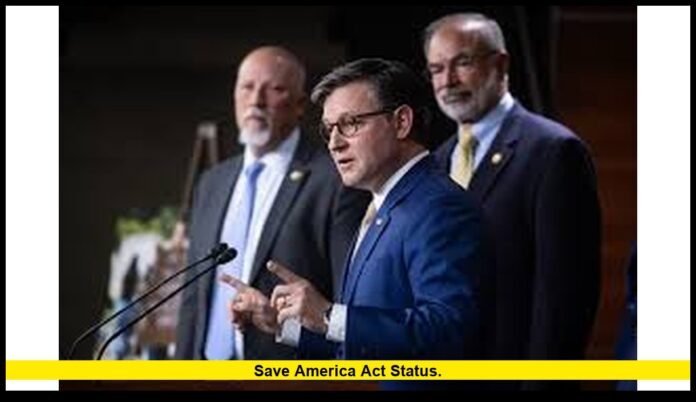

The save america act status continues to draw national attention as lawmakers debate one of the most significant election-related proposals in Congress. The legislation, formally known as the Safeguard American Voter Eligibility (SAVE) America Act, would require documentary proof of U.S. citizenship when registering to vote in federal elections. While supporters say the bill would strengthen election integrity, critics argue it could create additional barriers for eligible voters.
As of today, the SAVE America Act has not become federal law. The proposal remains under active political discussion, but Congress has not completed the legislative process required for it to take effect.
What Is the SAVE America Act?
The SAVE America Act is a federal election reform proposal designed to amend the National Voter Registration Act of 1993. The bill aims to establish stricter verification requirements for voter registration by requiring applicants to provide documentary proof of U.S. citizenship before being added to voter rolls for federal elections.
Supporters believe the legislation would create a more secure voter registration system, while opponents argue existing laws already prohibit non-citizens from voting in federal elections and that additional documentation requirements could affect eligible voters.
Some of the major provisions include:
- Requiring proof of U.S. citizenship when registering to vote.
- Establishing verification procedures for election officials.
- Defining acceptable citizenship documents.
- Creating federal standards for voter registration verification.
Current Save America Act Status
The current save america act status is that the legislation has not been enacted into law.
The latest version, H.R. 7296, was introduced in the U.S. House of Representatives in January 2026 by Representative Chip Roy. As of today, the bill remains in the House Committee on House Administration and has not completed the legislative process required to become law.
Although Congress has considered similar election legislation during the current session, no final version of the SAVE America Act has been approved by both chambers and signed into law.
Latest Political Developments
The SAVE America Act has remained a major legislative priority for President Donald Trump and many congressional Republicans throughout 2026.
Following Senate setbacks earlier this year, President Trump publicly criticized lawmakers for failing to pass the legislation. He also linked his support for unrelated legislation to congressional action on the SAVE America Act, keeping the proposal at the center of political debate.
House Republican leaders have also indicated they remain committed to advancing the legislation through Congress, although procedural challenges continue to stand in the way.
Why the Bill Has Not Become Law
Several factors have prevented the SAVE America Act from becoming federal law.
Senate Opposition
While Republicans largely support the legislation, Senate Democrats have remained opposed. Because most legislation requires sufficient votes to overcome Senate procedural rules, the proposal has struggled to advance.
Procedural Challenges
Congressional procedures require both the House and Senate to approve identical versions of legislation before it can be sent to the president.
Even when lawmakers have discussed alternative legislative strategies, those efforts have not yet resulted in final passage.
Political Division
Election policy continues to be one of the most politically divided issues in Washington.
Supporters view the legislation as necessary to improve election security, while opponents argue it could complicate voter registration for eligible citizens.
Arguments Supporting the Bill
Supporters of the SAVE America Act believe it would:
- Increase confidence in federal elections.
- Prevent non-citizens from registering to vote.
- Create uniform voter registration standards nationwide.
- Improve election integrity through document verification.
Republican lawmakers have consistently described the proposal as an important election security measure.
Criticism of the Legislation
Opponents argue the legislation could:
- Make voter registration more difficult for some eligible Americans.
- Increase administrative work for election officials.
- Require documents that not every eligible voter readily possesses.
- Duplicate safeguards already used by many states.
Voting rights organizations and Democratic lawmakers have raised these concerns throughout congressional debate.
Could the SAVE America Act Still Pass?
Yes. Because the bill has not been withdrawn, Congress could continue considering it during the current legislative session.
Possible next steps include:
- Additional House committee action.
- House floor consideration.
- Senate negotiations.
- Revised legislative language.
- Inclusion of related election provisions in broader legislation.
However, there is no official confirmation that any of these steps will occur or that the bill will ultimately become law.
What the Bill Would Mean if Passed
If enacted, the SAVE America Act would introduce new nationwide requirements for voter registration in federal elections.
Potential changes include:
- Documentary proof of U.S. citizenship during registration.
- Additional verification responsibilities for election officials.
- New federal compliance standards for voter registration systems.
- Uniform documentation requirements across states for federal elections.
The exact implementation would depend on the final version approved by Congress.
Impact on Current Elections
For now, existing federal election laws remain in place.
The SAVE America Act has not changed voter registration requirements nationwide.
Eligible voters should continue following the voter registration rules established by their individual states and existing federal law.
Public Interest in the Bill
The SAVE America Act has become one of the most discussed election proposals in recent years because it addresses issues that remain politically significant ahead of future federal elections.
News coverage has increased whenever Congress debates election legislation or when national political leaders discuss election reform priorities. The bill continues to attract attention from lawmakers, election officials, advocacy groups, and voters across the country.
What to Watch Going Forward
The future of the SAVE America Act depends entirely on congressional action.
Observers will be watching for:
- Committee movement in the House.
- Possible House floor votes.
- Senate negotiations.
- Any revised versions of the legislation.
- Official statements from congressional leadership.
Until Congress completes the legislative process, the SAVE America Act remains a proposal rather than federal law.
Final Thoughts
The save america act status remains unchanged as of today. The legislation continues to be one of the highest-profile election reform proposals before Congress, but it has not been enacted into federal law. While Republican leaders continue to support the measure and seek avenues for advancing it, significant legislative hurdles remain. Unless Congress approves the bill and it is signed into law, existing federal and state election rules continue to govern voter registration.
What are your thoughts on the SAVE America Act? Share your opinion in the comments below and stay tuned for the latest verified updates as the legislation continues to develop.