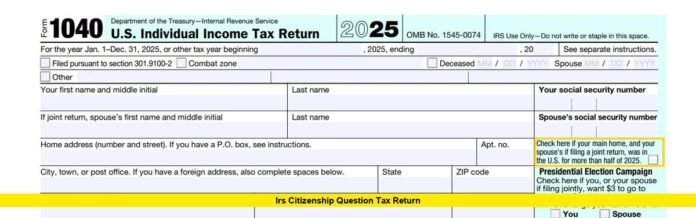

The IRS is weighing one of the most consequential changes to the American tax system in decades — adding a citizenship question directly to the Form 1040 tax return. First reported by Reuters on May 22, 2026, the proposal has sparked intense debate among tax professionals, immigrant advocates, lawmakers, and millions of non-citizen filers who currently use the same federal tax forms as U.S. citizens. Here is everything you need to know about what is being proposed, why it matters, and what it could mean for taxpayers across the country.
What Is the IRS Citizenship Question Proposal?
The IRS is currently evaluating two separate versions of Form 1040 — the standard tax return document used by individuals to report income and claim deductions and credits — for the 2027 tax year. The proposal was first revealed in late May 2026 through exclusive reporting from Reuters and confirmed by multiple additional outlets.
One version of the draft form contains only routine technical updates tied to recent changes in federal tax law. The second version includes those same updates plus a new checkbox with proposed language reading: “Check this box if you are a non-U.S. citizen or have dual citizenship.”
Sources familiar with the internal discussions spoke on the condition of anonymity, citing concerns about professional reprisals. The Treasury Department, which oversees the IRS, declined to comment when initially asked about the proposal.
Why Is the IRS Considering This Change?
The proposed citizenship question is part of the Trump administration’s broader initiative to link federal agencies more tightly to its immigration enforcement and anti-fraud operations. Throughout 2025, the Treasury Department and the Department of Homeland Security (DHS) worked extensively to establish systems allowing immigration officials access to confidential taxpayer data to assist with deportation efforts.
That collaboration was blocked in November 2025, when a federal judge issued an injunction preventing the IRS from transferring taxpayer data to DHS. The federal government subsequently appealed the ruling. In February 2026, the IRS admitted in court that it had already erroneously shared the personal data of more than 42,000 taxpayers with DHS before that court order took effect. Disclosing taxpayer information outside narrow legal exceptions carries serious penalties, including potential criminal liability.
Against that backdrop, the citizenship checkbox on Form 1040 is widely seen as an administrative workaround — a way to formally collect citizenship status data directly within the tax filing system itself.
Who Would Be Affected by the Citizenship Question?
The impact of this proposed change would reach far beyond undocumented immigrants. The checkbox question as currently drafted targets two groups:
Non-U.S. Citizens
Under current law, foreign nationals living in the United States — including undocumented individuals — are legally required to file federal tax returns and use the same IRS documents as American citizens. Non-citizens who do not have a Social Security number file using an Individual Taxpayer Identification Number (ITIN), a nine-digit identifier issued specifically for tax purposes. There are no exemptions based on immigration status. The IRS has also discussed creating differentiated ITIN codes to indicate a filer’s immigration status, according to reporting by The New York Times.
Dual Citizens
The proposed checkbox does not stop at undocumented immigrants. It would also require disclosure from individuals holding dual citizenship — meaning U.S. citizens who are also citizens of another country. Estimates suggest roughly 5 million Americans currently hold citizenship in at least one other country. For these individuals, checking the box would create a formal, documented trail connecting their tax return to the fact of a second passport — a concern particularly relevant to participants in investment migration programs and Americans living abroad.
What Has the IRS Said Officially?
As of late June 2026, the IRS has not officially confirmed or denied the proposal. IRS leadership would need to navigate regulatory procedures, public comment periods, and congressional review before implementing any formal change to Form 1040. Because 2027 tax year forms are typically finalized six to eight months in advance, analysts expect a decision point to arrive by late 2026.
The proposal remains under internal consideration, and no announcement confirming its adoption has been made.
The History: IRS and Immigration Enforcement in 2025–2026
╔══════════════════════════════════════════════════════╗ ║ KEY POINTS SUMMARY ║ ╠══════════════════════════════════════════════════════╣ ║ • IRS proposed citizenship checkbox on Form 1040 ║ ║ • Reuters broke the story on May 22, 2026 ║ ║ • Two form versions: one with, one without checkbox ║ ║ • Federal judge blocked IRS-DHS data sharing (2025) ║ ║ • 42,000+ taxpayer records wrongly sent to DHS ║ ║ • Yale Budget Lab: $313B revenue risk over decade ║ ║ • Dual citizens (~5 million Americans) also affected║ ║ • No official IRS confirmation as of June 2026 ║ ╚══════════════════════════════════════════════════════╝
The path to this proposal has been building for over a year. Here is a brief timeline:
2025: The Treasury Department and DHS spent much of the year attempting to create information-sharing systems allowing immigration officials to access IRS taxpayer data for use in deportation campaigns.
November 2025: A federal judge blocked the IRS from disclosing that data following a lawsuit filed by the Center for Taxpayer Rights. The federal government appealed.
February 2026: The IRS admitted in court to having erroneously shared records of over 42,000 taxpayers with DHS before the injunction took effect.
March 2026: Reports emerged of a hidden checkbox that had already appeared on the 2025 Form 1040, though formal guidance on its legal implications remained unclear.
May 22, 2026: Reuters and U.S. News exclusively reported that the IRS is formally evaluating two versions of Form 1040 for 2027, one of which includes an explicit citizenship status checkbox.
The Financial Stakes: What a Citizenship Question Could Cost the Government
Proponents of the citizenship question argue it would help align tax administration with national security goals and improve accuracy in federal program administration. But the fiscal math tells a complicated story.
Tax preparers across the country reported a surge in client fear during the 2025 filing season, specifically linked to the IRS’s collaboration with immigration enforcement. Many non-citizens — including lawful permanent residents, visa holders, and undocumented workers — expressed reluctance or outright refusal to file.
The Yale Budget Lab has estimated that reduced tax compliance among immigrant communities, driven by fear of information sharing and enforcement, could result in a $313 billion loss in federal revenue over the next ten years. Depending on how taxpayers and employers change their behavior, that estimate ranges from $147 billion to $479 billion.
Industries that depend heavily on immigrant labor — including construction, agriculture, hospitality, and food service — face outsized exposure. A chilling effect on tax filing could push more workers into off-the-books arrangements, reducing both payroll tax revenue and income tax compliance across those sectors.
Legal and Privacy Concerns
Tax law experts and civil liberties advocates have raised substantial concerns about the legal foundation for adding a citizenship question to the tax return.
For decades, the IRS has operated on the principle that its role is tax administration — collecting what is owed — not immigration policing. The agency has long permitted non-citizens to file using ITINs precisely because the goal is maximum tax compliance across the full workforce, regardless of legal status.
Nina Olson, executive director of the Center for Taxpayer Rights, described the proposal as an effort to turn the IRS into an arm of immigration enforcement rather than an independent tax administration agency. Her organization was the plaintiff in the 2025 lawsuit that blocked IRS-DHS data sharing. Immigration advocates have already signaled intent to challenge any formal adoption of the citizenship checkbox through administrative appeals and litigation.
Separately, disclosing taxpayer personal information outside narrow legal exceptions can carry criminal penalties — a reminder that taxpayer data confidentiality has long been treated as a bedrock protection under federal law.
What Does This Mean for Current Filers?
For the 2025 tax year (returns due in 2026), nothing has changed. Non-citizens and dual citizens continue to file the same Form 1040 or Form 1040-NR as applicable, with no citizenship status checkbox required.
The proposed change targets the 2027 tax year, meaning returns filed during the spring 2028 filing season — if the proposal is adopted. Until a final decision is announced and a public comment period is completed, current filing obligations remain unchanged.
Filers who are non-citizens or who hold dual citizenship should:
- Continue filing annually as required by current law
- Use their ITIN if they do not have a Social Security number
- Monitor IRS announcements and Form 1040 updates through the official IRS website at irs.gov
- Consult a qualified tax professional if concerned about how changes may affect their specific situation
FAQ: IRS Citizenship Question on Tax Return
Q: Is the IRS citizenship question on the 2025 tax return? No. As of the current 2025 tax year filing cycle, there is no official citizenship status checkbox on Form 1040. The proposal under discussion targets the 2027 tax year.
Q: Are non-citizens required to file a U.S. tax return? Yes. Under current law, foreign nationals living in the United States — including undocumented individuals — are required to file federal income tax returns if their income meets the filing threshold. They may use an ITIN in place of a Social Security number.
Q: Would dual citizens have to check the citizenship box? Under the proposed language, yes. The draft checkbox reads: “Check this box if you are a non-U.S. citizen or have dual citizenship.” This means U.S. citizens who also hold citizenship in another country would be covered.
Q: Could the IRS share citizenship information with immigration authorities? A federal judge in November 2025 blocked the IRS from sharing taxpayer data with DHS. That ruling is under appeal. Whether citizenship status declared on a tax return could be shared with immigration agencies is a key legal question that remains unresolved.
Q: When will a final decision be made on the citizenship checkbox? No timeline has been officially confirmed. However, because 2027 tax forms are typically designed six to eight months in advance, experts expect a decision to emerge by late 2026.
Q: What is an ITIN and how does it relate to this proposal? An ITIN (Individual Taxpayer Identification Number) is a nine-digit number issued by the IRS to individuals who are not eligible for a Social Security number. Non-citizens use ITINs to file tax returns. The IRS has also reportedly considered creating differentiated ITIN codes to indicate immigration status as a parallel approach.
What Comes Next
The IRS citizenship question on the tax return represents a potential turning point in how the federal government uses the tax system. If adopted, it would be the first time in U.S. history that the standard Form 1040 formally distinguishes between citizens and non-citizens in its core filing structure.
The road to implementation is not straightforward. Any formal change to Form 1040 must pass through regulatory review, public comment periods, and potential congressional scrutiny. Legal challenges are considered highly likely if the proposal moves forward.
For now, all filers — citizens, permanent residents, visa holders, and undocumented individuals — should continue meeting their existing tax obligations. The IRS has not changed current requirements, and any eventual shift would come with advance notice through official channels.
Stay informed, file on time, and consult a tax professional if the evolving landscape raises questions about your specific situation.
What do you think about adding a citizenship question to the IRS tax return — does it cross a line, or is it a reasonable step? Drop your thoughts in the comments below and bookmark this page for updates as the IRS makes its final decision.