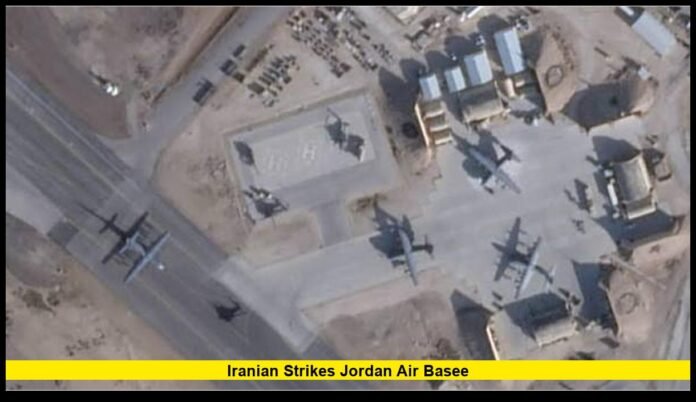

The latest iranian strikes jordan air base developments have added a dangerous new dimension to the rapidly expanding U.S.-Iran conflict, after Iranian ballistic missiles targeted the Muwaffaq Salti Air Base in Jordan and reportedly damaged several American military aircraft. The attack came during a broader wave of retaliation involving U.S. forces, Iran, and armed groups aligned with Tehran, raising fresh concerns about the security of American personnel and military facilities across the Middle East.
Jordanian authorities said the country came under a missile attack originating from Iran, while reports later indicated that U.S. aircraft at the strategically important base suffered varying levels of damage. The incident highlights the increasingly complicated security situation facing Jordan, which maintains a close military partnership with Washington while attempting to prevent its territory from becoming a larger battlefield.
What Happened at the Jordan Air Base?
The attack targeted the Muwaffaq Salti Air Base near Al-Azraq in eastern Jordan. The installation is operated by the Jordanian military but has become an important location for U.S. military operations in the region.
According to the Jordanian Armed Forces, 20 ballistic missiles were launched toward Jordan. Jordanian air-defense systems intercepted and destroyed 18 of them, while two missiles fell in unpopulated areas.
The initial Jordanian assessment reported no deaths from the missile barrage. Military teams were dispatched to locations where missile fragments and debris landed, while authorities urged residents not to approach unidentified fragments.
The attack demonstrated the importance of Jordan’s air-defense network, but it also revealed that even a heavily defended military installation can remain vulnerable when large numbers of ballistic missiles are launched during a wider regional conflict.
American Aircraft Were Damaged
The most significant new development was the reported damage to U.S. aircraft stationed at the base.
Several reports citing people familiar with the incident said an A-10 Thunderbolt II was struck and suffered severe damage, including the loss of a wing. The A-10, widely known as the Warthog, is designed primarily for close-air-support missions and has long been valued for its ability to operate in demanding combat environments.
Approximately eight F-15 fighter aircraft also reportedly sustained minor damage. Unlike the heavily damaged A-10, the affected F-15s were reportedly returned to service.
The aircraft damage is significant because Muwaffaq Salti Air Base serves as a major hub for American air operations. The installation hosts numerous aircraft and supports missions across the region.
The incident therefore represents more than an isolated attack on a military facility. It shows that Iranian missiles can potentially threaten valuable U.S. aircraft even when sophisticated air-defense systems are deployed.
Why Did Iran Target Jordan?
The United States had announced military action against five Iranian oil tankers. Washington said the operation followed Iranian attacks directed at U.S. naval forces.
Iran subsequently announced retaliatory military operations against American interests and facilities in the region.
Muwaffaq Salti Air Base became an important target because of its role in supporting U.S. military operations. From Tehran’s perspective, striking a U.S.-used installation in Jordan offered a way to pressure American forces without limiting retaliation to locations inside the Persian Gulf.
The attack also illustrates how Jordan’s close relationship with the United States has made the kingdom increasingly exposed to the consequences of the conflict.
Muwaffaq Salti Air Base Explained
Muwaffaq Salti Air Base is located near Azraq in eastern Jordan and is one of the country’s most strategically important military facilities.
The base has become increasingly significant to the United States because of Jordan’s geographic position. Jordan sits between several major areas of strategic importance, including Iraq, Syria, Israel, the West Bank and Saudi Arabia.
Its location provides the U.S. military with operational depth while allowing aircraft and support personnel to operate relatively close to several areas affected by the conflict.
The base has also supported logistics and combat operations involving American aircraft. Its importance has grown as Washington has increased military activity associated with the confrontation with Iran.
That strategic value also makes the facility an obvious target during an extended conflict.
Jordan’s Air Defenses Intercepted Most Missiles
Jordan’s response was centered on its air-defense systems.
The Jordanian military said 18 of the 20 ballistic missiles fired toward the country were intercepted and destroyed. The remaining two landed in areas without population.
The interception rate helped limit the immediate human impact of the attack. No deaths were reported in the Jordanian military’s initial statement.
However, the fact that American aircraft were reportedly damaged indicates that missile-defense success does not necessarily mean every military asset at a targeted installation will remain untouched.
Ballistic missile defense is designed to reduce the probability of a successful strike, but even a small number of missiles penetrating a defensive network can cause substantial damage if they reach aircraft, fuel facilities, maintenance areas or other critical infrastructure.
The Attack Followed a Major U.S.-Iran Escalation
The Jordan strike was part of a much larger series of military developments.
The confrontation has increasingly involved U.S. naval forces, Iranian missile units, commercial shipping and military bases throughout the Middle East.
Iran has also threatened maritime traffic and used its regional partnerships to expand pressure on U.S. allies.
The United States, meanwhile, has attempted to restrict Iran’s ability to generate revenue from oil exports while maintaining military pressure on Iranian forces.
The destruction of Iranian oil tankers became a major trigger for the latest retaliatory cycle. Iran responded with attacks against U.S. and allied interests, including the missile barrage directed at Jordan.
This pattern has created fears that individual military operations could repeatedly trigger larger retaliation.
Jordan Faces a Difficult Strategic Position
Jordan is in an unusually difficult position.
The country has maintained a close defense and security relationship with the United States for decades. American forces operate from multiple locations in Jordan, and Washington considers the kingdom an important regional security partner.
At the same time, Jordan has consistently sought to protect its sovereignty and avoid being dragged directly into wars involving neighboring countries.
The latest missile attack demonstrates how difficult that balancing act has become.
Even when Jordan is not itself seeking confrontation with Iran, American military activity from Jordanian territory can make facilities inside the kingdom targets for Iranian retaliation.
This puts the Jordanian government under pressure to strengthen air defenses while reassuring the public that the country’s territory will remain protected.
No Major U.S. Casualties Were Reported
Despite the reported aircraft damage, no U.S. deaths were reported in connection with the latest attack on the Jordanian base.
That distinction is important because American forces operating in the region remain exposed to repeated missile and drone attacks.
Military aircraft can be repaired or replaced, but casualties among service members could produce a much more significant political and military response from Washington.
The absence of reported American fatalities may therefore limit the immediate pressure for a dramatically larger U.S. response, although the damage to aircraft could still influence American military planning.
What the Aircraft Damage Means for U.S. Operations
The reported damage to one A-10 and several F-15s could affect U.S. operations depending on the extent of repairs required.
The F-15 aircraft were reportedly returned to service, suggesting that their damage was relatively limited.
The condition of the A-10 is less clear. Severe structural damage could require extensive maintenance, potentially taking the aircraft out of combat operations for a longer period.
The larger issue is the vulnerability of aircraft parked on the ground.
Modern fighter aircraft are highly capable but can be vulnerable when they are concentrated at a fixed airfield. Missile attacks can damage aircraft without engaging them in aerial combat.
For this reason, military planners may respond by dispersing aircraft, increasing hardened shelters, strengthening missile defenses and changing operating patterns.
Patriot Missile Defenses Under Pressure
The attack also focuses attention on the growing demand for U.S. missile-defense systems.
Patriot batteries and other air-defense systems have been heavily relied upon during the expanding conflict.
Reports indicated that U.S. forces used Patriot interceptors while defending against the Iranian attack on Jordan.
The continuing use of interceptors raises questions about ammunition stocks. Missile defense requires defenders to maintain sufficient inventories to respond not only to one attack but potentially to repeated barrages.
A prolonged conflict could therefore become a test of industrial capacity as much as battlefield performance.
Iran does not need every missile to penetrate an air-defense network to cause problems. A sustained barrage can force defenders to expend expensive interceptors while attempting to protect multiple military bases and strategic locations simultaneously.
The Conflict Is Spreading Beyond Iran and the United States
The Jordan attack is only one part of a broader regional crisis.
The conflict has increasingly involved countries that are not direct participants in the original U.S.-Iran confrontation.
Iran-backed Houthi forces in Yemen have carried out attacks against Saudi targets, while shipping routes around the Red Sea and Persian Gulf have faced growing security concerns.
The Strait of Hormuz has become particularly important because of its role in global energy transportation.
Any sustained disruption to oil shipments could have consequences well beyond the Middle East, affecting fuel prices, transportation costs, inflation and financial markets.
The Jordan missile attack therefore has implications that extend beyond the immediate damage at the air base.
Oil Markets Are Watching the Escalation
Energy markets have responded to the broader conflict with increased volatility.
The possibility of prolonged disruption to oil transportation has pushed traders to price in a larger geopolitical risk premium.
The Strait of Hormuz is particularly sensitive because large volumes of global energy supplies traditionally move through the waterway.
If attacks on tankers increase or shipping companies become reluctant to operate in the region, oil prices could rise sharply.
That would create another layer of pressure on governments already dealing with the military and diplomatic consequences of the conflict.
For consumers, a prolonged crisis could eventually translate into higher gasoline, diesel and transportation costs.
Could Iran Strike Jordan Again?
Another major question is whether the latest attack will be followed by additional Iranian missile or drone operations.
Iran has demonstrated that it is willing to target U.S. military facilities located outside the country’s immediate borders.
Jordan’s continued hosting of American forces means additional attacks remain a possibility if the wider confrontation continues.
The Jordanian military has already increased the readiness of its surveillance and air-defense systems. Officials are likely to continue monitoring Iranian missile activity and potential threats to military installations.
Any additional attack could place further pressure on Amman to balance its alliance with Washington against the risks posed to Jordanian territory.
What Could Happen Next?
The next stage of the conflict could develop in several directions.
A further U.S. response against Iranian military or economic assets could trigger another Iranian retaliation. Alternatively, diplomatic efforts could eventually reduce the intensity of the fighting.
The key variables include U.S. military operations, Iran’s missile capabilities, attacks against commercial shipping and the involvement of Iran-aligned groups in countries such as Yemen.
The longer the confrontation continues, the greater the risk that an attack could produce substantial casualties or damage critical infrastructure.
For Jordan, the priority will likely remain protecting its airspace and population while limiting the effects of the wider conflict on its territory.
Why This Attack Matters
The significance of the latest iranian strikes jordan air base incident extends well beyond one military installation.
It demonstrates that Jordan’s geographic position and alliance with Washington have placed the kingdom directly in the path of the expanding conflict.
The reported damage to American aircraft also provides an important reminder that missile defenses cannot eliminate every risk. Even when most incoming weapons are intercepted, a small number can potentially damage high-value aircraft and infrastructure.
For the United States, the attack raises questions about how aircraft and personnel should be positioned across the region. For Jordan, it underscores the security risks associated with hosting American forces. For global markets, it reinforces concerns about a conflict capable of threatening energy supplies and major shipping routes.
Bottom Line
The missile attack on Muwaffaq Salti Air Base represents one of the clearest signs yet that the U.S.-Iran conflict is reaching deeper into the territory of America’s regional partners.
Jordan’s military reported that 18 of 20 Iranian ballistic missiles were intercepted, while two landed in unpopulated areas. No deaths were initially reported from the barrage.
At the same time, reports of an A-10 suffering severe damage and approximately eight F-15s receiving minor damage show that Iranian forces were able to affect American military equipment despite extensive defensive measures.
The immediate danger may have passed, but the strategic consequences are likely to continue. As long as the United States and Iran remain locked in a cycle of retaliation, military bases in Jordan and other allied countries will remain potential targets.
The biggest concern now is whether the latest exchange becomes another step toward a broader regional war or whether diplomatic pressure can eventually halt the escalation.