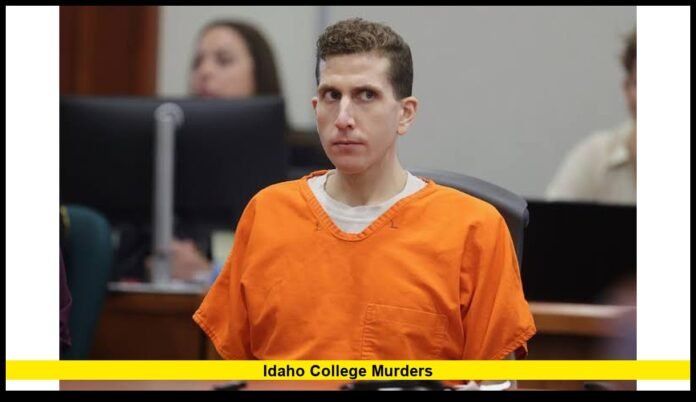

The Idaho college murders case is back before the courts after Bryan Kohberger filed a post-conviction challenge seeking to withdraw the guilty plea that resulted in four consecutive life sentences. Kohberger admitted in July 2025 that he murdered University of Idaho students Madison Mogen, Kaylee Goncalves, Xana Kernodle and Ethan Chapin. On July 27, 2026, however, he filed a petition challenging those convictions and alleging problems with the legal representation and information he received before accepting his plea deal.
The new filing does not erase Kohberger’s convictions or change his sentences. He remains imprisoned in Idaho while the court considers what happens next.
His latest move creates another major legal chapter in a case that captured nationwide attention after four young students were killed inside an off-campus home in Moscow, Idaho, on November 13, 2022.
What Is the Latest Update in the Idaho College Murders Case?
Kohberger filed a petition for post-conviction relief in Ada County District Court on July 27, 2026.
In the filing, he seeks to withdraw his guilty plea and raises allegations about the legal representation he received before accepting the agreement.
Kohberger claims ineffective assistance of counsel. He also argues that misleading information and promises influenced his decision to plead guilty.
Among his allegations are claims involving prison conditions and evidence that he believes his attorneys did not adequately address with him before the plea.
These are Kohberger’s claims in a legal petition. A court has not accepted them as established facts.
That distinction is important because Kohberger personally admitted responsibility for all four murders during his 2025 plea hearing.
As of July 30, 2026, his murder convictions remain valid. His life sentences also remain unchanged.
Kohberger Admitted Killing All Four Students
The current challenge stands in sharp contrast to what happened in court on July 2, 2025.
Kohberger appeared before Judge Steven Hippler and pleaded guilty to four counts of first-degree murder and one count of burglary.
During the hearing, the judge questioned him directly about each victim.
Kohberger acknowledged killing Madison Mogen, Kaylee Goncalves, Xana Kernodle and Ethan Chapin. He also confirmed that he was pleading guilty because he was guilty.
Those statements allowed the criminal case to move toward sentencing without a trial.
The plea agreement removed the possibility of the death penalty. In return, Kohberger accepted sentences that ensured he could spend the rest of his life in prison.
His current petition asks the court to revisit that outcome.
Bryan Kohberger Is Serving Four Consecutive Life Sentences
Judge Hippler sentenced Kohberger on July 23, 2025.
He received four consecutive life sentences without the possibility of parole for the four murders. The court also imposed a 10-year sentence for burglary.
The judge ordered financial penalties as part of the sentence as well.
Kohberger remains in the custody of the Idaho Department of Correction. State records list him at the Idaho Maximum Security Institution.
His post-conviction petition does not automatically suspend or cancel any part of his punishment.
Unless a court grants relief, Kohberger will continue serving his existing sentences.
Who Were Madison Mogen, Kaylee Goncalves, Xana Kernodle and Ethan Chapin?
The victims were four University of Idaho students whose deaths devastated their families and the Moscow community.
Madison Mogen and Kaylee Goncalves were both 21. Xana Kernodle and Ethan Chapin were both 20.
Mogen, Goncalves and Kernodle lived in the King Road rental home where the murders occurred. Chapin, Kernodle’s boyfriend, was staying at the residence that night.
Two other roommates survived.
The students had spent portions of the evening of November 12, 2022, at different locations before returning to the house.
By the early hours of November 13, all four victims were inside the residence.
The attack occurred shortly after 4 a.m.
What Happened at the King Road House?
Details presented during the 2025 plea proceedings provided a clearer account of the prosecution’s case.
Kohberger lived in Pullman, Washington, and attended Washington State University. Pullman sits only a short drive from Moscow.
During the early morning of November 13, prosecutors said Kohberger drove his white Hyundai Elantra toward the King Road neighborhood.
Surveillance evidence tracked a white vehicle making several movements near the residence.
Kohberger eventually entered the home through a sliding door.
Mogen and Goncalves were on the third floor. Both women were killed there.
Kernodle was awake during part of the period surrounding the attack. She had received a food delivery shortly before the killings.
Kohberger also killed Kernodle and Chapin on the second floor.
A surviving roommate later described seeing a masked man dressed in dark clothing inside the home.
The attacker then left.
Read More – Idaho College Murders Documentary: New Insights, Streaming Details, and the Story That Shook a Nation
A Knife Sheath Became One of the Case’s Most Important Clues
Investigators found a knife sheath near Madison Mogen.
The sheath contained male DNA that investigators ultimately connected to Kohberger.
That discovery became a critical part of the investigation.
Authorities believed a large fixed-blade knife was used in the killings. The murder weapon itself has not been recovered.
The sheath therefore gave investigators a physical piece of evidence from the immediate crime scene.
DNA was only one part of the state’s case.
Investigators also collected surveillance footage, cellphone information and vehicle evidence while working to identify the person responsible.
The White Hyundai Elantra Drew Investigators’ Attention
Video footage from Moscow became another important element of the investigation.
Authorities identified a white sedan traveling around the King Road neighborhood during the relevant time period.
Investigators eventually focused on a white Hyundai Elantra connected to Kohberger.
Kohberger lived in nearby Pullman, where he was pursuing doctoral studies in criminal justice at Washington State University.
Investigators also reviewed cellphone information as they reconstructed his movements.
The evidence gathered during the investigation formed the basis of the prosecution’s planned case against Kohberger.
A jury never heard that full case because Kohberger pleaded guilty before his scheduled trial.
How Police Arrested Bryan Kohberger
For weeks after the killings, authorities publicly identified no suspect.
The investigation involved local police, Idaho State Police and the FBI. Investigators processed the King Road residence, interviewed people and examined large amounts of digital and physical evidence.
Attention eventually turned to Kohberger.
By late December 2022, he had traveled from Washington to Pennsylvania with his father.
Police arrested him at his family’s Pennsylvania home on December 30, 2022.
The arrest came roughly seven weeks after the killings.
Kohberger was later returned to Idaho to face the criminal charges.
For much of the pretrial process, the case appeared headed toward a death-penalty trial.
Why the Case Never Went to Trial
The direction of the prosecution changed dramatically in the summer of 2025.
Kohberger agreed to plead guilty to all four murders and burglary. Prosecutors agreed not to seek his execution.
The agreement guaranteed severe punishment without requiring a lengthy murder trial.
On July 2, Kohberger formally entered his guilty pleas.
Sentencing followed three weeks later.
The agreement generated mixed reactions among relatives of the victims. Some family members supported avoiding additional years of court proceedings, while others strongly opposed the decision to remove the death penalty.
The Goncalves family was particularly critical of the agreement.
Still, the court accepted Kohberger’s pleas, and he received four consecutive life terms without parole.
Why the 2026 Court Filing Is Significant
Kohberger’s July 2026 petition attempts to challenge a case that appeared legally resolved after his sentencing.
He alleges that ineffective legal representation affected his decision to plead guilty.
His filing also raises claims about what he says he was told regarding prison conditions and aspects of the evidence.
The court must evaluate those arguments through the post-conviction process.
His previous statements in court will remain highly relevant.
Kohberger did not simply accept a written agreement. He appeared before a judge and personally admitted committing each murder.
He also confirmed that he understood the plea proceedings.
His current position conflicts with those admissions.
No court ruling has overturned his guilty pleas as of July 30, 2026.
Families Face Another Round of Legal Proceedings
The new petition brings renewed court attention to a case that the families had already endured for years.
Relatives of the victims experienced the original investigation, Kohberger’s arrest, lengthy pretrial litigation, the plea agreement and sentencing.
Now, his attempt to withdraw the plea could produce another legal battle.
Kaylee Goncalves’ family has pointed to Kohberger’s courtroom admissions while criticizing his new effort to challenge the convictions.
The state is also prepared to defend the existing judgment.
For the families, however, the legal process remains only one part of the story.
Madison, Kaylee, Xana and Ethan were college students with families, friendships and plans that ended during a single violent morning.
The Motive Remains One of the Biggest Unanswered Questions
Kohberger’s guilty plea established his responsibility for the murders in court, but it did not provide a confirmed motive.
Authorities have not publicly established why he chose the King Road residence or why he killed the four students.
Kohberger did not explain his motive when he entered his pleas.
He also declined to make a statement at sentencing.
No confirmed evidence has established that one particular victim was the intended target.
That leaves one of the case’s most persistent questions unanswered.
The absence of a confirmed motive has contributed to continued public interest, even after Kohberger admitted committing the murders.
What Happened to the King Road House?
The house where the students died no longer exists.
The property owner donated the residence at 1122 King Road to the University of Idaho after the killings.
Investigators, prosecutors and defense representatives had opportunities to examine the property as the case developed.
The University of Idaho began demolishing the house on December 28, 2023.
Its removal changed the physical landscape of the neighborhood, but the criminal proceedings continued for another year and a half before Kohberger entered his guilty plea.
Idaho College Murders Timeline
| Date | Development |
|---|---|
| November 13, 2022 | Madison Mogen, Kaylee Goncalves, Xana Kernodle and Ethan Chapin are murdered |
| December 30, 2022 | Police arrest Bryan Kohberger in Pennsylvania |
| January 2023 | Kohberger returns to Idaho to face charges |
| December 28, 2023 | Demolition of the King Road house begins |
| July 2, 2025 | Kohberger pleads guilty to four murders and burglary |
| July 23, 2025 | Kohberger receives four consecutive life sentences without parole |
| July 27, 2026 | Kohberger files a petition seeking post-conviction relief |
| July 30, 2026 | Convictions and sentences remain in effect |
What Happens Next for Bryan Kohberger?
The focus now shifts to the post-conviction process.
Kohberger wants the court to allow him to withdraw his guilty plea. He has raised allegations involving his former legal representation and the circumstances surrounding his decision to accept the plea agreement.
The filing itself does not prove those allegations.
It also does not return the case to trial.
A court must determine whether his claims provide a legal basis for relief.
Until a judge rules otherwise, the outcome established in July 2025 remains intact.
Bryan Kohberger stands convicted of murdering Madison Mogen, Kaylee Goncalves, Xana Kernodle and Ethan Chapin. He remains sentenced to four consecutive terms of life imprisonment without parole.
The latest court challenge ensures that the Idaho college murders will remain an active legal story in 2026. Yet the central facts remain unchanged: four University of Idaho students lost their lives, Kohberger admitted killing them in court, and his convictions remain valid while he pursues post-conviction relief.
What do you think about the latest court developments in the case? Share your thoughts in the comments and stay updated as the legal process continues.