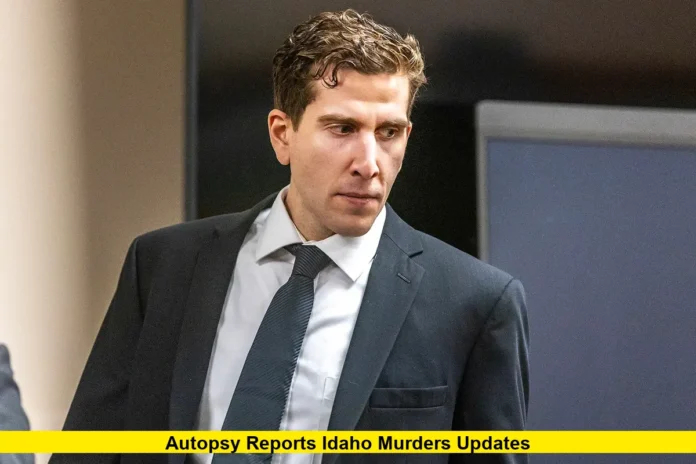

The Autopsy Reports Idaho Murders: Updates remain one of the most searched topics surrounding the University of Idaho homicide case. Since Bryan Kohberger pleaded guilty in 2025 to the murders of Madison Mogen, Kaylee Goncalves, Xana Kernodle, and Ethan Chapin, additional court records and previously sealed documents have continued to emerge. In 2026, newly released autopsy reports offered a clearer picture of the injuries suffered by the four victims while also renewing public interest in one of America’s most closely followed criminal investigations.
Although the reports contain graphic medical details, they also provide important forensic information that investigators relied upon when building the case against Kohberger. At the same time, his recent attempt to withdraw his guilty plea has brought renewed attention to the evidence and legal proceedings.
Why the Autopsy Reports Became Public
The release of the autopsy reports in the University of Idaho murders case came after significant legal developments concluded the criminal proceedings against Bryan Kohberger. In July 2025, Kohberger pleaded guilty to the murders of Madison Mogen, Kaylee Goncalves, Xana Kernodle, and Ethan Chapin, avoiding a lengthy capital murder trial. After the court accepted his plea and imposed four consecutive life sentences without the possibility of parole, many records that had previously been sealed during the active investigation became eligible for public release under Idaho law.
During the investigation and pretrial process, authorities kept numerous documents confidential to protect the integrity of the case, preserve potential evidence, and ensure that Kohberger could receive a fair trial. Once the case was resolved through the guilty plea, many of those concerns were reduced, allowing courts and public agencies to release additional investigative materials.
Among the newly available records were autopsy reports prepared by the Spokane County Medical Examiner. These reports detailed the medical findings for each victim, including the official cause and manner of death, while confirming information that investigators had previously shared in court documents. Although the reports provided greater insight into the forensic evidence, officials continued to withhold certain sensitive materials, such as crime scene photographs and other graphic evidence, to protect the privacy and dignity of the victims and their families.
The Four University of Idaho Victims
The University of Idaho murders claimed the lives of four students whose deaths shocked the nation and forever changed the Moscow, Idaho, community. The victims—Madison Mogen, Kaylee Goncalves, Xana Kernodle, and Ethan Chapin—were all enrolled at the University of Idaho and were remembered by family, friends, and classmates for their vibrant personalities and close-knit friendships.
During the early morning hours of November 13, 2022, the four students were fatally stabbed inside an off-campus rental home on King Road in Moscow. Madison Mogen and Kaylee Goncalves were lifelong friends who had spent the evening together before returning home. Xana Kernodle and her boyfriend, Ethan Chapin, were also at the residence that night. Two other roommates were inside the home but were not physically harmed during the attack.
The killings sparked one of the largest homicide investigations in Idaho’s history, drawing nationwide media attention and prompting an extensive search for the person responsible. After weeks of investigation, authorities arrested Bryan Kohberger in Pennsylvania in December 2022.
In July 2025, Kohberger pleaded guilty to four counts of first-degree murder and one count of burglary, admitting responsibility for the killings. The plea agreement allowed him to avoid a capital murder trial and a possible death sentence. He was instead sentenced to four consecutive life terms in prison without the possibility of parole, bringing the criminal case to a legal conclusion while leaving many questions about his motive unanswered.
What the Newly Released Autopsy Reports Confirmed
The autopsy reports confirmed several facts that investigators had previously discussed in court filings.
Cause of Death
Medical examiners determined that all four victims died from multiple sharp-force injuries.
The injuries were consistent with a large fixed-blade knife, matching earlier investigative findings involving a Ka-Bar-style weapon believed to have been used during the attack.
Defensive Injuries
The reports indicated that at least one victim suffered defensive wounds while attempting to resist the attack.
Xana Kernodle’s injuries particularly suggested that she fought back before dying, supporting investigators’ earlier conclusions that she encountered the attacker while awake.
Different Levels of Injury
Medical findings showed that the severity of injuries differed among the victims.
Some sustained substantially more stab wounds than others, though all ultimately died from multiple sharp-force injuries.
Experts have noted that variations in injury patterns do not necessarily establish motive but may help reconstruct the sequence of events inside the residence.
Did the Reports Reveal a Motive?
The short answer is no. Although the release of the autopsy reports has generated renewed public interest in the University of Idaho murders, the documents do not explain why the killings occurred or reveal Bryan Kohberger’s motive. Their primary purpose is to document the medical findings related to each victim’s death, including the cause, manner, and nature of the injuries. They are forensic records rather than investigative reports, so they are not intended to address a suspect’s state of mind or reasons for committing a crime.
One reason the question of motive remains unresolved is that Kohberger’s criminal case ended with a guilty plea rather than a full trial. By pleading guilty in 2025, he admitted responsibility for the murders, eliminating the need for prosecutors to present all of their evidence in court. As a result, much of the investigative material that might have been introduced during a trial—including witness testimony, expert analysis, and other evidence related to motive—was never publicly examined before a jury.
As of now, law enforcement has not officially identified a definitive motive for the murders. Investigators have not released any statement explaining why Kohberger targeted the victims, and Kohberger himself has not publicly provided a credible explanation. While various theories have circulated in media reports, documentaries, podcasts, and online discussions, none has been confirmed by investigators or established as fact. Consequently, the motive behind the Idaho murders remains one of the most significant unanswered questions in the case.
Key Forensic Evidence Beyond the Autopsies
While the autopsy reports provided crucial medical evidence about how the four University of Idaho students died, they represented only one part of the broader investigation. Detectives from multiple law enforcement agencies spent weeks gathering and analyzing forensic, digital, and physical evidence that ultimately led to Bryan Kohberger’s arrest and conviction. Together, these findings helped prosecutors build a strong case before Kohberger chose to plead guilty in 2025.
One of the most significant pieces of evidence was DNA recovered from a knife sheath found near one of the victims at the King Road residence. Investigators later matched the DNA to Bryan Kohberger using forensic testing and genetic genealogy techniques, making it one of the central links between the suspect and the crime scene.
Authorities also relied heavily on surveillance footage collected from homes and businesses in the Moscow area. Investigators tracked the movements of a white Hyundai Elantra, a vehicle matching the one owned by Kohberger, as it traveled near the victims’ residence before and after the killings. The footage helped establish a timeline of the vehicle’s movements during the early morning hours of November 13, 2022.
In addition, investigators analyzed cell phone location data obtained through search warrants. The records indicated that Kohberger’s phone had been in the vicinity of the King Road neighborhood on multiple occasions before the murders, suggesting repeated visits to the area. Although the phone was inactive during part of the time the killings occurred, prosecutors argued that the surrounding location data still supported the overall timeline of the investigation.
Digital evidence also played a key role. Law enforcement examined electronic devices, internet records, and other digital forensic material collected throughout the investigation. Combined with witness statements, surveillance footage, DNA evidence, and phone records, these findings created a comprehensive body of evidence that prosecutors said strongly connected Kohberger to the crimes. Rather than contesting that evidence before a jury, Kohberger ultimately entered a guilty plea, resulting in four life sentences without the possibility of parole.
Bryan Kohberger’s Guilty Plea
In July 2025, Bryan Kohberger formally pleaded guilty to the murders of four University of Idaho students, bringing one of the nation’s most closely followed criminal cases to a legal conclusion without a trial. During a court hearing in Boise, Idaho, Kohberger admitted guilt to four counts of first-degree murder for the killings of Madison Mogen, Kaylee Goncalves, Xana Kernodle, and Ethan Chapin, as well as one count of felony burglary for unlawfully entering the King Road residence where the attacks occurred.
The guilty plea was part of an agreement between Kohberger and prosecutors that removed the possibility of a capital murder trial and the death penalty. Instead of seeking execution, prosecutors agreed to recommend a sentence of life imprisonment without the possibility of parole. The court accepted the plea agreement and later sentenced Kohberger to four consecutive life sentences, ensuring he will spend the remainder of his life in prison. He also received an additional prison sentence for the burglary conviction, which runs according to the court’s sentencing order.
The plea agreement had a significant impact on the legal process. By admitting guilt, Kohberger waived his right to a jury trial and avoided months of courtroom proceedings that would have included extensive testimony, forensic evidence, and cross-examinations. The resolution also spared the victims’ families from reliving the traumatic events during a lengthy capital trial, although some relatives publicly expressed mixed emotions about the decision. While several family members supported bringing the case to a swift conclusion, others said they would have preferred a full trial to learn more about Kohberger’s motive and the circumstances surrounding the murders.
Although Kohberger later sought post-conviction relief and attempted to withdraw his guilty plea, his convictions remain in effect. As of the latest court proceedings, he continues to serve four consecutive life sentences without the possibility of parole, and no court has granted him a new trial or overturned his guilty plea.
Latest Legal Updates in 2026
The University of Idaho murders case has returned to the spotlight in 2026 after Bryan Kohberger filed a petition for post-conviction relief, seeking to challenge the guilty plea that resulted in his conviction and life sentences. The filing has renewed public interest in the case, including previously released autopsy reports and other investigative records, as legal proceedings continue in Idaho.
In his petition, Kohberger argues that his 2025 guilty plea was not entered voluntarily. He alleges that he was pressured into accepting the plea agreement, claims his defense attorneys provided ineffective legal representation, and contends that certain exculpatory evidence—evidence that he believes could have supported his defense—was not properly disclosed before he agreed to plead guilty. Kohberger has also asserted that he is innocent and is asking the court to allow him to withdraw his plea. These claims are part of his legal challenge and have not been proven or accepted by any court.
As the case moves forward, an Idaho judge has appointed new legal counsel to represent Kohberger during the post-conviction process. The newly appointed attorney is expected to review the trial record, court filings, and evidence before deciding whether to amend or expand the petition.
Despite these developments, Kohberger’s convictions remain fully in effect. He continues to serve four consecutive life sentences without the possibility of parole, along with a sentence for burglary. Filing a petition for post-conviction relief does not automatically invalidate a guilty plea or entitle a defendant to a new trial. Under Idaho law, Kohberger must convince the court that significant legal errors or constitutional violations occurred during the original proceedings. Until a judge rules otherwise, his guilty plea remains valid, and no new trial has been ordered.
Families Continue Seeking Privacy
Even as additional investigative records have been released following Bryan Kohberger’s guilty plea and sentencing, many relatives of the four University of Idaho victims continue to call for privacy and respect. While they recognize the public’s interest in understanding one of the nation’s most widely followed criminal cases, several family members have voiced concerns about the publication of sensitive medical records, crime-scene evidence, and graphic forensic details.
The release of autopsy reports and other court documents has sparked renewed discussion about balancing government transparency with the rights and dignity of victims and their loved ones. Although Idaho’s public records laws allow certain documents to become available after a criminal case concludes, families have argued that highly graphic materials should remain confidential to prevent unnecessary emotional distress and avoid further sensationalizing the tragedy.
Relatives have emphasized that the victims should be remembered for their lives rather than the violent circumstances of their deaths. Some have publicly stated that while factual information about the investigation serves the public interest, detailed autopsy photographs, graphic injury descriptions, and crime-scene images should remain sealed out of respect for the victims and to spare their families additional pain.
In response to these concerns, authorities have continued to withhold some of the most graphic evidence, even as other investigative records have been released. The ongoing debate highlights the challenge of maintaining transparency in high-profile criminal cases while protecting the privacy, dignity, and emotional well-being of the victims’ families.
Public Interest Remains High
Nearly four years after the University of Idaho murders, the case continues to draw widespread public attention across television, streaming platforms, podcasts, books, and online news outlets. The brutal killings of Madison Mogen, Kaylee Goncalves, Xana Kernodle, and Ethan Chapin, combined with the lengthy investigation and Bryan Kohberger’s eventual guilty plea, have made the case one of the most closely followed criminal investigations in recent U.S. history.
Interest has remained strong even after Kohberger’s conviction because new court filings, investigative records, and legal developments continue to emerge. In 2026, the release of additional documents—including autopsy reports and other previously sealed records—prompted renewed media coverage and public discussion. These materials have provided greater insight into the forensic investigation while also raising new questions about the legal process and Kohberger’s ongoing efforts to challenge his conviction.
Several recent television specials, documentary series, and true-crime productions have revisited the case, examining the evidence collected by investigators, the timeline of the murders, and the prosecution’s case against Kohberger. Many of these programs have incorporated information from newly released public records while also featuring interviews with legal experts, journalists, investigators, and, in some cases, family members of the victims.
Despite the extensive coverage, many aspects of the case remain unresolved in the public eye. Most notably, law enforcement has never announced an official motive for the murders, and Kohberger has not publicly explained why he committed the crimes. As a result, the University of Idaho murders continue to generate national interest, with many people closely following future court proceedings and any new information that may emerge through the ongoing post-conviction process.
Frequently Asked Questions
Q: Were the Idaho murders autopsy reports released?
A: Yes. Following Bryan Kohberger’s guilty plea, conviction, and sentencing, several previously sealed investigative records, including the victims’ autopsy reports, became publicly available through court filings and Idaho’s public records process. However, authorities have continued to withhold certain highly graphic materials, such as crime-scene photographs, to protect the privacy and dignity of the victims and their families.
Q: What was the official cause of death?
A: The official cause of death for all four University of Idaho students was multiple sharp-force injuries. The medical examiner determined that each victim died from stab wounds sustained during the attack at the King Road residence in Moscow, Idaho, on November 13, 2022.
Q: Did the autopsy reports identify the murder weapon?
A: The autopsy reports did not identify a specific knife by brand or model. However, they concluded that the victims’ injuries were consistent with those caused by a large fixed-blade knife, which aligned with the prosecution’s evidence that the murders were committed using a Ka-Bar-style weapon.
Q: Has Bryan Kohberger received a new trial?
A: No. As of August 2026, Bryan Kohberger remains legally convicted and is serving four consecutive life sentences without the possibility of parole. Although he has filed a petition for post-conviction relief seeking to withdraw his guilty plea, no court has granted him a new trial or overturned his convictions.
Q: Did the autopsy reports explain why the murders happened?
A: No. The autopsy reports are medical documents that describe the victims’ injuries, the cause of death, and other forensic findings. They do not explain Bryan Kohberger’s motive or why the murders occurred. Law enforcement has not officially identified a definitive motive, and Kohberger has not publicly provided a credible explanation for the killings.
Conclusion
The Autopsy Reports Idaho Murders: Updates have provided the public with a more complete understanding of the forensic evidence in one of the most widely followed criminal cases in recent U.S. history. The reports confirmed that all four University of Idaho students died from multiple sharp-force injuries and documented evidence of defensive wounds and varying injury patterns. While these findings have answered some forensic questions, they have not resolved the central mystery of why the murders occurred. Meanwhile, Bryan Kohberger remains imprisoned for life as his post-conviction challenge moves through the Idaho court system.
Stay tuned for the latest verified updates on the Idaho murders case as new court filings and official records become available.