
In 2025, more Americans than ever are exploring how to set up Roth IRA as changing tax laws and new retirement rules reshape the savings landscape. From updated income limits to finalized Roth catch-up rules, the way you open and use a Roth IRA today can have a lasting impact on your tax-free retirement income tomorrow.
Whether you’re setting up your very first account or fine-tuning an existing strategy, understanding every step—and the rules behind it—is essential. Below is a complete, expanded guide designed to walk you through everything clearly and practically, without jargon or fluff.
Why the Roth IRA Still Stands Out in 2025
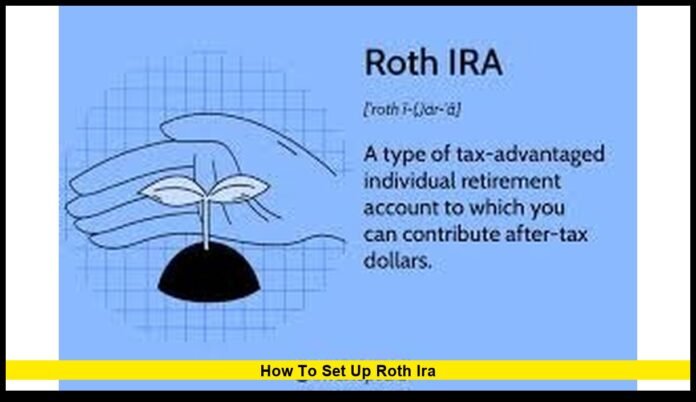
For decades, Roth IRAs have been a cornerstone of U.S. retirement planning. What makes them unique is the tax treatment. Unlike traditional IRAs, where contributions may be deductible but withdrawals are taxed, Roth IRAs are funded with after-tax dollars—so qualified withdrawals are completely tax-free.
This benefit becomes more significant in times of tax policy uncertainty. As the U.S. faces potential tax changes in 2026, many savers see Roth accounts as a way to “lock in” today’s tax rates and secure tax-free growth for decades.
Other advantages include:
- No Required Minimum Distributions (RMDs): Unlike traditional IRAs, you don’t have to withdraw at a certain age.
- Tax-Free Growth: Earnings grow tax-free as long as rules are met.
- Withdrawal Flexibility: Contributions can be withdrawn at any time, tax- and penalty-free.
- Estate Planning Benefits: Heirs can inherit Roth IRAs tax-free (subject to distribution rules).
What’s New for Roth IRAs in 2025
While the fundamental setup process hasn’t changed, several regulatory updates and IRS adjustments affect contributions, eligibility, and planning.
1. Contribution Limits Unchanged but Catch-Up Rules Finalized
- For 2025, you can contribute up to $7,000 if you’re under 50.
- If you’re 50 or older, you can add a $1,000 catch-up contribution, for a total of $8,000.
2. Income Phase-Out Ranges Increased
To be eligible for full contributions, your modified adjusted gross income must be under these limits:
- Single or Head of Household: $150,000 (full) to $165,000 (phased out)
- Married Filing Jointly: $236,000 (full) to $246,000 (phased out)
If you earn above the upper limit, you can’t contribute directly—but alternative strategies like backdoor Roth conversions may apply.
3. Roth Catch-Up Rule Effective in 2026
If you earn over $145,000 and make catch-up contributions in employer plans, those contributions must be Roth. This won’t affect Roth IRAs directly, but it signals a broader shift toward Roth-style savings.
4. Roth 401(k)s Now Aligned with Roth IRAs
Since 2024, Roth 401(k)s no longer have RMDs. This makes transitioning from employer plans to Roth IRAs more seamless.
Step 1: Confirm Your Eligibility
Before setting up your Roth IRA, confirm you’re eligible to contribute. Eligibility depends on earned income and income limits.
- Earned income includes wages, salaries, tips, and self-employment income.
- Unearned income, like interest, dividends, or rental income, doesn’t count.
Then compare your modified adjusted gross income (MAGI) to the limits:
| Filing Status | Full Contribution | Partial Contribution | Not Eligible |
|---|---|---|---|
| Single/Head of Household | ≤ $150,000 | $150,000–$165,000 | > $165,000 |
| Married Filing Jointly | ≤ $236,000 | $236,000–$246,000 | > $246,000 |
If you’re above the limit, you can’t directly contribute—but you might still benefit through a backdoor Roth (contributing to a traditional IRA, then converting). This involves careful tax planning.
Step 2: Choose Your Roth IRA Custodian
The custodian is the financial institution that holds your account. Your choice determines fees, investment options, and user experience.
Common options include:
- Brokerage Firms: Fidelity, Vanguard, Charles Schwab, Merrill Edge
- Banks/Credit Unions: Typically offer more conservative investment options
- Robo-Advisors: Ideal for automated investing and hands-off strategies
Factors to compare:
- Account fees and minimum balances
- Investment variety (ETFs, mutual funds, stocks, bonds)
- Digital platform quality
- Customer support responsiveness
- Auto-investment capabilities
Selecting the right custodian can save you money and give you the flexibility to invest how you want.
Step 3: Complete the Application
Setting up a Roth IRA is straightforward, especially online. Most custodians offer a digital form that takes about 10–15 minutes. You’ll provide:
- Full legal name, address, date of birth
- Social Security number
- Employment information
- Funding method (bank account, transfer, or rollover)
- Beneficiary designations
Beneficiary designations are often overlooked but crucial for estate planning. Designate a primary and contingent beneficiary so your account passes smoothly to heirs.
Step 4: Fund Your Account
Once the account is open, the next step is funding it.
Contribution Limits for 2025:
- $7,000 if under 50
- $8,000 if 50 or older (includes $1,000 catch-up)
Deadline: You have until April 15, 2026, to make 2025 contributions.
Ways to fund your Roth IRA:
- One-time lump sum from your bank account
- Automatic monthly contributions (common and effective)
- Transfers from another IRA
- Rollover from eligible employer plans
- Conversions from a traditional IRA (taxable event—plan carefully)
Important: If you contribute too much, fix it by the tax deadline to avoid the 6% excise tax.
Step 5: Choose Your Investments
A Roth IRA is not an investment itself—it’s an account that holds investments. Choosing wisely determines your long-term returns.
Popular investment choices:
- Target-date funds: Simplified, all-in-one solutions that adjust over time
- Index funds & ETFs: Low-cost, diversified, ideal for long-term growth
- Individual stocks: For those comfortable with higher risk
- Bonds or money market funds: For conservative savers or near-retirees
Sample Portfolio for a 30-Year-Old Saver:
- 70% total stock market index fund
- 20% international stock index fund
- 10% bond fund
Sample Portfolio for a 55-Year-Old Saver:
- 50% stock index funds
- 40% bond funds
- 10% cash equivalents
Revisit your allocation annually to keep it aligned with your goals.
Step 6: Know the Withdrawal Rules
Roth IRAs come with two critical rules for tax-free withdrawals:
- Five-Year Rule
- You must wait at least five tax years after your first contribution to withdraw earnings tax-free.
- The clock starts January 1 of the year you made your first contribution.
- Age 59½ Rule
- You must be at least 59½ to withdraw earnings without tax or penalty.
Good news: You can always withdraw your contributions (not earnings) at any time, tax- and penalty-free.
Strategic Timing: Why 2025 Is a Smart Year to Act
The sunsetting of 2017 tax cuts in 2026 means many expect higher tax rates in the near future. Opening or funding a Roth IRA in 2025 may allow you to pay taxes at today’s rates and lock in tax-free growth for life.
Additionally, the SECURE 2.0 catch-up rule changes will impact employer plan savers starting in 2026. By setting up a Roth IRA now, you can diversify your tax treatment and have more control over retirement distributions.
Common Mistakes to Avoid
Setting up a Roth IRA is simple, but many make avoidable errors:
- Ignoring eligibility rules: Contributing when income is too high leads to penalties.
- Leaving funds uninvested: Cash sitting in the account won’t grow.
- Forgetting beneficiary designations: Can complicate inheritance.
- Over-contributing and not correcting it: Triggers excise taxes.
- Not planning for conversions: Backdoor Roths require careful tax timing.
Sample Timeline for Setting Up a Roth IRA in 2025
| Timeline | Action |
|---|---|
| January–March 2025 | Open Roth IRA, set contribution plan |
| Mid-Year | Review income projections, adjust contributions if needed |
| End of 2025 | Confirm eligibility and contribution status |
| By April 15, 2026 | Finalize 2025 contributions before deadline |
| 2026 and Beyond | Monitor legislative changes and tax rules |
When a Roth IRA Makes the Most Sense
A Roth IRA is especially powerful if:
- You expect to be in a higher tax bracket in retirement.
- You want to avoid required distributions.
- You value tax-free growth over immediate tax deductions.
- You have decades for compounding.
A traditional IRA may suit those who need an upfront tax deduction or have temporarily high incomes. Many investors combine both for a balanced tax strategy.
Action Plan to Set Up Your Roth IRA Now
- Check income eligibility for 2025.
- Select a custodian that fits your investing style.
- Open the account online—usually takes 10–15 minutes.
- Fund it early to give your investments more time to grow.
- Pick a diversified portfolio based on your age and goals.
- Stay informed on legislative changes that could affect retirement accounts.
FAQ
Q1: Can I have a Roth IRA and a 401(k) at the same time?
Yes. You can contribute to both as long as your income allows Roth contributions.
Q2: What if my income is too high?
You may still use a “backdoor Roth” strategy—contribute to a traditional IRA and then convert—but plan for the tax implications.
Q3: Can I withdraw contributions whenever I want?
Yes. Contributions are always tax- and penalty-free to withdraw, though withdrawing earnings early may trigger taxes and penalties.
Thank you for exploring this in-depth 2025 guide on how to set up Roth IRA. Your retirement future depends on informed, early action—so take the next step today and build a strategy that lasts.
Disclaimer: This article is for informational purposes only and should not be taken as financial, legal, or tax advice. Consult a qualified professional for guidance tailored to your situation.