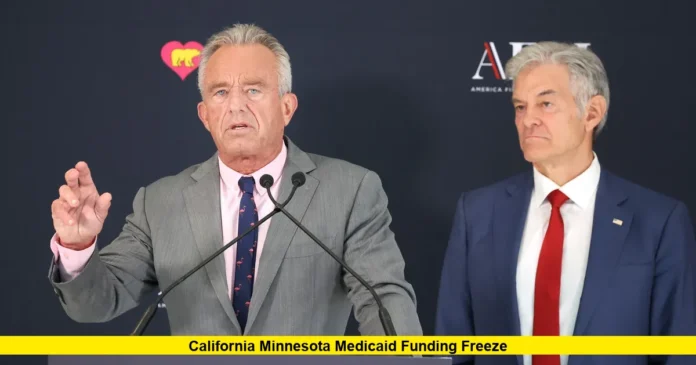

The Trump administration has taken another major step against two Democratic-led states, freezing more than a billion dollars in federal Medicaid payments to California and Minnesota. The Trump administration is halting more than $1 billion in federal Medicaid payments to California and Minnesota until the states take more steps to investigate questionable claims, according to federal health officials. The announcement has reignited a broader fight over how Washington is handling Medicaid oversight in blue states.
What Happened With the Medicaid Funding Freeze
U.S. Health and Human Services Secretary Robert F. Kennedy Jr. confirmed the pause on Tuesday, saying the administration froze more than $867 million in Medicaid funds from California and more than $200 million in Minnesota. Kennedy did not hold back on his criticism of the two states, stating that the states “violated the social contract that makes this country strong and makes our democracy function.”
The freeze affects Medicaid, the public health insurance program for people with low incomes, including some disabled and elderly people, which is jointly funded by state and federal dollars. The Department of Health and Human Services and the Centers for Medicare & Medicaid Services (CMS) deferred more than $867 million to California and $199 million to Minnesota, citing a need for more documentation on claims tied to services considered high risk for fraud.
Officials say the states can get the money released if they cooperate. Kennedy said California and Minnesota can get those funds back if they provide documentary proof that the payments are legitimate. How Officials Say They Found the Fraud
According to CMS, the review process leaned heavily on technology. The administration used artificial intelligence, advanced analytics, and traditional financial verification to uncover the alleged fraud in both states.
For California, the concerns center largely on in-home care spending. CMS said roughly $646 million of California’s freeze is tied to in-home supportive services, with another $221 million linked to claims involving individuals described as having “unsatisfactory immigration status.” CMS Administrator Dr. Mehmet Oz said California’s spending on in-home supportive services rose 24% over the past two federal fiscal years, roughly double the national average, and argued the state still hasn’t adequately documented hundreds of millions of dollars in claims.
Minnesota’s situation looks a bit different. Oz said Minnesota’s flagged spending came from 14 high-risk programs, including personal care and home health services. These 14 Medicaid services are largely tied to long-term care for elderly and disabled residents. Officials said roughly $3 million in payments were identified as fraudulent due to documentation gaps, including claims for treatment billed for a person who had already died.
Why This Freeze Matters
This isn’t an isolated incident — it’s part of a bigger pattern. The moves continue a series of freezes on blue states’ funding as part of the administration’s broader crackdown on fraud, and they also keep scrutiny on Minnesota’s safety net funding after officials previously cited the state’s fraud problems to justify a major ICE enforcement surge there last year.
The dollar amounts involved aren’t small compared to overall state budgets. Minnesota officials have warned that funding freezes could seriously damage the state’s broader Medicaid program, which cost $18 billion in 2024 and covers many other low-income residents beyond those in the flagged categories.
There’s also a real-world impact already being felt on the ground. The funding fight has affected thousands of Medicaid providers in Minnesota, some of whom were abruptly cut off from funding as the state scrambled to meet a federal deadline to screen all providers in the flagged “high-risk” service categories.
This also isn’t the first freeze this year. The Trump administration was already withholding $1.3 billion in Medicaid funding from California since May, along with nearly $260 million from Minnesota, meaning Tuesday’s action adds to funds already paused.
How State Officials Are Responding
Minnesota’s Medicaid leadership pushed back hard against the administration’s justification. Minnesota’s temporary commissioner and state Medicaid director, John Connolly, said CMS “has not provided data or explanation on how the deferral amount was calculated or what it was based on,” and called the action part of an “unprecedented and punitive” pattern he described as a “war on Medicaid and its recipients.”
Minnesota officials also pushed back on the characterization that they weren’t cooperating. State officials told Axios the administration has been actively cooperating with a federal inquiry and called the funding pause unexplained, unprecedented, and punitive.
CMS, for its part, has defended the move as a matter of protecting taxpayer money. CMS Administrator Oz said, “CMS is done trying to chase down stolen and misused funds after they’ve already left the building,” framing the freeze as a way to safeguard federal taxpayer dollars. Kennedy also directly addressed the states’ Democratic governors, saying, “If Governor Gavin Newsom or Governor Tim Walz wants this funding released, all they have to do is provide basic documentation showing that these services are legitimate and not fraudulent. And that’s common sense.”
Key Points Summary
+------------------------------------------------------------+
|  CALIFORNIA & MINNESOTA MEDICAID FREEZE - KEY FACTS         |
+------------------------------------------------------------+
|  Total frozen: Over $1 billion                              |
|  California share: ~$867 million                            |
|  Minnesota share: ~$199-200 million                          |
|  Reason cited: High-risk, undocumented Medicaid claims       |
|  California focus: In-home supportive services               |
|  Minnesota focus: 14 high-risk service categories            |
|  States' response: Call it punitive and unexplained          |
|  Path to release: States must submit documentation           |
+------------------------------------------------------------+
Frequently Asked Questions
How much Medicaid funding was frozen for California and Minnesota?
The administration froze more than $867 million in Medicaid funds from California and more than $200 million from Minnesota, totaling over $1 billion.
Why did the Trump administration freeze this Medicaid funding?
Federal officials say they need more documentation from both states to support Medicaid claims for services considered high risk for fraud.
Can California and Minnesota get the frozen funds back?
Yes — officials have said the states can recover the funds by providing documentary proof that the payments in question are legitimate.
Is this the first time these states have faced a Medicaid funding freeze?
No, the Trump administration was already withholding $1.3 billion in Medicaid funding from California since May, plus nearly $260 million from Minnesota, prior to this newest freeze.
What do Minnesota officials say about the freeze?
Minnesota’s temporary Medicaid director has called the action “unprecedented and punitive,” arguing CMS has not explained how it calculated the deferral amount.
What services are affected in California?
The bulk of California’s freeze, about $646 million, is tied to in-home supportive services, with another $221 million linked to claims involving immigration status issues.
Have thoughts on how this Medicaid funding fight could affect families in California and Minnesota? Drop a comment below and keep checking back — this story is still developing.