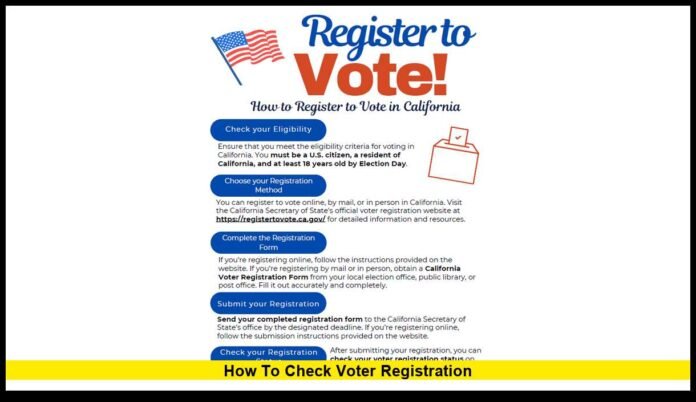

How to check voter registration has become an important step for Americans preparing for elections, particularly after moving, changing a legal name or updating personal information. Voters can review their status through the election system serving their state or territory and confirm whether their registration details are current.
Election administration is handled at the state and local levels, so the exact process varies across the country. Most states provide an online way to locate a voter record, while election offices can also help people who cannot use an online lookup.
Checking early can be especially useful because registration deadlines differ from state to state. Some jurisdictions allow registration close to Election Day, while others set deadlines considerably earlier.
Start With Your State’s Election System
There is no single voter-registration process that works identically across the entire United States. Each state establishes its own procedures for registering voters, maintaining records and handling updates.
To check your status, identify the state or territory where you currently live and use its official election-registration service.
A typical online search asks for information that helps election officials locate the correct record. Depending on the jurisdiction, that may include:
- Full name
- Date of birth
- Residential address
- Driver’s license information
- State identification information
- Voter identification number
Not every state requests the same information. Enter the details exactly as the registration system requires.
What You Can Learn From a Registration Search
A registration lookup can provide more than a simple yes-or-no answer.
Depending on the jurisdiction, voters may be able to see whether their record is active, verify their registered address and review other information associated with their voter file.
Some systems may also provide a polling-place location or other election information.
The information available can include:
- Current registration status
- Registered name
- Residential address
- Political affiliation, where applicable
- Voter identification information
- Assigned voting location
- Other election-related details
The available fields differ between jurisdictions. A voter should focus on whether the information displayed matches their current circumstances.
Why Your Address Deserves Special Attention
Your residential address plays a major role in determining where you vote.
A move within the same state can require a registration update. A permanent move to another state generally means registering in the new state instead.
An outdated address can lead to confusion about your assigned voting location and other election information. That is why checking a registration record after moving is particularly important.
Do not assume that changing your address with another government agency automatically updates every voter-registration record. Follow the election procedures applicable to your state.
Moving to a New State Requires Extra Attention
Voter registration does not automatically follow a person across state lines.
Someone who permanently relocates should check the registration requirements in the new state and complete the appropriate process. The old registration may also need to be canceled or otherwise handled under the rules of the former state.
Deadlines are not uniform. A person who waits until shortly before an election could discover that the standard registration deadline has already passed.
For that reason, checking registration soon after a move is a practical way to identify what needs to be done.
A Name Change Can Affect Your Record
A legal name change is another reason to review voter information.
If the name on your registration does not reflect your current legal name, your state may require an update. The procedure can involve an online submission, a form, an election-office visit or another method.
Requirements differ, so voters should follow the instructions provided by the election authority responsible for their registration.
Reviewing the record after a legal name change can also help identify inconsistencies before an election.
What an Active Status Means
An active registration generally indicates that the election system recognizes the voter as currently registered.
That does not mean voters should stop reviewing the rest of the record.
An active voter can still have an outdated address or another piece of information that needs correction. If anything has changed, follow the state’s process for updating the record.
An active status should therefore be viewed as confirmation of the registration record, not as confirmation that every personal detail is necessarily current.
What an Inactive Status Means
Some states use inactive categories when election officials need additional information or confirmation connected with a voter record.
An inactive designation does not have one universal meaning nationwide. The consequences and steps for resolving it depend on state law and election procedures.
If your record displays an inactive status, read the instructions provided by your election authority. You may need to confirm information, update your registration or take another specified step.
Because procedures differ, voters should not rely on assumptions based on another state’s rules.
What to Do When No Record Appears
A missing search result does not always explain why a registration cannot be located.
Begin by checking the state selected and reviewing every piece of information entered into the search form.
If the system offers multiple search methods, another option may locate the record.
Someone who recently registered should also consider whether the application has had enough time to be processed. Processing procedures differ among election jurisdictions.
If the registration still cannot be located, contacting the relevant election office is the safest next step. Election officials can explain whether an application was received and whether additional action is required.
Registration Deadlines Are Different Across States
There is no single nationwide voter-registration deadline.
Every state establishes its own deadline, and the amount of time available before an election varies. Some jurisdictions permit registration shortly before voting, while others require applications substantially earlier.
This difference makes early verification valuable.
A voter who discovers an incorrect address or missing registration shortly before an election may have fewer options than someone who checks weeks in advance.
The deadline for changing an existing registration can also differ from the deadline for an initial registration.
Checking Your Registration Before an Election
A registration check is particularly useful as an election approaches.
Voters can review their information before deadlines arrive and determine whether an update is necessary.
A simple pre-election review can include:
- Confirm your state of registration.
- Locate your voter record.
- Review your name.
- Confirm your residential address.
- Check your registration status.
- Review available polling-place information.
- Make any necessary changes.
- Verify that the update has been processed.
Taking these steps early leaves more time to resolve unexpected issues.
How to Check Voter Registration After Updating Information
Making a registration change is not necessarily the end of the process.
If you submit a new address, name or other update, check the record again when the state indicates that the change should be processed.
This provides an opportunity to make sure the information now appears correctly.
Keep any confirmation information supplied during the update process. If the change does not appear as expected, use the appropriate election-office contact information to ask about its status.
Can a Registration Card Confirm Your Status?
A voter-registration card can contain useful information, including a voter’s name, address and other registration details.
However, voters should not depend exclusively on an old card when checking their current status.
Information can change after a card was issued. A person may have moved, changed a name or submitted another registration update.
The current election record is therefore more useful when determining whether registration information remains accurate.
A registration card also is not universally required to vote. Identification and voting requirements vary by state.
Where to Get Help With a Registration Problem
Online lookup systems are convenient, but they are not the only option.
State and local election offices can answer questions about registration records, deadlines, address changes and other voting procedures.
A voter who cannot locate a record, sees unexpected information or has an inactive status can contact the appropriate election office for guidance.
This is especially important when an election deadline is approaching.
Why Checking Early Matters in 2026
The 2026 election calendar includes federal, state and local contests across the country. Election dates and registration deadlines vary depending on the jurisdiction and the type of election.
That makes it important for voters to focus on the rules that apply where they live rather than assuming that procedures from another state are the same.
A registration check can take only a short time, but correcting a problem may take longer.
The safest approach is to verify your record before the applicable deadline and address discrepancies as soon as they appear.
Final Takeaway
A current voter-registration record helps ensure that your election information reflects where you live and how you are currently registered. Checking your status online, reviewing your personal details and correcting changes early can reduce unnecessary complications before voting.
Registration rules remain state-specific, so voters should always follow the procedures and deadlines that apply to their own jurisdiction.
Take a few minutes to verify your voter record today and make sure your information is ready for your next election.