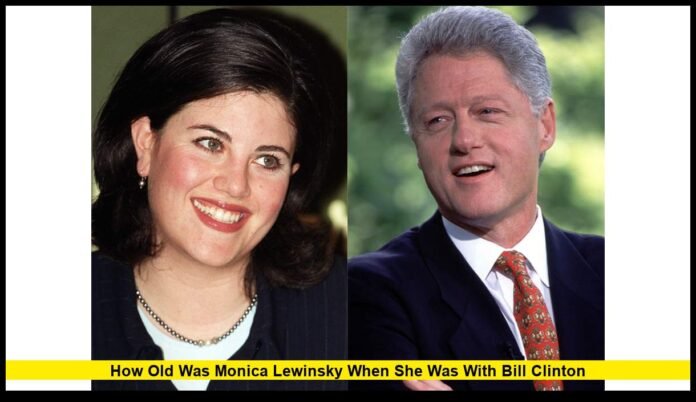

The question how old was Monica Lewinsky when she was with Bill Clinton remains one of the most asked topics in American political history. Monica Lewinsky was 22 years old when her relationship with President Bill Clinton began in 1995. This fact has remained central to public discussions about power, consent, and accountability in the political world. Nearly three decades later, the story continues to influence how Americans view leadership ethics and workplace conduct.

Monica Lewinsky’s Early Life and Background
Monica Samille Lewinsky was born on July 23, 1973, in San Francisco, California, and raised primarily in Los Angeles. She grew up in an educated and professionally accomplished family. Her father, Dr. Bernard Lewinsky, was a respected oncologist, while her mother, Marcia Lewis, was an author and social figure. Lewinsky’s upbringing exposed her to both academic achievement and the cultural life of Southern California, shaping her confidence and social awareness from an early age.
During her school years, Lewinsky attended several private institutions in Los Angeles, where she developed strong communication skills and a keen interest in psychology and human behavior. Friends and teachers often described her as outgoing, expressive, and eager to participate in social and academic activities. These qualities later influenced her interest in public service and political environments.

Lewinsky enrolled at Lewis & Clark College in Portland, Oregon, where she pursued a degree in psychology. Her college experience helped refine her understanding of interpersonal dynamics, an area that would later intersect with the public scrutiny she faced. She graduated in 1995, entering adulthood with ambitions that extended beyond traditional career paths.
That same year, Lewinsky secured a prestigious internship at the White House Office of Legislative Affairs during the Clinton administration. For many young graduates, such an opportunity represented a gateway into national politics, and Lewinsky approached it with enthusiasm and determination. Her role involved administrative and support tasks, but it also placed her in close proximity to the workings of federal government and political leadership.
Colleagues recalled Lewinsky as energetic, personable, and eager to contribute. However, what began as a promising entry into public service soon became historically significant. Her time in Washington would place her at the center of a major political controversy, transforming her from a relatively unknown intern into a figure widely recognized in American political history.

The Beginning of the Relationship
Monica Lewinsky arrived at the White House in July 1995 as a 22-year-old intern eager to build a career in public service. At the time, President Bill Clinton was 49 years old and serving his first term as President of the United States. The environment of the White House placed young staff members in close proximity to senior officials and the daily operations of national leadership, creating interactions that often went beyond routine professional contact.
According to later testimony and investigations, Lewinsky and Clinton developed a connection during Lewinsky’s early months at the White House. What began as friendly interactions gradually evolved into a personal relationship. Their encounters were described in official records as intimate and occurred during a period when Lewinsky worked in various roles, including after her transfer to the Pentagon in 1996.
The relationship reportedly continued from 1995 into 1997, meaning Lewinsky was between 22 and 24 years old during this time. Although the relationship was initially private, it unfolded within one of the most powerful institutions in the world. That setting — the executive branch of the U.S. government — would later amplify the public reaction once details became known.

At the time, the relationship remained largely hidden from the public and most colleagues. However, its existence eventually surfaced through conversations Lewinsky had with confidant Linda Tripp, which were secretly recorded and later became key evidence. These recordings contributed to a broader legal and political investigation that expanded far beyond the personal relationship itself.
What began as a private connection ultimately became central to a major political crisis in the late 1990s. The revelation of the relationship triggered intense media scrutiny, legal proceedings, and constitutional questions, transforming a personal matter into a defining moment in modern American political history.
A Timeline of Key Events
Understanding Monica Lewinsky’s age during the Clinton scandal provides important context for how events unfolded and why the story drew such intense public attention. The timeline below highlights the major developments that defined the course of the controversy and the stages of Lewinsky’s life at each point.
1995 (Age 22): Begins White House Internship
In July 1995, Monica Lewinsky started her internship at the White House Office of Legislative Affairs shortly after graduating from Lewis & Clark College. At just 22 years old, she entered one of the most influential workplaces in the world, gaining exposure to national politics and senior government officials.
1996 (Age 23): Transfer to the Pentagon
Lewinsky was later transferred to a position at the Pentagon. Despite the change in workplace, the personal relationship that had developed earlier reportedly continued during this period. This year also marked the beginning of conversations Lewinsky had with Linda Tripp, which would later become significant to the investigation.
1997 (Age 24): Relationship Reportedly Ends
By 1997, the relationship between Lewinsky and President Bill Clinton was reported to have ended. However, events set in motion during this period — including recorded conversations — would soon bring the matter into the public sphere.

1998 (Age 24–25): Affair Becomes Public and Investigation Begins
In early 1998, the story became public following reporting by major news outlets. Independent Counsel Kenneth Starr expanded an ongoing investigation to examine whether the president had committed perjury or obstructed justice related to the relationship. Lewinsky, still in her mid-twenties, suddenly became the focus of intense global media attention.
1999 (Age 25): Senate Acquittal
In 1999, the U.S. Senate acquitted President Clinton on charges of perjury and obstruction of justice after impeachment proceedings in the House of Representatives. The trial marked the political conclusion of the scandal, though its cultural and personal impact continued for years.
Each stage of this timeline illustrates how Lewinsky navigated extraordinary legal, political, and media pressure at a relatively young age, shaping public conversation about power, privacy, and accountability in modern American politics.
Public Disclosure and Political Fallout
In January 1998, the story broke publicly through the media, sending shockwaves through Washington. The revelation came during an ongoing legal investigation led by Independent Counsel Kenneth Starr. The disclosure that the sitting president had engaged in a sexual relationship with a 22-year-old intern dominated headlines across the nation.
The political consequences were immediate. President Clinton faced intense scrutiny, both legally and morally. By December 1998, the House of Representatives voted to impeach Clinton on charges of perjury and obstruction of justice. In February 1999, the Senate acquitted him, allowing him to complete his term in office.

Media and the Age Debate
When the story first emerged, media coverage focused heavily on the sensational aspects of the affair. Television networks, newspapers, and magazines discussed the scandal in round-the-clock cycles. However, one recurring question stood out: How old was Monica Lewinsky when she was with Bill Clinton?
Her age became symbolic of the imbalance in the situation. She was a 22-year-old intern, new to Washington and early in her career, while Clinton was one of the most powerful men in the world. This dynamic has fueled decades of debate over the issues of power, consent, and workplace ethics.
During the late 1990s, public discussions often criticized Lewinsky harshly. Many portrayed her as the cause of the problem rather than a young woman caught in a deeply unequal power relationship. Today, that narrative has evolved. Modern conversations recognize how her age and limited experience made her especially vulnerable to the circumstances she faced.
Monica Lewinsky’s Life After the Scandal
Following the intense media attention of the late 1990s, Monica Lewinsky withdrew from public life. The scrutiny she endured at such a young age was unprecedented. She later described how the scandal turned her into one of the first people to experience global online humiliation, long before the age of social media.
In the years that followed, Lewinsky rebuilt her life. She pursued graduate studies at the London School of Economics, earning a master’s degree in social psychology. By her early forties, she began to reemerge in public as a voice against cyberbullying, public shaming, and online harassment.
Her 2015 TED Talk, “The Price of Shame,” became a landmark speech about empathy and the consequences of digital cruelty. She spoke candidly about being only 22 when her private life became public property, describing how that experience nearly destroyed her emotionally. Her courage to reclaim her story has earned her respect and admiration from many who once viewed her only through the lens of scandal.
Bill Clinton’s Reflection and Legacy
Bill Clinton has acknowledged that his actions were wrong, though his public reflections have varied in tone over the years. While he has apologized, some critics argue his statements have not fully addressed the imbalance in power that existed.
Now 79 years old, Clinton remains active in philanthropic work through the Clinton Foundation. Yet the events of 1995–1998 remain an enduring part of his legacy. Every discussion of the scandal inevitably returns to the fact that Monica Lewinsky was only 22 years old when their relationship began—a detail that continues to shape how history evaluates the episode.

Cultural Reassessment Over Time
Over time, the public has begun to interpret the scandal through a broader social and ethical lens. In the late 1990s, discussions of workplace misconduct and power imbalance were limited. Since then, movements like #MeToo have changed how society understands the dynamics between authority figures and younger employees.
Today, Monica Lewinsky’s age is not just a detail—it’s a symbol of that evolving understanding. Being 22 years old and involved with a president is no longer framed as a private mistake but as a reflection of deeper systemic issues within powerful institutions.
Modern historians and commentators use the case to explore how gender, media narratives, and social pressure intersected in a pre-digital era. Lewinsky’s experience serves as a reference point for how far conversations about workplace ethics and consent have progressed.
Media Evolution and Redemption
When the scandal broke in 1998, traditional media—television, radio, and print—were the dominant sources of information. The internet was still in its infancy, yet the story became one of the first to spread online. Lewinsky became an early example of how digital exposure could amplify personal suffering on a massive scale.
Years later, she turned that painful experience into advocacy. Through articles, interviews, and public talks, she’s emphasized the human cost of shaming culture. Her participation as a producer in FX’s “Impeachment: American Crime Story” (2021) gave her a chance to present the events from her perspective, offering nuance and empathy for the young woman she once was.
The cultural shift toward understanding, rather than judgment, marks one of the most significant legacies of the affair. The world now recognizes that a 22-year-old intern caught in such circumstances deserves compassion, not condemnation.
Why Her Age Still Matters
Decades later, the question “how old was Monica Lewinsky when she was with Bill Clinton” remains relevant because it anchors the conversation in context. Her age provides insight into how quickly youth, ambition, and trust can collide with political power.
It also reveals how much society has changed. In 1998, discussions of consent and workplace ethics were rare in the public sphere. In 2025, those issues are central to how companies, governments, and individuals think about professional conduct. Lewinsky’s experience serves as both a warning and a guidepost for future generations.
Her story demonstrates that personal accountability and systemic responsibility must coexist. Power, when unchecked, can blur moral lines—and age often determines who bears the heavier cost of those mistakes.
The Broader Lesson for America
The Clinton-Lewinsky scandal is now part of the nation’s collective memory. Beyond politics, it shaped discussions about truth, leadership, and media responsibility. It also reminded the world how quickly a private relationship can become a global event in the age of instant information.
For Monica Lewinsky, being 22 years old at the time remains the most striking element of her story. It highlights the vulnerability of youth and the importance of protecting individuals in environments where power and ambition intersect.
In 2025, Lewinsky’s message is one of empathy and resilience. Her ability to turn public humiliation into advocacy stands as a testament to personal growth and strength.
Conclusion
The answer to the question how old was Monica Lewinsky when she was with Bill Clinton is clear—she was 22 years old when the relationship began in 1995. Yet the meaning behind that fact runs much deeper. It reflects lessons about responsibility, integrity, and the enduring impact of choices made in the public eye.
Monica Lewinsky’s journey shows how one person’s story can change how a nation understands power and compassion.