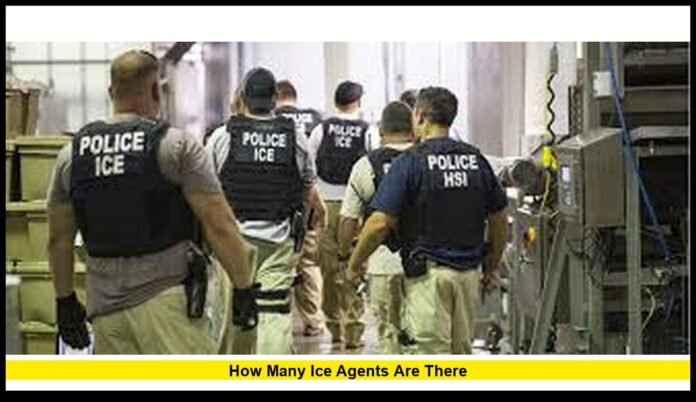

As of the most recent confirmed staffing reports, ICE employs approximately 20,000 total personnel nationwide. This figure includes both sworn law enforcement agents and non-law-enforcement support staff.
This article provides a clear, factual breakdown of how many ICE agents are currently employed, how the agency is structured, and what those staffing levels mean today. All figures reflect the most recently confirmed staffing data available as of today and are presented for a U.S. audience.
Understanding ICE and Its Role
Immigration and Customs Enforcement (ICE) is a key federal law enforcement agency within the U.S. Department of Homeland Security (DHS). It was established in 2003 following the creation of DHS, with the mission of protecting the United States from cross-border crime, unauthorized immigration, and threats to public safety and national security.
ICE’s work is organized primarily through two major operational divisions. The first is Enforcement and Removal Operations (ERO), which focuses on enforcing immigration laws within the United States. ERO officers identify, arrest, detain, and remove non-citizens who are in violation of U.S. immigration law, with priority often given to individuals with serious criminal convictions, national security concerns, or recent unlawful entry. This division also manages detention facilities and oversees alternatives-to-detention programs.
The second major division is Homeland Security Investigations (HSI), which handles a wide range of criminal investigations. HSI agents target transnational crimes such as human trafficking, drug smuggling, money laundering, cybercrime, intellectual property theft, weapons trafficking, and financial crimes that have international connections. HSI is one of the largest investigative components of DHS and often works jointly with the FBI, DEA, local police departments, and foreign law enforcement agencies.
ICE operates in all 50 U.S. states and maintains offices in numerous countries, allowing it to coordinate with international partners on cross-border investigations and deportation logistics. Its personnel include special agents, deportation officers, intelligence analysts, attorneys, and support staff, each playing a role in the agency’s law enforcement, legal, and administrative functions.
Overall, ICE’s role combines immigration enforcement with broader criminal and national security investigations, making it a central agency in the federal government’s efforts to address illegal migration, combat global crime networks, and safeguard U.S. borders and communities.
How Many ICE Agents Are There Today
As of the most recent confirmed staffing reports, Immigration and Customs Enforcement employs approximately 20,000 total personnel across the United States. This figure represents the agency’s full workforce and includes both sworn law enforcement officers and a wide range of civilian employees who support daily operations.
Within that total, about 13,000 are sworn agents and officers. These personnel work primarily in ICE’s two main operational branches: Enforcement and Removal Operations (ERO), which carries out immigration enforcement and detention, and Homeland Security Investigations (HSI), which conducts criminal investigations into transnational crime, trafficking, financial fraud, cybercrime, and national security threats.
The remaining roughly 7,000 employees serve in non-sworn roles. They include attorneys, intelligence analysts, mission support specialists, detention management staff, information technology professionals, and administrative personnel. These positions are essential for case processing, legal proceedings, intelligence coordination, logistics, and the overall functioning of the agency.
Together, this combined workforce enables ICE to operate nationwide and internationally, supporting immigration enforcement, criminal investigations, and national security missions on a daily basis.
Breakdown of ICE’s Two Main Enforcement Divisions
ICE’s law enforcement workforce is primarily organized into two major operational branches, each with distinct responsibilities and staffing roles:
Enforcement and Removal Operations (ERO)
- Enforces U.S. immigration laws within the country.
- Identifies, arrests, detains, and removes individuals who are in violation of immigration law.
- Manages immigration detention facilities and transportation.
- Oversees alternatives-to-detention programs, such as monitoring and reporting requirements.
- Works closely with state and local law enforcement agencies on custody transfers and deportation proceedings.
- Staffed mainly by deportation officers, detention enforcement officers, and support personnel.
Homeland Security Investigations (HSI)
- Conducts criminal investigations involving cross-border and transnational crimes.
- Targets offenses such as human trafficking, drug smuggling, money laundering, cybercrime, weapons trafficking, and intellectual property theft.
- Handles national security–related investigations, including counterterrorism and export control violations.
- Operates both domestically and through international offices in coordination with foreign law enforcement.
- Staffed primarily by special agents, intelligence analysts, forensic specialists, and investigative support teams.
Each division serves a distinct function: ERO focuses on civil immigration enforcement and removals, while HSI functions as a broad criminal investigative arm addressing complex international and national security threats.
Enforcement and Removal Operations (ERO) Staffing
Enforcement and Removal Operations (ERO) is the ICE division responsible for carrying out immigration enforcement within the United States. Its mission centers on identifying, arresting, detaining, and removing individuals who are in violation of U.S. immigration laws.
Key staffing and operational details:
- Employs approximately 6,100 sworn law enforcement officers nationwide.
- Operates through more than 200 field offices and sub-offices across all 50 states and U.S. territories.
- Officers include deportation officers, detention enforcement officers, and fugitive operations teams.
- Manages and oversees immigration detention facilities, transportation, and transfer operations.
- Handles the execution of final orders of removal issued by immigration courts.
- Often works in coordination with local, state, and federal law enforcement agencies.
- ERO officers are typically the most publicly visible ICE personnel, as they conduct arrests, court transfers, and removals.
- Primary focus is on individuals subject to:
- Final deportation orders
- Criminal convictions
- National security or public safety concerns
- Recent unlawful entry
ERO serves as the front-line enforcement arm of ICE, carrying out civil immigration law through custody operations, detention management, and removals from the United States.
Homeland Security Investigations (HSI) Staffing
Homeland Security Investigations (HSI) serves as the principal criminal investigative arm of ICE. Its agents handle complex cases that often extend beyond immigration and involve serious federal and international crimes.
Current confirmed staffing and structure:
- Employs approximately 7,000 special agents nationwide.
- Agents are assigned to field offices across the United States and to international attaché offices in dozens of countries.
- Conducts long-term, multi-jurisdictional investigations that can span months or years.
- Works closely with:
- FBI
- DEA
- ATF
- U.S. Secret Service
- State and local law enforcement
- Foreign police and security agencies
- Investigative focus includes:
- Transnational organized crime
- Human trafficking and exploitation
- Drug and weapons smuggling
- Cybercrime and financial fraud
- Intellectual property theft
- National security and counterterrorism cases
- HSI special agents are federal criminal investigators with:
- Authority to carry firearms
- Authority to execute search and arrest warrants
- Powers similar to those of FBI and DEA agents
HSI’s staffing and global presence allow it to function as a full-scale federal investigative agency, addressing sophisticated criminal networks and national security threats that cross U.S. borders.
Combined Law Enforcement Strength
When combining officers from Enforcement and Removal Operations (ERO) and agents from Homeland Security Investigations (HSI), U.S. Immigration and Customs Enforcement (ICE) maintains an estimated force of approximately 13,000 sworn law enforcement personnel nationwide. These officers and agents are responsible for carrying out arrests, conducting criminal investigations, executing search warrants, performing surveillance operations, and leading a wide range of federal enforcement actions.
This total reflects only sworn personnel with direct law enforcement authority and does not include support staff such as attorneys, intelligence analysts, administrative professionals, or other non-sworn employees who play critical roles in supporting ICE operations.
Support Staff and Non-Agent Personnel
Beyond sworn agents, ICE relies on thousands of additional employees to function effectively.
These roles include:
- Immigration attorneys
- Intelligence analysts
- Case managers
- IT specialists
- Administrative staff
Support personnel account for roughly 7,000 positions, bringing ICE’s total workforce to around 20,000 employees.
How ICE Staffing Has Changed Over Time
Staffing levels at U.S. Immigration and Customs Enforcement have fluctuated over the years, largely influenced by congressional budget allocations, shifting presidential administrations, evolving immigration policies, and broader national security priorities.
In recent years, several key trends have emerged:
- Relatively stable overall staffing numbers: While funding debates have been frequent, the total number of sworn personnel has remained comparatively steady rather than expanding dramatically.
- Targeted growth in investigative roles: There has been modest growth in specialized investigative positions, particularly within areas focused on transnational crime, cyber investigations, human trafficking, and financial crimes.
- Greater emphasis on technology and intelligence: Investments have increasingly prioritized digital forensics, data analytics, intelligence coordination, and surveillance capabilities, reflecting a broader modernization of enforcement strategy.
Although the overall headcount of ICE agents has not seen substantial spikes in recent years, the agency’s internal resource allocation has evolved. More emphasis is now placed on intelligence-driven enforcement, interagency collaboration, and technological capabilities, signaling a strategic shi
Budget and Staffing Limits
Staffing levels at U.S. Immigration and Customs Enforcement are directly tied to congressional appropriations. Each fiscal year, Congress determines funding levels that authorize how many positions the agency can fill, how many new personnel can be hired, and how resources are distributed across operational divisions.
Authorized staffing numbers are not solely based on agency preference. Instead, they are shaped by federal budget negotiations, legislative priorities, and broader homeland security funding decisions. Even when operational demands increase, hiring expansions require formal approval and allocated funding.
Several core factors influence staffing decisions:
- National enforcement priorities: Shifts in immigration enforcement strategy, border security focus, or transnational crime initiatives can lead to reallocating personnel or expanding specific units.
- Detention capacity: The availability of detention beds and funding for detention operations affects the number of officers needed for custody management, transportation, and removal operations.
- Investigative caseloads: Growth in complex cases—such as human trafficking, cybercrime, financial crimes, or narcotics investigations—can increase demand for specialized agents.
- Technology and support needs: Investments in intelligence systems, digital forensics, surveillance tools, and data analysis may shift resources toward technical specialists and support personnel.
Ultimately, these budgetary and operational considerations determine how many ICE agents are hired, reassigned, or maintained each year. Rather than fluctuating solely based on enforcement rhetoric, staffing levels are primarily governed by funding authority and strategic resource planning.
Where ICE Agents Are Located
Agents from U.S. Immigration and Customs Enforcement are stationed throughout the United States, with deployments strategically aligned to enforcement priorities, population density, and operational demands.
While ICE maintains a nationwide footprint, staffing concentrations are typically found in:
- Border states: States along the U.S.–Mexico and U.S.–Canada borders often have a higher presence of enforcement personnel due to immigration enforcement activity and cross-border crime investigations.
- Large metropolitan areas: Major cities generate significant investigative caseloads involving financial crimes, human trafficking, cybercrime, and organized criminal networks.
- Transportation hubs: Airports, seaports, and major logistics centers are key locations for monitoring international travel and trade-related violations.
- Regions with federal detention facilities: Areas that house ICE detention centers require officers to manage custody operations, detainee transport, and removal proceedings.
In addition to domestic offices, agents from Homeland Security Investigations (HSI) are assigned to international field offices. These overseas postings support cross-border investigations, coordinate with foreign law enforcement agencies, and address transnational criminal organizations operating beyond U.S. borders.
Overall, ICE agent deployment reflects a combination of geographic need, investigative workload, detention infrastructure, and national security considerations.
What ICE Agents Do Day to Day
The daily responsibilities of personnel at U.S. Immigration and Customs Enforcement vary significantly depending on their division, assignment, and operational focus. ICE operates through two primary enforcement branches, each with distinct missions and workloads.
Enforcement and Removal Operations (ERO)
Officers in Enforcement and Removal Operations concentrate primarily on immigration enforcement and detention management. Their routine duties often include:
- Immigration arrests: Locating and apprehending individuals subject to removal orders or immigration violations.
- Custody transfers: Coordinating the movement of detainees between facilities, courts, and other jurisdictions.
- Removal coordination: Managing deportation logistics, including travel documentation and coordination with foreign governments.
- Compliance checks: Monitoring individuals enrolled in alternatives-to-detention programs to ensure adherence to court or supervision requirements.
ERO officers frequently work in detention facilities, field offices, and court settings, balancing enforcement responsibilities with administrative and legal coordination.
Homeland Security Investigations (HSI)
Agents within Homeland Security Investigations (HSI) focus on complex criminal investigations that often extend beyond immigration enforcement. Their day-to-day work may involve:
- Criminal investigations: Targeting transnational criminal organizations involved in narcotics trafficking, weapons smuggling, and other federal offenses.
- Human trafficking and exploitation cases: Investigating networks involved in labor trafficking, sex trafficking, and child exploitation crimes.
- Financial crimes: Probing money laundering, bulk cash smuggling, and fraud schemes.
- Cybercrime and document fraud: Addressing online criminal activity, identity fraud, and counterfeit documentation operations.
HSI agents typically conduct surveillance, execute search warrants, analyze digital evidence, and collaborate with federal, state, local, and international partners.
Why the Roles Are Split
This division of labor explains why ICE staffing numbers are distributed across distinct operational categories. While both divisions carry federal law enforcement authority, their missions differ substantially—one centered on immigration custody and removal, the other on broader criminal investigations with national and international scope.
How ICE Compares to Other Federal Agencies
ICE’s law enforcement workforce is smaller than some federal agencies and larger than others.
In general terms:
- ICE employs fewer agents than the FBI
- ICE employs more agents than several specialized federal units
- ICE relies heavily on interagency cooperation
These comparisons help place ICE’s staffing size in context.
Public Attention on ICE Staffing
The question of how many ICE agents are there often surfaces during debates about immigration enforcement.
Public interest tends to increase during:
- High-profile enforcement actions
- Policy changes
- Congressional budget discussions
Staffing levels influence how policies are carried out on the ground.
Why Staffing Numbers Matter
The number of ICE agents directly affects:
- Enforcement capacity
- Case processing times
- Detention and removal operations
- Investigative reach
Limited staffing can slow operations, while expanded staffing increases enforcement activity.
Oversight and Accountability
ICE agents operate under federal oversight and internal accountability systems.
Staffing levels are reviewed through:
- Budget oversight
- Inspector General audits
- Internal performance reviews
These processes help ensure agents are deployed effectively.
Training and Hiring Standards
ICE agents undergo extensive training before entering the field.
Requirements include:
- Federal law enforcement training
- Background checks
- Ongoing professional development
Hiring standards influence how quickly staffing levels can change.
Current Outlook for ICE Staffing
As of today, ICE staffing levels remain stable, with no confirmed large-scale expansion or reduction announced.
Officials continue to focus on:
- Efficient deployment
- Technology-supported enforcement
- Targeted investigations
Any future changes would depend on federal funding and policy direction.
Key Takeaway
So, how many ICE agents are there? The most accurate current answer is about 13,000 sworn law enforcement agents, supported by roughly 7,000 additional employees, for a total workforce of around 20,000 people nationwide.
These numbers define ICE’s capacity to carry out its mission today.
What are your thoughts on ICE staffing levels and their role in enforcement today? Join the discussion or stay connected for updates as policies evolve.