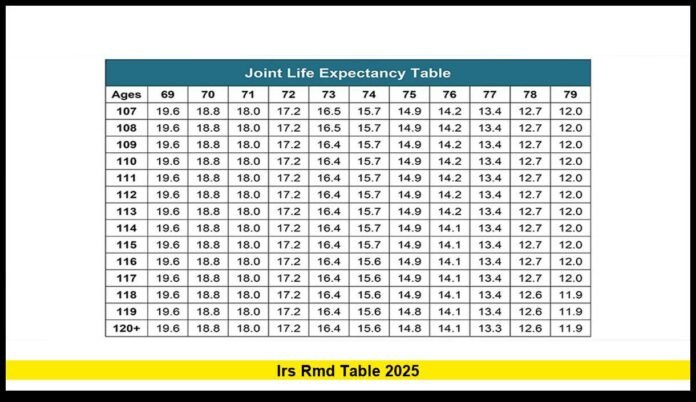

The IRS RMD Table for 2026 continues to use the updated life expectancy factors introduced in recent years, helping many retirees withdraw slightly smaller required minimum distributions from retirement accounts compared to older tables.
The IRS RMD table 2026 is now one of the most important reference points for retirees who must calculate their required minimum distributions for the year. With the age for mandatory withdrawals now set at 73 and the updated rules still in effect for 2026, Americans using tax-deferred retirement accounts need accurate numbers and clear guidance to stay compliant.
Latest Updates for the IRS RMD Table 2026
The IRS continues to use the updated life-expectancy tables that went into effect in recent years, meaning the distribution periods (or “life-expectancy factors”) shown in the IRS RMD table 2026 remain the current standard for calculation.
Here are the most important verified updates for 2026:
- The RMD age remains 73. Anyone who turns 73 in 2026 must take their first required minimum distribution.
- The Uniform Lifetime Table remains the default table for most IRA and 401(k) account owners and is still used to calculate annual withdrawal amounts based on age and account balance.
- The first RMD must be taken by April 1 of the year following the year you turn 73. All later RMDs must be taken by December 31 each year.
- Retirees who delay their first RMD until April 1 may still need to take a second distribution in the same calendar year, which could increase taxable income.
- The excise tax penalty for missing an RMD is 25%, which may be reduced to 10% if corrected promptly and reported properly to the IRS.
- Roth IRAs still have no RMDs for original owners. Roth 401(k) plans are free from RMDs beginning in 2025 and continuing into 2026.
- Inherited retirement accounts continue to follow separate beneficiary distribution rules, including the 10-year withdrawal rule for many non-spouse heirs.
- Account balances used to calculate 2026 RMDs are based on the retirement account value as of December 31, 2025.
- Financial institutions generally continue to provide estimated RMD calculations, but retirees remain responsible for ensuring withdrawals are accurate and completed on time.
- Retirees with multiple traditional IRAs may combine RMD amounts and withdraw from one or several IRA accounts, although separate rules still apply for many employer-sponsored plans such as 401(k)s.
- Qualified charitable distributions (QCDs) remain available for eligible IRA owners and can still help reduce taxable income while satisfying RMD requirements for qualifying individuals.
Understanding How the IRS RMD Table 2026 Works
The IRS Required Minimum Distribution (RMD) table helps retirees determine the minimum amount they must withdraw from certain retirement accounts each year. For 2026, most retirement account owners will continue using the IRS Uniform Lifetime Table to calculate their annual RMD. Understanding how the table works can help you stay compliant with IRS rules and avoid unnecessary penalties.
The Basic RMD Formula
Calculating your RMD is relatively simple. The IRS requires you to divide your retirement account balance from the end of the previous year by the distribution period listed in the applicable IRS table.
RMD Formula:
Prior Year Account Balance ÷ Distribution Period = RMD Amount
For example, if your IRA balance was $500,000 on December 31, 2025, and your distribution factor for age 75 is 24.6, your RMD would be approximately $20,325 for 2026.
Use Your Previous Year’s Account Balance
One of the most important steps in calculating an RMD is using the correct account value. The IRS requires account holders to use the balance as of December 31 of the previous year.
This means your 2026 RMD is based on the value of your retirement account on December 31, 2025, regardless of market gains or losses that occur afterward. Because investment values fluctuate, your required withdrawal may not reflect the current value of your account when you actually take the distribution.
Finding the Correct Distribution Factor
The IRS Uniform Lifetime Table assigns a life-expectancy factor to each age. These factors are designed to estimate how long retirement savings may need to last.
To calculate your RMD:
- Determine your age during 2026.
- Find your age on the IRS Uniform Lifetime Table.
- Locate the corresponding distribution period.
- Divide your prior-year account balance by that factor.
As you age, the distribution factor gradually decreases. Because the divisor becomes smaller, the amount you are required to withdraw generally increases over time.
Why Distribution Factors Matter
The distribution factor is the number that determines how much of your retirement account must be withdrawn each year.
A larger distribution factor results in a smaller required withdrawal because you are dividing your account balance by a larger number.
A smaller distribution factor results in a larger required withdrawal because the divisor is lower.
This reflects the IRS assumption that retirees have fewer remaining years of life expectancy as they get older.
For example, a 73-year-old uses a factor of 26.5, while a 90-year-old uses a factor of 12.2. As the factor decreases, the percentage of the account that must be withdrawn increases.
Most Retirees Use the Uniform Lifetime Table
The vast majority of retirement account owners use the Uniform Lifetime Table when calculating their RMDs.
However, there are exceptions. Some retirees may need to use a different IRS table based on their beneficiary situation.
For example, individuals whose spouse is the sole beneficiary and more than ten years younger may qualify to use the Joint and Last Survivor Life Expectancy Table. Certain inherited retirement accounts may also require separate beneficiary calculation methods.
Using the correct IRS table is important because different tables can produce different withdrawal amounts.
Financial Institutions May Provide RMD Estimates
Many banks, brokerage firms, and retirement account custodians calculate estimated RMD amounts for customers each year.
While these calculations can be helpful, the responsibility for taking the correct RMD ultimately belongs to the account owner. If a custodian makes an error or does not account for all retirement accounts, the account holder remains responsible for meeting IRS requirements.
For this reason, many retirees verify their RMD calculations independently or consult a financial advisor.
RMDs Change Every Year
Your required minimum distribution is not a fixed amount. It changes annually because both your account balance and your age factor change over time.
Your retirement account may grow or decline depending on market performance and withdrawals. At the same time, the IRS distribution factor generally decreases as you age.
These two variables mean that your RMD amount must be recalculated every year.
Taking More Than the Minimum Does Not Reduce Future RMDs
Many retirees withdraw more than the required minimum amount for living expenses or financial planning purposes.
Although larger withdrawals are permitted, they do not reduce future RMD obligations. Each year’s RMD must be calculated independently using that year’s account balance and applicable IRS distribution factor.
In other words, taking extra withdrawals in 2026 does not lower your required minimum distribution for 2027.
Penalties for Missing an RMD
Failing to withdraw the full required amount can lead to IRS penalties on the amount that should have been withdrawn.
While the IRS may provide relief in certain situations when mistakes are corrected promptly, retirees should make every effort to take their RMD before the applicable deadline.
Careful planning and annual review of retirement accounts can help avoid penalties and administrative complications.
Why Understanding the IRS RMD Table Matters
The IRS RMD Table 2026 serves as the foundation for calculating mandatory withdrawals from retirement accounts. By understanding how distribution factors work, using the correct account balance, and applying the appropriate IRS life-expectancy table, retirees can accurately determine their required withdrawals and remain compliant with federal tax rules.
A solid understanding of the RMD process can help retirees manage retirement income more effectively, avoid penalties, and make informed financial decisions throughout retirement.
Excerpt of the IRS RMD Table 2026
Below is a clear snapshot of the Uniform Lifetime Table as it applies to common ages:
| Age | Distribution Period (Years) |
|---|---|
| 73 | 26.5 |
| 74 | 25.5 |
| 75 | 24.6 |
| 76 | 23.7 |
| 77 | 22.9 |
| 78 | 22.0 |
| 79 | 21.1 |
| 80 | 20.2 |
| 85 | 16.0 |
| 90 | 12.2 |
| 95 | 9.0 |
| 100 | 6.4 |
These figures allow retirees to calculate withdrawals with precision.
Example: How to Apply the IRS RMD Table for 2026
Let’s look at a simple example of how the IRS Required Minimum Distribution (RMD) calculation works in 2026.
Suppose you turn 80 years old in 2026, and your retirement account balance on December 31, 2025, was $100,000.
According to the IRS Uniform Lifetime Table, the distribution period for age 80 is 20.2.
To calculate your RMD, use the following formula:
RMD = Account Balance ÷ Distribution Factor
$100,000 ÷ 20.2 = $4,950.50
As a result, your required minimum distribution for 2026 would be approximately $4,950.50.
Step-by-Step Breakdown
Retirement Account Balance: $100,000
IRS Distribution Factor (Age 80): 20.2
Calculation: $100,000 ÷ 20.2
Required Minimum Distribution: Approximately $4,950.50
This is the minimum amount you must withdraw from your eligible retirement account during 2026 to satisfy IRS requirements.
Why This Example Matters
This example shows how the IRS Uniform Lifetime Table converts your retirement savings into an annual minimum withdrawal requirement. The larger your account balance, the larger your RMD is likely to be. Likewise, as you age and the distribution factor decreases, the percentage of your account that must be withdrawn generally increases.
Important Notes
- Failing to withdraw the full required amount by the IRS deadline may result in penalties on the amount not withdrawn.
- RMD withdrawals are generally treated as taxable income unless the funds come from a qualified Roth account that is exempt from RMD requirements.
- You may withdraw more than the required minimum amount if needed, but extra withdrawals do not reduce future RMD obligations.
- If you own multiple traditional IRA accounts, IRS rules generally allow you to calculate each account’s RMD separately and then withdraw the combined total from one or more IRAs.
- RMD amounts must be recalculated every year because both your account balance and age factor can change.
By understanding this simple calculation, retirees can better plan their annual withdrawals, manage taxable income, and remain compliant with IRS retirement distribution rules.
Why the IRS RMD Table 2026 Matters
The IRS Required Minimum Distribution (RMD) rules are designed to ensure that retirement savings accumulated in tax-deferred accounts are eventually subject to taxation. Because contributions and investment earnings in many retirement accounts can grow tax-deferred for decades, the government requires account holders to begin taking distributions once they reach the applicable age.
Understanding and correctly applying the IRS RMD Table 2026 is important not only for meeting legal requirements but also for making informed retirement income decisions. A clear understanding of how the table works can help retirees avoid penalties, manage taxes, and create a more effective long-term financial strategy.
It Determines Your Minimum Required Withdrawal
The primary purpose of the IRS RMD table is to determine the minimum amount you must withdraw from eligible retirement accounts each year.
The table assigns a life-expectancy factor based on age. This factor is then used to calculate the minimum withdrawal required under IRS rules. Without the correct distribution factor, it is impossible to accurately determine your annual RMD obligation.
Using the Wrong Factor Can Lead to Costly Mistakes
Even a small calculation error can have consequences.
If you use the wrong distribution period or apply an incorrect IRS table, you may withdraw less than the required amount. Under-withdrawing can expose you to IRS penalties and additional administrative complications.
Using the correct factor ensures that your withdrawal satisfies federal requirements and helps you avoid unnecessary issues with the IRS.
Failure to Meet RMD Requirements May Trigger Penalties
One of the biggest reasons the IRS RMD table matters is the potential penalty for failing to withdraw the full required amount.
If an account holder does not take the complete RMD by the applicable deadline, the IRS may impose an excise tax on the portion that was not withdrawn. While relief may be available in certain circumstances, avoiding the mistake altogether is the best approach.
Accurate calculations help ensure compliance and reduce the likelihood of costly penalties.
RMD Planning Helps Manage Taxable Income
Required Minimum Distributions are generally taxable as ordinary income.
As a result, the amount withdrawn each year can affect your overall tax situation. Knowing your expected RMD in advance allows you to estimate taxable income and make adjustments to your broader financial plan.
Proper planning can help retirees better understand how withdrawals may affect tax brackets, deductions, credits, and other aspects of their financial picture.
Larger Withdrawals Can Increase Tax Burdens
Although retirees are free to withdraw more than the minimum amount, larger withdrawals may create unintended tax consequences.
Taking significantly more than the required amount could push a retiree into a higher federal income tax bracket. It may also increase income-related Medicare costs or affect the taxation of other retirement income sources.
Understanding the minimum required amount gives retirees greater flexibility when deciding how much additional money, if any, should be withdrawn.
Better Planning Reduces Financial Surprises
Retirees who understand their RMD obligations are less likely to face unexpected tax bills or year-end withdrawal issues.
Knowing upcoming mandatory distributions allows individuals to plan cash flow needs, schedule withdrawals strategically, and coordinate retirement income throughout the year.
This proactive approach can reduce stress and improve overall financial management during retirement.
Supports Long-Term Retirement Strategies
RMD calculations play an important role in broader retirement planning.
Understanding future withdrawal requirements can help retirees:
- Develop realistic retirement spending plans.
- Manage investment withdrawals more efficiently.
- Support estate planning objectives.
- Evaluate charitable giving opportunities.
- Plan for future healthcare and long-term care expenses.
- Coordinate tax strategies across multiple retirement accounts.
Because RMDs affect both income and taxes, they often become a central part of comprehensive retirement planning.
Helps Coordinate Multiple Sources of Retirement Income
Most retirees receive income from several sources, including Social Security benefits, pensions, annuities, investment income, and retirement account withdrawals.
Understanding how RMDs fit into the overall income picture allows retirees to coordinate these sources more effectively. This can improve cash-flow planning and help minimize unexpected tax consequences throughout retirement.
Makes Financial Planning More Predictable
One of the greatest benefits of understanding the IRS RMD Table 2026 is predictability.
Because the IRS provides age-based distribution factors in advance, retirees can estimate future mandatory withdrawals years ahead of time. This makes budgeting, tax planning, and investment management much easier.
By knowing what withdrawals will likely be required in future years, retirees can make more informed decisions about spending, saving, gifting, and preserving wealth.
How to Use the IRS RMD Table 2026 for Multiple Retirement Accounts
Many retirees own more than one retirement account, making Required Minimum Distribution (RMD) calculations slightly more complex. While the IRS RMD Table 2026 is used to determine the required withdrawal amount for each eligible account, the rules for taking those withdrawals vary depending on the type of retirement account involved.
Understanding these differences can help retirees remain compliant with IRS regulations and avoid unnecessary penalties.
Traditional IRAs
If you own multiple Traditional IRA accounts, the IRS requires you to calculate the RMD separately for each IRA using the applicable distribution factor from the IRS Uniform Lifetime Table.
However, once those individual RMD amounts have been calculated, the IRS generally allows you to combine the totals and withdraw the full required amount from a single IRA or from any combination of your IRA accounts.
For example, if:
- IRA Account A has an RMD of $3,000
- IRA Account B has an RMD of $2,000
- IRA Account C has an RMD of $1,000
Your total IRA RMD would be $6,000. You could withdraw:
- The entire $6,000 from one IRA account, or
- Portions from multiple IRA accounts that add up to $6,000
This flexibility allows retirees to manage investments and cash flow more efficiently.
401(k) Plans
The rules are different for 401(k) plans.
If you have multiple 401(k) accounts, you generally must calculate the RMD for each account separately and take the required withdrawal from each specific 401(k).
Unlike Traditional IRAs, IRS rules generally do not allow you to aggregate multiple 401(k) RMDs and satisfy the requirement through a single withdrawal from one account.
For example:
- 401(k) Account A requires a $4,000 RMD
- 401(k) Account B requires a $2,500 RMD
You must withdraw:
- $4,000 from Account A, and
- $2,500 from Account B
Taking the entire $6,500 from only one of the accounts would generally not satisfy IRS requirements.
Roth IRAs
For original account owners, Roth IRAs remain one of the most favorable retirement accounts from an RMD perspective.
No Required Minimum Distributions apply to Roth IRAs during the owner’s lifetime, including in 2026.
Because contributions to Roth IRAs are generally made with after-tax dollars, the IRS does not require original owners to take mandatory annual withdrawals.
This allows Roth IRA assets to continue growing tax-free for as long as the owner chooses.
Why These Differences Matter
Understanding which accounts can be aggregated and which cannot is essential for proper RMD compliance.
Common mistakes include:
- Combining RMDs from different account types incorrectly.
- Assuming 401(k) withdrawals can be aggregated like IRA withdrawals.
- Forgetting to calculate RMDs for all eligible accounts.
- Overlooking inherited retirement account rules that may have separate requirements.
These errors can result in missed distributions and potential IRS penalties.
Best Practices for Managing Multiple Accounts
Retirees with several retirement accounts can reduce mistakes by:
- Reviewing all account balances each year.
- Calculating RMDs separately for every eligible account.
- Keeping records of withdrawal amounts and dates.
- Confirming which accounts qualify for aggregation.
- Working with a financial advisor or tax professional when needed.
Proper planning makes it easier to satisfy IRS requirements while maintaining control over retirement income and investment strategies.
What Has Not Changed for 2026
For retirees and retirement account owners, one of the most important updates for 2026 is that there have been no significant changes to the IRS Required Minimum Distribution (RMD) calculation framework. The rules that applied in recent years largely remain intact, providing continuity and predictability for retirement planning.
The IRS continues to use the same life-expectancy tables that became effective in 2022, and there are no new calculation methods or withdrawal procedures that affect most account holders in 2026.
No Changes to the RMD Distribution Factors
The distribution periods, often referred to as RMD denominators, remain unchanged for 2026.
Retirees will continue using the same IRS Uniform Lifetime Table factors that have been in place since the updated life-expectancy tables were introduced. As a result, account holders can calculate their RMDs using the same age-based factors that were used in previous years.
This consistency makes annual retirement planning easier and helps prevent confusion when calculating required withdrawals.
No Changes to the Calculation Method
The basic RMD formula remains exactly the same.
Retirement account owners must continue to:
- Determine the account balance as of December 31 of the previous year.
- Find the appropriate distribution factor based on their age.
- Divide the account balance by the applicable life-expectancy factor.
- Withdraw at least the resulting amount during the year.
The IRS has not introduced any new formulas, additional calculation steps, or alternative methods for determining required minimum distributions.
No Changes to Withdrawal Timing Rules
The timing requirements for taking RMDs also remain unchanged.
Eligible account owners must continue to satisfy annual withdrawal requirements within the IRS deadlines. The established rules regarding first-year RMDs, subsequent annual withdrawals, and applicable deadlines remain in effect.
Retirees can therefore continue following the same withdrawal schedules they have used in recent years.
The Current RMD Framework Remains Stable
Because there have been no major regulatory revisions affecting RMD calculations, retirees can generally rely on existing planning strategies.
Financial advisors, tax professionals, and retirement account custodians are continuing to use the same life-expectancy tables, calculation procedures, and compliance standards that have governed RMDs over the past several years.
This stability provides retirees with greater confidence when planning annual income needs and tax obligations.
The RMD Age Increase to 75 Has Not Yet Taken Effect
Although federal law includes a future increase in the RMD starting age, that change does not affect current retirees in 2026.
Under the SECURE 2.0 Act, the age at which certain individuals must begin taking RMDs will eventually rise to 75 beginning in 2033.
Until then, existing age-based RMD requirements remain in place for those already subject to mandatory distributions. As a result, retirees calculating RMDs for 2026 should continue following the current rules applicable to their age and retirement account type.
Inherited IRA Rules Remain Separate
Another area that remains unchanged is the treatment of inherited retirement accounts.
Beneficiaries of inherited IRAs are generally subject to a separate set of IRS rules that differ from those applicable to original account owners.
Withdrawal requirements depend on factors such as:
- Whether the beneficiary is classified as an eligible designated beneficiary.
- Whether the beneficiary is a designated beneficiary subject to the 10-year rule.
- The date of the original account owner’s death.
- The type of retirement account involved.
Because inherited IRA regulations can be complex, beneficiaries should not assume that the standard Uniform Lifetime Table rules apply to their situation.
Why Stability Matters for Retirees
The absence of major changes for 2026 is good news for many retirees. Stable rules make it easier to:
- Estimate future withdrawal obligations.
- Plan retirement income strategies.
- Manage annual tax liabilities.
- Coordinate RMDs with Social Security benefits and pensions.
- Avoid calculation errors and compliance issues.
When the regulatory framework remains consistent, retirees can focus more on financial planning and less on adapting to new requirements.
Tips for Managing RMDs in 2026
To make the most of the IRS RMD table 2026:
- Double-check your year-end balances.
- Plan early in the year, not in December.
- Avoid taking two RMDs in the same tax year unless necessary.
- Consider withholding taxes directly from the RMD to simplify tax filing.
- Review your situation if your spouse is more than 10 years younger, since a different IRS table may reduce your RMD.
- Consult a financial professional for complex situations, such as inherited accounts or multiple employer plans.
Small mistakes can lead to big penalties. Planning ahead ensures compliance and smoother withdrawals.
Final Thoughts
The IRS RMD table 2026 remains a vital tool for U.S. retirees managing tax-deferred retirement accounts. Understanding the table, keeping track of deadlines, and calculating withdrawals accurately help you stay compliant while protecting your retirement income strategy.
If you have questions about using the IRS RMD table 2026 for your own retirement planning, feel free to share them in the comments below.