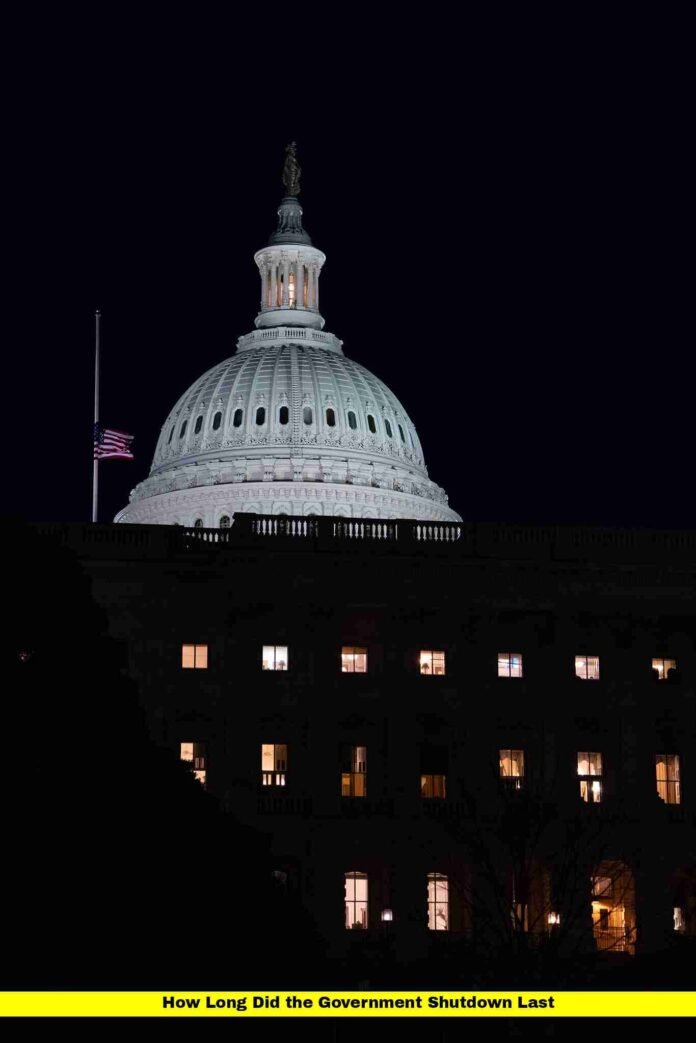

The question how long did the government shutdown last has finally been answered. The most recent U.S. government shutdown of 2025 lasted 43 days, marking it as the longest federal funding lapse in American history. From October 1 to November 12, 2025, government operations were partially frozen, millions of workers were affected, and the economy faced mounting pressure. Here’s a complete look at the shutdown’s duration, impact, and what happens next.
The Official Duration of the Shutdown
The 2025 government shutdown began at midnight on October 1, 2025, when Congress failed to pass a funding bill before the deadline. It officially ended on November 12, 2025, after both chambers of Congress approved a bipartisan agreement to reopen the government.
In total, the shutdown spanned 43 full days, surpassing the previous record of 35 days set in early 2019. This duration made it the longest federal government shutdown in U.S. history. During that time, thousands of public services were disrupted, and federal employees across various departments were either furloughed or required to work without pay.
Why the Shutdown Lasted So Long
The 43-day shutdown wasn’t simply the result of a missed budget deadline. It was the outcome of deep political disagreements over several critical funding issues. Lawmakers in both parties were divided over healthcare spending provisions, Affordable Care Act subsidy extensions, and long-term budget reforms.
Multiple short-term funding proposals failed in both chambers as leaders struggled to find a middle ground. The political standoff became a test of endurance between the administration and Congress, with neither side willing to compromise quickly.
The longer the shutdown continued, the more pressure mounted from affected citizens, federal workers, and state governments. Eventually, bipartisan negotiations began to gain momentum in early November, paving the way for the agreement that finally reopened the government.
Key Dates and Timeline of the Shutdown
The timeline of the 2025 shutdown highlights just how prolonged the political stalemate became:
- October 1, 2025 – The government officially shuts down after budget talks collapse before midnight.
- October 10, 2025 – Federal agencies start reducing non-essential operations, and furloughs are implemented.
- October 20, 2025 – Public protests by unpaid federal workers and union representatives grow across several major cities.
- October 28, 2025 – Economic analysts warn of significant GDP loss if the shutdown continues beyond November.
- November 5, 2025 – Lawmakers report progress on a compromise, but disagreements on healthcare subsidies delay final approval.
- November 11, 2025 – A joint resolution passes the Senate with bipartisan support.
- November 12, 2025 – The House approves the same measure, and the President signs it into law, officially ending the shutdown.
From start to finish, these 43 days tested not only the resilience of the federal workforce but also the patience of the American public.
Read Also-Trump blames Democrats for ‘massive harm’ of shutdown
The Impact on Federal Workers and Services
The 43-day shutdown deeply affected millions of people who rely on federal operations. More than 900,000 government employees were either placed on unpaid leave or required to work without immediate pay. Many missed multiple paychecks, forcing them to rely on savings or local aid programs to cover essentials.
Key public services also suffered:
- Air traffic control operations continued under strain, with limited staffing and overtime burdens.
- National parks saw closures and maintenance backlogs.
- Food safety inspections and small business loan programs experienced significant delays.
- Federal courts and immigration hearings faced postponements, further increasing backlogs.
The Department of Defense, Social Security, and Medicare payments continued since they operate under mandatory funding, but their supporting administrative functions were slowed dramatically.
Economic Consequences of the Shutdown
Economists estimate that the 43-day funding lapse cost the U.S. economy between $7 billion and $11 billion in lost productivity and delayed spending. Many government contractors — particularly small businesses dependent on federal projects — saw contracts frozen and cash flows disrupted.
Consumer confidence dipped during October, and delays in government paychecks had ripple effects on local economies in cities with high concentrations of federal workers, such as Washington, D.C., Denver, and Huntsville.
By the time the shutdown ended, analysts agreed that while the economy would rebound, the prolonged uncertainty had already dampened momentum heading into the final quarter of 2025.
How It Compared to Previous Shutdowns
Before 2025, the longest shutdown in U.S. history lasted 35 days, from December 22, 2018, to January 25, 2019. The 2025 shutdown broke that record by more than a week, becoming a new benchmark for political deadlock.
Unlike previous shutdowns, this one impacted a broader range of services and sectors because of its duration. Federal workers faced the longest delay in paychecks ever recorded, and agencies struggled to manage both backlogged work and employee morale once operations resumed.
The historical comparison underscores how political polarization and unresolved policy disputes have made shutdowns a recurring risk in American governance.
Political Fallout and Reactions
When the shutdown finally ended, reactions poured in from across the political spectrum.
Moderate lawmakers who had supported the final funding bill emphasized that reopening the government was a moral and practical necessity. Progressives, however, criticized the final deal for lacking stronger commitments to healthcare and social programs.
For the administration, the end of the shutdown was a partial victory, restoring federal operations but leaving many contentious issues unresolved. Several members of Congress called for reforms to prevent future shutdowns, such as automatic continuing resolutions that keep the government funded during political disputes.
Public opinion polls conducted immediately afterward showed widespread frustration with both parties. A majority of Americans believed that the shutdown should have been resolved much sooner.
Why Knowing the Shutdown Duration Matters
Understanding how long the government shutdown lasted is more than just a matter of counting days. It reveals the scale of disruption caused by political stalemates and the human cost of legislative inaction.
Each day of a shutdown has tangible consequences — for families missing paychecks, businesses waiting on contracts, and citizens relying on government services. The 43-day record stands as a reminder that these events are not mere political theater but have real, measurable effects on everyday life.
Moreover, the length of the shutdown reflects a growing challenge in U.S. governance: the difficulty of finding bipartisan solutions in an increasingly divided political environment.
The Path Forward After 43 Days
Now that the government has reopened, focus has shifted toward recovery and prevention. Agencies are working to process back pay for employees, restart delayed projects, and address backlogs in public services. However, the temporary funding bill only runs until January 30, 2026, meaning that another funding crisis could arise if Congress fails to reach a longer-term agreement.
This next phase will test whether lawmakers have learned from the 43-day standoff. Many experts urge Congress to adopt automatic funding mechanisms or bipartisan budget frameworks to avoid future disruptions.
The public, meanwhile, remains watchful. After such an extended shutdown, confidence in political leadership will take time to rebuild.
Conclusion
The answer to how long did the government shutdown last is clear — 43 days of halted services, unpaid workers, and stalled progress. It was the longest shutdown in U.S. history and a stark lesson in the consequences of political gridlock.
As the country moves forward, this record-setting closure serves as both a warning and a call to action: America’s leaders must find ways to govern without holding essential services hostage to partisan disputes.
If you experienced the effects of the shutdown — whether as a worker, business owner, or citizen — share your perspective and join the discussion on how the nation can prevent another crisis like this one.