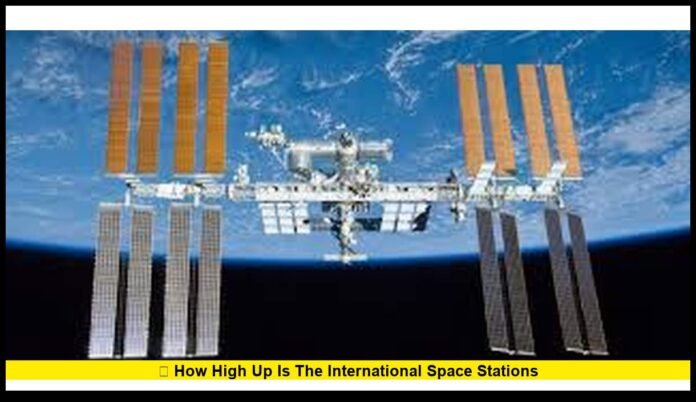

The question how high up is the international space station remains one of the most searched topics about space, especially as interest in human spaceflight continues to grow across the United States. The International Space Station (ISS) orbits Earth at an altitude that generally ranges between about 370 kilometers (230 miles) and 460 kilometers (286 miles), with an average height of roughly 420 kilometers, or about 260 miles above the surface.
This altitude places the ISS in a unique position—far above airplanes and weather systems, yet still relatively close to Earth compared to many satellites. It is this balance that allows astronauts to live and work in orbit while maintaining regular connections with missions on the ground.
A Remarkably Close Outpost in Space
Many people imagine space as an extremely distant frontier, but the ISS is closer than most expect. At about 260 miles above Earth, it sits within what scientists call Low Earth Orbit. This region extends from about 160 kilometers to 2,000 kilometers above the planet.
To put that into perspective, if you could drive straight upward at highway speeds, you could theoretically reach the altitude of the ISS in less than five hours. While that scenario is impossible in reality, it highlights just how “near” the station is on a cosmic scale.
Despite being relatively close, the ISS operates in a completely different environment than anything on Earth. The thin traces of atmosphere at this altitude still influence its movement, and gravity remains strong enough to keep it locked in orbit.
Why the ISS Doesn’t Stay at One Fixed Height
The ISS does not orbit at a constant altitude. Instead, it moves within a controlled range that shifts over time. This is due to several natural and operational factors.
Atmospheric Drag in Low Earth Orbit
Even hundreds of kilometers above Earth, small amounts of atmospheric particles exist. These particles create drag on the station, gradually slowing it down and pulling it closer to Earth.
Regular Orbital Boosts
To counteract this drag, mission teams perform what are known as reboost maneuvers. Visiting spacecraft or onboard propulsion systems fire their engines to raise the station’s altitude back to its target range.
Mission Planning and Safety Adjustments
Altitude changes are also made to align with incoming spacecraft, improve docking conditions, or avoid potential collisions with space debris.
Because of these factors, the ISS constantly shifts within its typical range rather than staying fixed at a single number.
How Fast the ISS Travels Around Earth
The speed of the ISS is just as impressive as its altitude. Orbiting at roughly 17,500 miles per hour (about 28,000 kilometers per hour), the station moves fast enough to circle Earth in about 90 minutes.
This means astronauts aboard the ISS experience:
- Around 16 sunrises and sunsets every day
- Continuous transitions between daylight and darkness
- A constantly changing view of Earth from space
At this speed, the ISS covers the distance from New York to Los Angeles in under 10 minutes.
Why 420 Kilometers Is the Ideal Orbit
The altitude of the ISS is not random. Engineers and scientists carefully selected this range to balance several competing needs.
Efficient Access From Earth
A lower orbit makes it easier for rockets to reach the station. This reduces fuel costs and allows for more frequent missions carrying astronauts, food, equipment, and scientific experiments.
Reduced Atmospheric Resistance
While some atmospheric drag exists, it is low enough at this altitude to allow the station to remain in orbit for extended periods between boosts.
Operational Flexibility
This altitude allows for easier adjustments when necessary, whether to avoid debris or coordinate with visiting spacecraft.
Thermal and Radiation Considerations
The ISS operates within a region where Earth’s magnetic field still provides partial protection from harmful radiation, helping to safeguard astronauts during long missions.
Comparing the ISS to Other Heights
Understanding the station’s altitude becomes easier when compared with other well-known distances:
- Commercial aircraft fly at about 6 to 7 miles above Earth
- The recognized boundary of space begins at about 62 miles
- The ISS orbits at about 260 miles
- Some satellites orbit thousands of miles away
This shows that while the ISS is firmly in space, it is still relatively close in comparison to many other objects orbiting Earth.
Can You See the ISS From the Ground?
Yes, and millions of Americans do each year.
The ISS is one of the brightest objects in the night sky after the Moon and certain planets. Because of its large solar panels, it reflects sunlight, making it visible even when the ground below is dark.
How to Spot It
- Look just after sunset or before sunrise
- Choose a location away from bright city lights
- Watch for a steady, bright object moving quickly across the sky
Unlike airplanes, the ISS does not blink and moves smoothly in a straight path.
Life Aboard the ISS at 260 Miles Up
Living at this altitude presents unique challenges that require constant adaptation.
Microgravity Conditions
Astronauts float continuously due to the station’s constant free-fall around Earth. This environment allows for experiments that cannot be conducted under normal gravity.
Daily Routines in Orbit
Crew members follow strict schedules that include scientific research, exercise, equipment maintenance, and communication with mission control.
Health Considerations
Extended time in microgravity affects muscles, bones, and circulation. Astronauts exercise daily to maintain their health during long missions.
How the ISS Stays in Orbit
The ISS remains in orbit due to a balance between gravity and motion. Earth’s gravity pulls the station inward, while its forward speed keeps it moving sideways.
This combination creates a continuous loop around the planet. Instead of falling straight down, the station keeps missing Earth as it moves forward, resulting in orbit.
Without this precise balance, the ISS would either drift away into space or fall back toward Earth.
Ongoing Operations and Orbital Management
The ISS continues to operate as a key hub for international collaboration in space. Its altitude is constantly monitored and adjusted to ensure safety and efficiency.
- Cargo missions deliver supplies and scientific equipment
- Crew rotations bring new astronauts to the station
- Engineers track debris and adjust the orbit when necessary
- Periodic boosts maintain the station’s altitude within its target range
Plans are also in place for the eventual retirement of the ISS around the end of this decade, with efforts underway to transition to new commercial space stations.
Why This Orbit Still Matters Today
Understanding how high up is the international space station is about more than just numbers. Its altitude plays a crucial role in shaping the future of space exploration.
The ISS serves as a testing ground for technologies that could support missions to the Moon, Mars, and beyond. Its position in Low Earth Orbit allows for rapid testing, iteration, and collaboration between agencies and private companies.
This orbit also supports the growing commercial space industry, which is developing new spacecraft, habitats, and services that will expand access to space in the coming years.
The Future Beyond the ISS
As the ISS approaches the later stages of its operational life, new platforms are being developed to take its place. These future stations are expected to operate at similar altitudes, building on decades of experience gained from the ISS.
The lessons learned from maintaining an orbit around 420 kilometers will continue to influence how humanity lives and works in space.
Final Answer: How High Is the ISS Today?
The International Space Station orbits Earth at an average altitude of about 420 kilometers, or roughly 260 miles. Its altitude typically varies between 370 kilometers and 460 kilometers, depending on operational needs and environmental factors.
Traveling at around 17,500 miles per hour, the ISS completes a full orbit every 90 minutes, making it one of the most dynamic and visible human-made objects in space.
What do you think about life just 260 miles above Earth? Share your thoughts and keep exploring more fascinating space insights right here.