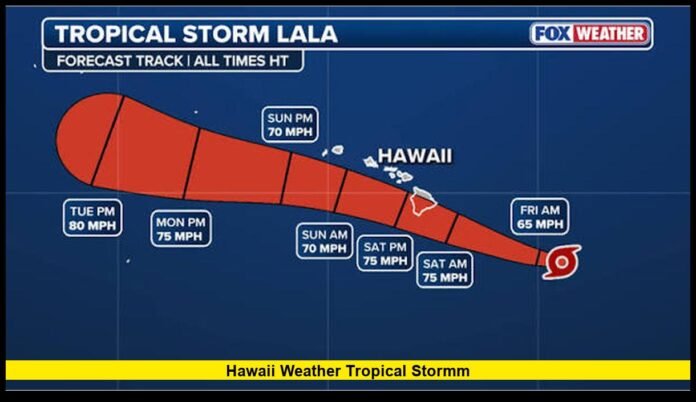

The latest hawaii weather tropical storm situation is becoming increasingly serious as Tropical Storm Lala moves toward the Hawaiian Islands with strengthening winds, torrential rain, dangerous surf and the potential to reach hurricane strength before its closest approach. Officials are urging residents and visitors to complete preparations as quickly as possible, particularly on the Big Island, where the greatest impacts are expected.
Lala was moving west-northwest across the central Pacific on Friday with maximum sustained winds near 60 mph. Forecasters expect additional strengthening before the storm approaches Hawaii, potentially allowing Lala to become a hurricane. The storm is expected to move close to Hawaii Island before its effects spread farther across the island chain.
Tropical Storm Lala Becomes a Major Hawaii Weather Threat
Lala has quickly become the focus of Hawaii’s weather forecast after developing over the central Pacific and organizing into a tropical storm. The system is expected to continue strengthening while approaching the islands, with conditions potentially becoming dangerous before the center reaches Hawaii.
The Big Island faces the most immediate threat. A hurricane warning is in effect for Hawaii County, signaling that hurricane conditions are expected somewhere within the warning area. Maui County is also under a tropical storm warning, while tropical storm watches have been extended to other parts of the island chain.
The storm’s effects are not expected to be limited to the location of its center. Tropical-storm-force winds extend a considerable distance from Lala, while bands of heavy rain can reach areas well away from the core.
That makes preparation particularly important for communities that may not experience a direct passage of the center but could still face flooding, damaging winds and hazardous coastal conditions.
When Will Lala Reach Hawaii?
Forecast guidance indicates that the most significant impacts will begin on Hawaii Island late Friday and into Saturday, followed by worsening conditions across other islands.
The storm is expected to approach the Big Island from the east-southeast and pass near or south of the island. The exact track remains important because even a relatively small shift can change which communities receive the strongest winds and heaviest rainfall.
After affecting Hawaii Island, Lala is expected to continue west-northwest, bringing tropical weather into Maui Nui and potentially toward Oahu and Kauai.
Officials have warned that conditions may remain unsettled for many hours after the center moves away. Tropical moisture can continue producing heavy showers even after the strongest winds have passed.
Big Island Faces the Greatest Risk
Hawaii Island is expected to experience the most severe weather associated with Lala.
The island’s size and mountainous terrain create several different weather environments. Windward locations can receive extreme rainfall when moist tropical air is pushed against the mountains, while exposed coastal and elevated areas can experience stronger winds.
The combination of rain and wind could make travel dangerous.
Roads may become flooded, trees could fall, power lines could be damaged and visibility could deteriorate rapidly. In mountainous areas, heavy rain may also trigger rockfalls, landslides and debris flows.
Residents in vulnerable locations should avoid waiting until the storm is immediately overhead before taking protective measures.
Hurricane Strength Is Possible
A tropical cyclone reaches hurricane status when sustained winds reach at least 74 mph. Lala has already reached sustained winds of about 60 mph, leaving only a relatively modest increase necessary for hurricane classification.
Forecasters expect the storm to strengthen as it approaches Hawaii, although the ultimate intensity will depend on several environmental factors.
Even if Lala becomes only a Category 1 hurricane, residents should not assume that the storm will be minor. A lower-category hurricane can still produce destructive winds, dangerous surf, extensive flooding and significant infrastructure problems.
For Hawaii, rainfall and flooding may ultimately prove more disruptive than the storm’s maximum wind speed.
Heavy Rain Could Become the Biggest Hazard
Flooding is among the most serious concerns associated with Lala.
Forecasts indicate that several areas could receive several inches of rain, while much higher totals are possible in windward and mountainous areas of the Big Island. Some forecasts have placed the highest potential rainfall totals at roughly 25 inches in isolated locations.
Such amounts can overwhelm drainage systems and rapidly raise water levels in streams and rivers.
Flash flooding is particularly dangerous because it can occur quickly, sometimes before people realize how much water is moving through an area.
Drivers should never attempt to cross a flooded roadway. Water can hide damaged pavement, debris or deep channels, while fast-moving water can sweep vehicles away.
Mudslides and Landslides Are Another Concern
Hawaii’s steep terrain makes heavy tropical rainfall especially dangerous.
When large quantities of water soak into hillsides, unstable slopes can give way. Mudslides and landslides can block roads, damage buildings and isolate communities.
Mountain roads may become especially difficult to navigate during and after periods of intense rainfall.
Residents living near steep slopes should pay attention to local warnings and be prepared to leave if authorities issue evacuation instructions.
The danger may continue after the heaviest rain ends because saturated ground can remain unstable for hours or even longer.
Strong Winds Could Cause Widespread Damage
Wind conditions are expected to deteriorate as Lala approaches.
Tropical-storm-force winds can break branches, damage roofs, knock down trees and disrupt electricity. Stronger gusts may occur in exposed locations, particularly along higher terrain and near the storm’s core.
Residents should secure anything outside that could become airborne.
Outdoor furniture, umbrellas, trash containers, decorations, tools and other loose objects can become dangerous projectiles in strong winds.
People should also avoid parking vehicles beneath large trees or near structures that could shed debris.
Power Outages May Become More Common
Strong winds combined with falling trees and branches could cause scattered or widespread power outages.
Residents should prepare for the possibility that electricity may be unavailable for an extended period. Charging phones, backup batteries and other essential devices before conditions deteriorate can help households remain connected.
People who depend on electrically powered equipment should make appropriate arrangements before the storm becomes severe.
During an outage, residents should stay away from downed power lines and report dangerous electrical hazards through appropriate local channels.
Dangerous Surf and Rip Currents
Lala will also affect Hawaii’s surrounding waters.
Large waves, powerful surf and dangerous rip currents are expected as the storm approaches. Coastal conditions can become hazardous even when the weather overhead does not appear especially severe.
Swimmers should stay out of the ocean when dangerous-surf advisories are in effect.
People should also avoid standing on rocks, jetties or exposed coastal areas to watch large waves. A sudden surge can knock people into the water, creating an extremely dangerous situation.
Boaters should closely monitor marine conditions and avoid unnecessary trips into exposed waters while the storm approaches.
Storm Surge and Coastal Flooding
In addition to waves and rip currents, coastal communities can face elevated water levels.
Storm surge occurs when strong winds push seawater toward the shoreline. When combined with high surf, the result can be dangerous coastal flooding.
Low-lying coastal areas are particularly vulnerable.
Residents near beaches, harbors and exposed shorelines should follow local instructions and avoid assuming that a storm passing offshore means coastal areas are safe.
Maui County Prepares for Tropical Storm Conditions
Maui County is also facing a significant threat as Lala moves westward.
The warning area includes Maui, Lanai, Molokai and Kahoolawe. Conditions could include heavy rain, strong winds, rough seas and dangerous surf.
Maui’s mountainous landscape can produce localized rainfall extremes. Communities that are accustomed to normal tropical showers can experience much more intense conditions when a tropical cyclone pushes deep moisture across the islands.
Travelers staying on Maui and neighboring islands should monitor local alerts and be prepared for changes to transportation, tours and outdoor activities.
Oahu and Kauai Could See Impacts Later
The threat is expected to spread westward as Lala moves through the island chain.
Oahu and Kauai could experience tropical-storm conditions later in the weekend, depending on the storm’s track and intensity.
Even if Lala weakens after passing the Big Island, large amounts of tropical moisture may continue moving across the state.
Rainfall, gusty winds and dangerous ocean conditions can therefore remain a concern even after the storm’s strongest phase has ended.
Residents on Oahu and Kauai should not wait until the last possible moment to review their emergency plans.
What Residents Should Do Before Conditions Worsen
The most important preparation step is to act before strong winds and heavy rain arrive.
Residents should secure loose objects outside, clear appropriate drainage areas, charge electronic devices and gather essential supplies.
A basic emergency supply kit should include drinking water, nonperishable food, medications, flashlights, batteries, first-aid supplies and important documents.
Families should also make sure they know how they will receive emergency alerts.
People living in flood-prone areas should understand their evacuation routes and identify safer locations before conditions deteriorate.
The goal is to complete preparations while travel remains safe.
Travel Plans Could Be Disrupted
Tourists and business travelers should expect the possibility of transportation disruptions.
Flights may be delayed or canceled because of strong winds, heavy rain or airport operational restrictions. Road closures could also affect travel between communities.
Boat tours, water activities and other outdoor excursions are particularly vulnerable to weather-related cancellations.
Visitors should check with airlines, hotels and tour operators before heading out and should avoid unnecessary travel during the worst conditions.
Travel insurance and flexible reservations may also become important for people whose plans are affected by the storm.
Why This Storm Is Being Taken Seriously
Hawaii does not experience frequent direct hurricane impacts compared with some other coastal regions of the United States.
That relative rarity can create a false sense of security when a tropical system approaches.
However, Hawaii’s geography can amplify the effects of a storm. Mountains force moist air upward, increasing rainfall in certain areas, while narrow roads and isolated communities can make emergency response more difficult.
A storm does not need to make a direct landfall to create serious problems.
Lala’s broad wind field and moisture plume mean that significant weather could affect areas far from the center.
The Forecast Can Still Change
Residents should remember that tropical cyclone forecasts are updated regularly.
The storm’s track, intensity and size can change as new observations become available. Small differences in the forecast path may significantly alter local wind and rainfall conditions.
For that reason, people should avoid relying on a single forecast graphic or social-media post.
The most important information will come from updated official warnings and local emergency authorities.
Anyone living in a warning area should treat the current warning as the best guide for immediate preparation.
What Happens After Lala Passes?
The end of the strongest winds will not necessarily mean the end of the danger.
Floodwaters can continue moving downstream, saturated hillsides can remain unstable and fallen trees may block roads.
Coastal conditions can also remain dangerous after the storm center has moved away.
Residents should therefore continue following official instructions until authorities confirm that conditions have improved.
People should never assume that a blue sky or temporary lull means the storm threat has completely ended.
Hawaii Weather Outlook Remains Closely Watched
The latest hawaii weather tropical storm developments are centered on Lala’s approach, but the forecast will continue evolving as the system interacts with the Hawaiian Islands.
The immediate priorities are protecting lives, completing preparations and avoiding unnecessary exposure to dangerous conditions.
For residents of Hawaii Island, Maui County and other potentially affected areas, the combination of strong winds, heavy rain, flooding and hazardous surf deserves serious attention.
The coming days will determine how closely Lala follows its projected path and how much the storm strengthens before moving through the island chain.
Bottom Line
Tropical Storm Lala is becoming an increasingly dangerous weather system for Hawaii, with hurricane-strength conditions possible as it approaches the Big Island. Heavy rainfall, flash flooding, mudslides, strong winds, rough surf and coastal flooding are all significant concerns.
The greatest impacts are expected around Hawaii Island, but Maui County and other islands could also experience dangerous weather as the system moves westward.
Residents and visitors should complete preparations early, avoid flooded roads and exposed coastal areas, secure loose objects and remain alert for changing warnings. The safest approach is to prepare for the worst conditions while continuing to follow updated local guidance.
Are you in Hawaii or planning a trip there? Share your local weather experience and keep checking back for the latest storm developments.