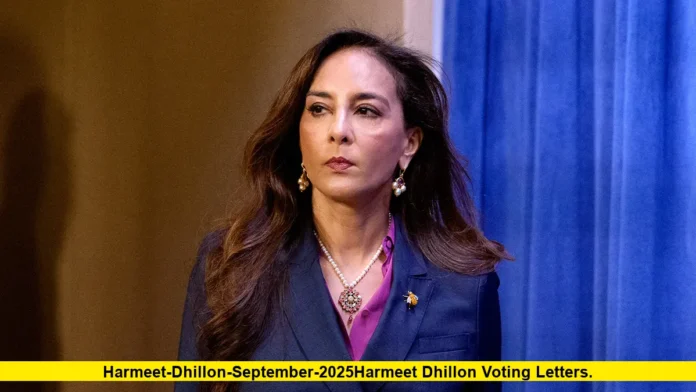

The Justice Department’s latest move in its ongoing scrutiny of American elections has put state officials on notice. The harmeet dhillon voting letters sent this week to election offices across the country have reignited a national debate over voter roll maintenance, federal overreach, and the political tensions surrounding the 2026 midterm elections. These letters, signed by Assistant Attorney General Harmeet Dhillon, warn top election officials that they could face criminal prosecution if noncitizens are found voting or remaining on state voter rolls.
The correspondence, sent to more than a dozen states including Arizona, Georgia, Michigan, Nevada, Tennessee, Utah, and Washington, represents one of the most aggressive federal interventions into state-run elections in recent memory. While the letters carry the weight of potential criminal liability, election administrators and legal experts have characterized them as more symbolic pressure than an imminent legal threat, given that every state already has procedures in place designed to prevent noncitizens from casting ballots.
Who Is Harmeet Dhillon
Harmeet Dhillon serves as the Assistant Attorney General for the Justice Department’s Civil Rights Division, a role that places her at the center of federal enforcement over voting rights, election administration, and civil liberties issues. Since taking on this position, Dhillon has directed the division’s attention toward a range of contentious topics, including disputes with Democrat-led states over transgender inmate housing policies, gun regulations, and allegations of antisemitism on college campuses.
Her tenure at the Civil Rights Division has been marked by an unusually assertive posture toward state election officials. The division under her leadership has repeatedly requested detailed voter registration data from states, including sensitive personal information such as dates of birth, driver’s license numbers, and partial Social Security numbers. Several of these data requests have been challenged in federal court, with judges in multiple jurisdictions ruling against the department’s attempts to compel states to hand over protected voter information.
The Content of the Letters
The letters at the heart of this controversy are strikingly similar across the states that received them, suggesting a coordinated nationwide campaign rather than isolated inquiries. A letter sent to Michigan Secretary of State Jocelyn Benson, for example, warned that state election officers, including the chief election officer of the state, could face criminal prosecution for aiding and abetting violations of federal laws that prohibit noncitizens from voting in federal elections.
According to the letters, knowingly retaining noncitizens on a state’s voter registration list, sending them ballots, or counting those ballots would amount to the unlawful procurement, casting, or tabulation of votes. The Justice Department cited authority under federal statutes, including the National Voter Registration Act, arguing that officials who knowingly and willfully deprive residents of a fair election process can be held criminally liable.
Each letter also came attached with a lengthy memo, in some cases running several pages, outlining the responsibilities of state and local election officials under federal law. States were given just five days to respond, explaining how they intend to comply with federal voter eligibility requirements and how the Justice Department could supposedly assist in meeting those obligations.
State Reactions and Pushback
The response from election officials across party lines has been swift and largely critical. In Arizona, Secretary of State Adrian Fontes called the letter politically motivated and described it as insulting to election workers who have long worked to verify voter eligibility under state law. Arizona has required proof of citizenship for voter registration since 2004, when voters approved a ballot measure specifically designed to prevent noncitizens from registering.
In Utah, a Republican official, Lieutenant Governor Deidre Henderson, was equally direct in her criticism. She described receiving the letter as “truly bizarre behavior” from an agency meant to protect civil rights, noting that dozens of courts have already ruled against similar data requests from the Justice Department. Her response is notable because it demonstrates that concern over these letters extends beyond Democrat-led states, cutting across the political spectrum among election administrators.
Washington Secretary of State Steve Hobbs also pushed back, stating that his office would review the legality of the request while accusing the Justice Department of accelerating down a path that threatens legal action against career election administrators. Nevada Secretary of State Francisco Aguilar pointed to existing safeguards already in place to prevent noncitizens from appearing on voter rolls in the first place.
Common threads in the responses from state officials include:
Assertions that existing state laws and verification systems already prevent noncitizen voting
Concerns that the letters represent political pressure ahead of the midterm elections rather than genuine legal enforcement
Objections to prior Justice Department requests for sensitive voter data, several of which have been blocked by federal courts
Frustration that the letters arrived with tight five-day response deadlines
Why Noncitizen Voting Has Become a Central Issue
Noncitizen voting in federal elections has long been illegal under U.S. law, and research consistently shows that instances of it occurring are exceedingly rare. When noncitizens have mistakenly appeared on voter rolls in the past, investigations have generally traced the issue back to administrative or bureaucratic errors rather than intentional fraud. Despite this, the topic has remained a persistent focus for the Trump administration and its allies, who have pushed for stricter national requirements, including proposed legislation that would mandate proof of citizenship for voter registration nationwide.
Critics of the administration’s approach argue that the emphasis on noncitizen voting is tied more closely to broader immigration enforcement priorities and efforts to cast doubt on the integrity of mail-in voting systems than to any documented pattern of election fraud. They also point to concerns that federal verification tools, such as the Department of Homeland Security’s SAVE database, have produced a notable rate of false positives when used to screen voter rolls, potentially placing eligible citizens at risk of being wrongly flagged or removed from registration lists.
Supporters of the Justice Department’s actions, meanwhile, contend that federal oversight is necessary to ensure that state election officials are actively maintaining accurate voter rolls and that any noncitizen presence, however limited, undermines public confidence in the electoral process.
The Broader Context of DOJ Election Oversight
This latest round of letters does not exist in isolation. The Civil Rights Division under Dhillon has previously sent similar communications to individual counties, including a letter earlier this year to a county clerk in Michigan regarding voter roll maintenance. The division has also sought expansive voter data from numerous states, an effort that has drawn scrutiny from members of Congress, with formal correspondence from lawmakers raising concerns about how the department is handling and safeguarding the personal information it has already collected.
Legal challenges to the Justice Department’s data collection efforts have largely favored the states. Multiple federal courts have dismissed the department’s attempts to compel the release of protected voter registration information, citing concerns over statutory authority and privacy protections. Despite these setbacks in court, the department has continued to pursue its broader campaign to scrutinize state voter rolls ahead of the 2026 midterm elections.
What Happens Next
As of this writing, there is no official confirmation of any state facing actual criminal charges as a result of these letters, and legal experts widely view the threat of prosecution as unlikely to materialize in the near term. The five-day response windows set by the Justice Department have largely passed or are approaching, and it remains to be seen how the department will respond to the pushback it has received from officials across the political spectrum.
What is clear is that the harmeet dhillon voting letters have intensified an already tense relationship between the federal government and state election administrators heading into a critical midterm election cycle. Whether this pressure campaign results in policy changes, further legal battles, or simply continued public disputes will likely become clearer in the coming weeks as states finalize their responses and as any potential litigation unfolds.
Final Thoughts
The controversy surrounding these letters underscores the deepening divide between federal and state authority over how elections are run in the United States. While the Justice Department frames its actions as necessary enforcement of existing voter eligibility laws, state officials from both parties have largely characterized the letters as an overreach that ignores the safeguards already built into their election systems. As the midterms approach, this dispute over noncitizen voting and federal authority is likely to remain a closely watched storyline in American politics.
Stay informed on this developing story and share your thoughts in the comments below.