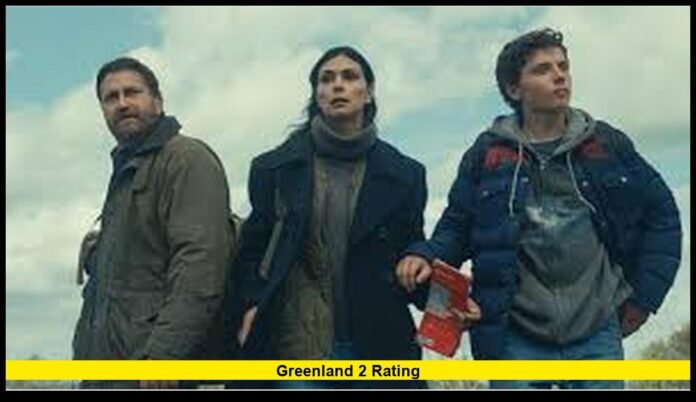

Greenland 2 rating is now officially confirmed, giving movie fans a clear idea of what to expect from one of 2026’s most anticipated films. The sequel, officially titled Greenland: Migration, has received a PG-13 rating from the Motion Picture Association (MPA) for “intense disaster sequences, thematic elements, and some violence.” The rating matches that of the original 2020 hit Greenland, signaling that the follow-up will continue its blend of emotional storytelling and high-stakes survival drama while maintaining accessibility for a broad audience.
With production completed, marketing ramping up, and a theatrical release expected later this year, Greenland: Migration is poised to make a significant impact on the 2026 box office.
A Long-Awaited Sequel Takes Shape
The first Greenland film, released in 2020, defied expectations. Arriving during a period of global uncertainty, the movie connected with audiences worldwide, not just for its thrilling disaster elements but for its deeply human story. The film followed structural engineer John Garrity (Gerard Butler), his wife Allison (Morena Baccarin), and their young son as they struggled to survive an extinction-level comet event.
Instead of focusing solely on massive explosions or CGI-heavy destruction, Greenland grounded its story in the emotions of ordinary people facing extraordinary danger. This approach earned it strong reviews and a devoted fan base, making a sequel inevitable.
By late 2021, the creative team confirmed that production was underway for a second chapter. Titled Greenland: Migration, the film continues the Garrity family’s journey as they emerge from their underground shelter in Greenland and attempt to rebuild life in a devastated world.
Filming and Production Timeline
The sequel began shooting in 2023, with Ric Roman Waugh returning as director and Chris Sparling once again penning the screenplay. Both played crucial roles in the original film’s success and were instrumental in shaping the sequel’s tone.
Filming took place across multiple international locations, including Iceland, the United Kingdom, and Georgia (U.S.), chosen for their diverse landscapes that could realistically portray a post-catastrophe Earth.
The production wrapped principal photography in mid-2024, with post-production extending well into 2025 due to the film’s heavy reliance on visual effects. Industry sources confirmed that the final cut was delivered to the studio by December 2025, just before the film received its MPA review.
Details of the Greenland 2 Rating
The Motion Picture Association’s PG-13 rating for Greenland: Migration reflects its intense but family-appropriate tone. The classification was issued based on:
- Extended disaster and survival sequences showing large-scale destruction.
- Scenes of moderate violence related to environmental collapse.
- Mature emotional themes surrounding family, community, and loss.
The PG-13 label allows the film to maintain the same emotional intensity and realism as its predecessor without crossing into graphic or explicit territory. It also aligns with the creative team’s stated goal of reaching a broad audience while preserving authenticity and tension.
For fans of the first movie, this rating ensures that Migration will deliver the same heart-pounding atmosphere and moral complexity without sacrificing accessibility for younger viewers.
Returning Stars and New Characters
The sequel brings back familiar faces while introducing new characters that expand the story’s emotional and geographic reach.
- Gerard Butler returns as John Garrity, a father determined to protect his family as they navigate a ravaged landscape. Butler also serves as a producer, emphasizing his creative involvement in the film’s direction.
- Morena Baccarin reprises her role as Allison Garrity, continuing her portrayal of a resilient mother who anchors the family’s emotional journey.
- Roger Dale Floyd, who played their son Nathan Garrity, returns as an older version of the character, now coping with life after near-extinction.
- Vicky Krieps joins the cast in a significant new role, reportedly portraying a survivor leading a settlement that offers hope of rebuilding civilization.
- Frank Grillo appears as a military commander overseeing relocation efforts in the film’s early scenes.
Director Ric Roman Waugh has emphasized that Migration focuses less on the spectacle of destruction and more on survival, community, and renewal. In contrast to the first film’s frantic escape narrative, this sequel explores the challenges of finding purpose and stability after global devastation.
Story and Setting: A Shift from Survival to Rebuilding
The sequel takes place several years after the events of Greenland, with Earth still recovering from the comet impacts that nearly wiped out humanity. The Garrity family emerges from their shelter in Greenland to find a drastically altered planet.
Their journey leads them across what remains of Europe, encountering isolated survivor groups, fractured governments, and new ecosystems formed by the comet’s aftermath. The movie’s tone blends elements of survival adventure with human drama, focusing on how ordinary people adapt in the face of irreversible change.
While the first film asked whether the family could survive, Greenland: Migration asks whether humanity can rebuild. It’s both a continuation and an evolution—shifting the theme from endurance to rebirth.
Director’s Vision and Filmmaking Approach
Ric Roman Waugh, who also directed Angel Has Fallen and Shot Caller, is known for his grounded approach to action and drama. His filmmaking style emphasizes realism and emotional authenticity over spectacle.
For Greenland: Migration, Waugh worked closely with cinematographer Dana Gonzales to create a stark, immersive visual tone. The film was shot using high-resolution digital cameras to capture both the natural beauty and devastation of the post-disaster setting.
The production team also used practical effects wherever possible. This choice enhances realism, allowing actors to physically interact with their environment instead of relying entirely on green-screen technology.
Sound design and music play an equally vital role. Composer David Buckley, who scored the first film, returns with a new orchestral theme intended to convey both grief and hope—reflecting the film’s core message of renewal.
Marketing Strategy and Release Expectations
As of January 2026, Greenland: Migration is entering the early stages of its global marketing rollout. The studio behind the film, STX Entertainment, is reportedly preparing its first trailer and poster campaign for release in spring 2026, aligning with the summer blockbuster season.
The film’s release is tentatively planned for late 2026, with a wide theatrical debut across the United States, followed by international distribution through STX International and Cineworld Group.
The marketing strategy will highlight the sequel’s emotional depth and epic scope, positioning it as both a thrilling continuation and a stand-alone story about human resilience. Early test screenings reportedly received strong audience feedback for pacing, character development, and visual effects quality.
Industry Insights and Early Buzz
Industry observers have noted that Greenland: Migration arrives at a time when audiences are gravitating toward grounded, character-driven blockbusters. While the disaster genre has long been dominated by high-concept spectacle, Migration differentiates itself by focusing on realism and emotional resonance.
Gerard Butler’s recent success in films such as Plane and Kandahar has also renewed interest in his action-drama projects. His consistent box office draw, combined with the established fan base from Greenland, gives the sequel a strong foundation heading into its release year.
Early previews shown at private industry events have highlighted the sequel’s larger scope, new locations, and mature storytelling tone. Many insiders believe the film could surpass the original in both emotional impact and box office performance.
Comparing the Two Films
| Feature | Greenland (2020) | Greenland: Migration (2026) |
|---|---|---|
| Director | Ric Roman Waugh | Ric Roman Waugh |
| Screenwriter | Chris Sparling | Chris Sparling |
| Lead Stars | Gerard Butler, Morena Baccarin | Gerard Butler, Morena Baccarin, Vicky Krieps |
| Story Focus | Escaping a comet disaster | Surviving and rebuilding after the catastrophe |
| Tone | Suspenseful, urgent, emotional | Hopeful, introspective, and expansive |
| Runtime | 119 minutes | Approx. 130 minutes (estimated) |
| MPA Rating | PG-13 | PG-13 |
| Distribution | Digital and limited theatrical | Full theatrical global release |
| Themes | Survival and family unity | Restoration, humanity, and second chances |
This comparison shows how the sequel expands thematically while maintaining continuity with the original. It’s a narrative evolution rather than a complete reinvention.
Cultural Impact and Audience Appeal
The original Greenland resonated with viewers partly because it arrived during a time of widespread uncertainty and anxiety. Its themes of family, hope, and resilience struck a universal chord.
Greenland: Migration builds on that foundation, promising an emotional exploration of what it means to rebuild after total loss. With environmental crises and climate-related discussions becoming more relevant globally, the film’s themes feel timely and relatable.
The PG-13 rating also ensures that the movie remains accessible to teens and adults alike, broadening its audience. Families who watched the first installment at home during lockdowns now have the opportunity to experience the sequel on the big screen.
Box Office Projections and Franchise Future
Given its production scale and returning creative team, Greenland: Migration is expected to perform well commercially. Industry analysts project that the film could open between $35 million and $45 million domestically in its first weekend, potentially earning over $200 million worldwide if audience response mirrors that of the original.
While no third installment has been officially announced, both Butler and Waugh have expressed openness to continuing the series if Migration succeeds financially. However, the creative team’s stated priority is delivering a satisfying, self-contained story that concludes the Garrity family’s arc.
Why the PG-13 Rating Matters
The Greenland 2 rating is crucial in shaping audience expectations. A PG-13 classification signals a movie that balances intensity with emotional accessibility—something that defines modern blockbuster success.
It also widens the film’s reach, allowing families, younger viewers, and general audiences to experience the story together. The MPA’s guidelines ensure that the content is impactful without being graphic, creating tension through storytelling rather than shock value.
For the filmmakers, this rating represents a creative achievement: maintaining realism and emotional stakes while staying within boundaries that invite inclusivity.
Post-Production and Visual Effects Work
The visual effects in Greenland: Migration are among its most ambitious elements. Studios based in London, Montreal, and Los Angeles collaborated on more than 1,000 VFX shots depicting destroyed landscapes, unstable weather systems, and remnants of human civilization.
Unlike many disaster films that rely on over-the-top visuals, Migration takes a subtle approach. The visual design focuses on realism—depicting quiet devastation, natural regrowth, and the gradual return of sunlight after years of ash-covered skies.
This restraint complements the story’s tone and helps distinguish Migration from typical disaster blockbusters.
What Audiences Can Expect
Fans can look forward to:
- A powerful continuation of the Garrity family’s journey, filled with emotion and moral complexity.
- Spectacular visuals that capture the haunting beauty of a world starting over.
- A balance of suspense and hope, as survivors navigate both natural and human challenges.
- An intimate focus on relationships and rebuilding, rather than pure spectacle.
The movie promises to expand the emotional universe of Greenland while remaining grounded in the themes that made the original resonate so deeply.
Final Thoughts
The confirmation of Greenland: Migration’s PG-13 rating marks an exciting milestone for fans who have waited six years to see the story continue. The film’s completion, returning stars, and updated narrative promise a cinematic experience that combines humanity, tension, and visual grandeur.
As 2026 unfolds, all signs point to Greenland: Migration being one of the year’s defining releases—a survival story not just about enduring destruction, but about rediscovering what it means to live.
Nearly six years after the first film, Greenland: Migration is ready to bring audiences back into its world of hope and survival. What are you most excited to see in the sequel? Share your thoughts below!