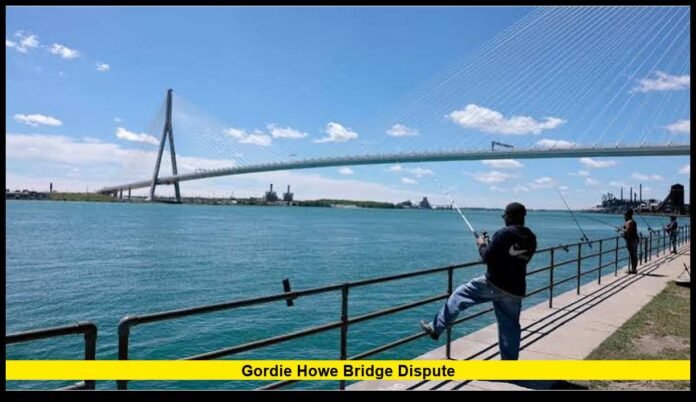

The long-running Gordie Howe bridge dispute reached an important turning point in July 2026 after officials from the United States and Canada finalized an agreement that clears the way for the long-awaited international crossing to begin operations. The resolution removes the final administrative and financial obstacles that delayed the opening despite construction being substantially complete.
For businesses, commuters, and the transportation industry, the announcement marks the conclusion of years of planning, engineering, negotiations, and policy discussions. The bridge has been viewed as one of North America’s most significant infrastructure projects because it strengthens one of the busiest trade corridors between the United States and Canada.
With operations now scheduled to begin, attention has shifted from negotiations to how the new crossing will reshape freight movement, improve border efficiency, and support future economic growth across both countries.
A Major Infrastructure Project Years in the Making
The international bridge connecting Detroit, Michigan, and Windsor, Ontario, has been under discussion for decades. Growing commercial traffic, increasing demand for reliable freight transportation, and concerns about relying heavily on a single international crossing convinced leaders on both sides of the border that additional capacity would eventually become necessary.
Planning involved years of environmental studies, engineering reviews, public consultation, legal approvals, and international agreements before construction finally moved forward.
Once work began, thousands of engineers, construction workers, designers, and specialists contributed to the massive project. The bridge gradually became one of the most recognizable new landmarks along the Detroit River while remaining one of the largest infrastructure investments ever undertaken jointly by the neighboring countries.
Although construction reached its final stages, opening the crossing required more than completing the physical structure. Operational agreements also had to be finalized before traffic could begin using the bridge.
Why the Opening Did Not Happen Immediately
Many people assumed that construction delays were responsible for postponing the opening.
In reality, the bridge itself had largely reached completion.
The remaining challenge involved agreements governing how the crossing would operate after opening.
Officials continued negotiations involving several important areas, including:
- Long-term financial management
- Revenue distribution
- Toll oversight
- Operational governance
- Cross-border administrative responsibilities
These discussions became increasingly important because both governments wanted a framework that would remain effective for decades rather than only during the first years of operation.
Until every major issue received approval, officials decided not to open the crossing.
How the Disagreement Developed
Large international infrastructure projects often require multiple governments to cooperate on financing, regulation, customs operations, transportation planning, and long-term maintenance.
As the project neared completion, discussions intensified over how operational revenue would be managed and how future policy decisions would be made.
Several areas required additional negotiation before final approval could be granted.
Among the most discussed topics were:
- Management of toll income
- Future adjustments to toll pricing
- Shared oversight responsibilities
- Long-term operational governance
- Financial transparency
Rather than rushing the opening, negotiators continued working toward an agreement acceptable to both countries.
That approach ultimately delayed operations but produced a framework both governments publicly supported.
The July 2026 Breakthrough
Negotiations concluded successfully during July 2026.
Officials confirmed that the remaining operational issues had been resolved, allowing the bridge to officially prepare for opening.
The agreement includes updated provisions covering financial administration, governance, and future operational oversight.
It also establishes a framework for cooperation as traffic begins using the crossing.
Following the announcement, agencies responsible for customs, transportation, and bridge operations immediately shifted their attention toward final preparations for the scheduled opening.
Why This Crossing Matters
The Detroit-Windsor corridor represents one of the busiest commercial gateways anywhere in North America.
Every day, enormous volumes of manufactured products, agricultural goods, consumer merchandise, medical supplies, industrial equipment, and automotive components move across the international border.
The regional economy depends heavily on reliable transportation between manufacturing centers located in both countries.
Adding another major crossing provides several important advantages.
These include:
- Increased border capacity
- Greater transportation reliability
- Improved freight movement
- Reduced congestion
- Additional routing flexibility
- Enhanced customs processing
The new crossing is expected to complement existing infrastructure rather than replace it, providing additional options for commercial carriers and travelers.
Supporting North American Supply Chains
Few industries illustrate the importance of cross-border transportation better than automotive manufacturing.
Vehicle production often involves components crossing the border multiple times before final assembly.
Even relatively small transportation delays can affect manufacturing schedules throughout North America.
The bridge is expected to improve supply chain efficiency by creating another modern crossing equipped to handle significant freight volumes.
Industries likely to benefit include:
- Automotive manufacturing
- Agriculture
- Food distribution
- Medical equipment
- Consumer goods
- Heavy industry
- Retail logistics
- Warehouse operations
Businesses have spent years preparing transportation strategies that incorporate the new route once traffic begins moving across the bridge.
Modern Design for Future Growth
The bridge was designed with long-term transportation needs in mind.
Several features distinguish it from older international crossings.
Among the most notable are:
- Six traffic lanes
- Modern customs plazas
- Direct interstate freeway connections
- Advanced inspection technology
- Shared pedestrian and cycling pathway
- Contemporary safety systems
These improvements are expected to increase efficiency while supporting continued growth in cross-border commerce for many years.
Construction Achievements
Building an international bridge across the Detroit River required careful coordination among engineers, environmental specialists, contractors, transportation agencies, and government officials.
Construction progressed through multiple stages.
Major milestones included:
- Foundation work
- Tower construction
- Cable installation
- Deck placement
- Customs plaza development
- Highway connections
- Structural testing
- Operational commissioning
Each stage involved detailed inspections to ensure the structure met safety and engineering standards before advancing to the next phase.
By the time negotiations became the primary focus, physical construction had largely concluded.
Trump Gordie Howe Bridge Dispute: What Happened, Why It Matters, and the Latest Updates
Economic Importance for Michigan
Michigan stands to benefit significantly from the new crossing.
The state serves as one of North America’s manufacturing centers, particularly within the automotive industry.
Reliable border transportation supports:
- Factory production
- Distribution networks
- International trade
- Warehousing
- Logistics services
- Employment growth
Businesses operating throughout southeastern Michigan anticipate greater flexibility when moving products into Canadian markets.
Improved transportation infrastructure also strengthens the region’s long-term competitiveness.
Benefits for Ontario
The advantages extend beyond the United States.
Ontario manufacturers rely heavily on access to American customers and suppliers.
A modern crossing helps reduce transportation bottlenecks while supporting continued industrial growth.
Companies throughout Windsor and surrounding communities have invested heavily in logistics facilities positioned to take advantage of improved border access.
The bridge also supports future commercial development on both sides of the international boundary.
How Freight Transportation Could Change
Commercial trucking will likely experience the most immediate operational improvements.
Drivers currently navigating congestion at existing crossings may gain another efficient option for moving freight between countries.
Expected operational benefits include:
- More predictable travel times
- Improved traffic flow
- Faster customs processing
- Better freeway access
- Reduced bottlenecks
- Increased border capacity
Although shipping patterns may evolve gradually, logistics companies have already begun planning future routing strategies around the new crossing.
Passenger Travel Will Also Improve
While freight transportation receives much of the attention, passenger vehicles are also expected to benefit.
Travelers crossing between Michigan and Ontario may experience:
- Reduced waiting times
- Additional border capacity
- Improved traffic distribution
- Easier highway connections
- Modern inspection facilities
Residents living in both Detroit and Windsor have closely followed construction progress for years, making the opening highly anticipated among local communities.
The Financial Framework
One distinctive feature of the project involves its financing.
Canada funded construction through the established project structure, making financial oversight an especially important topic during negotiations over long-term operations.
The finalized agreement establishes updated guidelines governing:
- Revenue administration
- Operational funding
- Financial accountability
- Long-term maintenance planning
- Oversight responsibilities
Creating a stable financial structure was considered essential before allowing traffic to begin using the bridge.
Preparing for Opening Day
With negotiations complete, operational teams have concentrated on final readiness.
Preparations include:
- Safety inspections
- Systems testing
- Border staffing
- Traffic management
- Customs coordination
- Emergency response planning
These activities ensure both countries are prepared for regular commercial and passenger traffic once operations officially begin.
Regional Business Expectations
Business organizations throughout Michigan and Ontario have welcomed the completed agreement.
Manufacturers, logistics companies, retailers, warehouse operators, and transportation providers all expect improved border reliability to strengthen regional economic activity.
Many companies delayed changes to transportation networks until the official opening date became certain.
With that uncertainty now removed, businesses can begin implementing long-term logistics plans.
Long-Term Economic Impact
Infrastructure investments of this scale typically influence regional economies for decades.
The bridge is expected to support:
- Stronger international trade
- Increased commercial investment
- Expanded logistics operations
- Manufacturing growth
- Improved transportation resilience
- Economic development on both sides of the border
Additional crossing capacity also provides greater flexibility during unexpected traffic disruptions or maintenance affecting existing routes.
What Travelers and Businesses Should Expect
When operations begin, freight carriers and passenger vehicles will gradually incorporate the bridge into regular travel patterns.
Transportation agencies expect traffic volumes to increase steadily as businesses gain experience using the new crossing.
Customs procedures, highway connections, and operational systems have all been designed to support efficient international movement while maintaining border security.
Although adjustments will occur during the initial operating period, officials anticipate the bridge becoming an essential component of North American transportation infrastructure.
A Historic Addition to Cross-Border Transportation
Few infrastructure projects have generated as much attention in recent years as this international crossing.
Its construction required years of engineering expertise, diplomatic cooperation, financial planning, and regulatory coordination.
The successful conclusion of negotiations represents more than simply resolving administrative issues.
It demonstrates the ability of neighboring countries to work through complex operational questions while advancing a project designed to strengthen trade and transportation for future generations.
As commercial traffic begins crossing the Detroit River using this new route, the bridge is expected to play an increasingly important role in supporting economic activity throughout the United States and Canada.
The agreement closes a significant chapter in the project’s history, but the bridge’s real impact will be measured in the years ahead. Share your thoughts below and stay informed as this landmark crossing begins a new era of cross-border transportation.