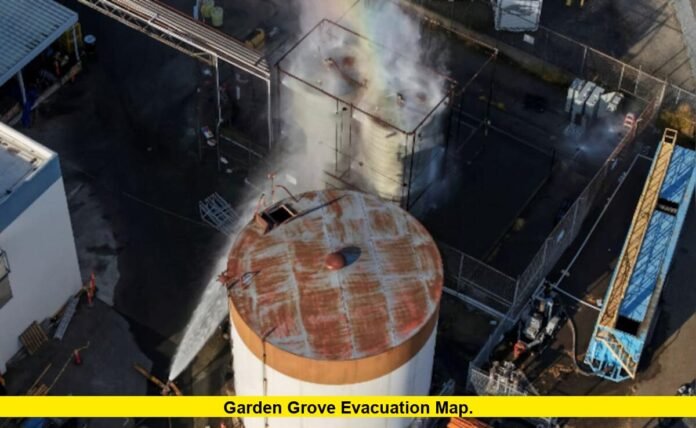

A major hazardous materials emergency in Southern California has placed the spotlight on the Garden Grove evacuation map after officials ordered roughly 40,000 residents to evacuate due to a potentially catastrophic chemical tank failure. The emergency unfolded in Orange County when a large storage tank containing methyl methacrylate began overheating and releasing dangerous vapors into the air. Authorities warned the tank could either rupture or explode, triggering one of the region’s most serious hazmat incidents in recent years.
What Happened in Garden Grove?
The incident began at a GKN Aerospace facility in Garden Grove, California, where emergency crews responded to reports of an overheating storage tank. Officials said the tank contained between 6,000 and 7,000 gallons of methyl methacrylate, a highly flammable industrial chemical commonly used in plastics and aerospace manufacturing.
As temperatures inside the tank increased, pressure built rapidly and vapors started venting into the atmosphere. Fire crews attempted cooling operations using unmanned water systems and sprinkler equipment, but officials warned the danger remained extremely high. Orange County Fire Authority officials publicly stated the tank would likely “fail or explode,” though the exact timing remained uncertain.
Garden Grove Evacuation Map Areas
The rapidly changing Garden Grove evacuation map expanded throughout the day as emergency officials widened the danger zone. Mandatory evacuation orders eventually impacted portions of:
- Garden Grove
- Anaheim
- Stanton
- Cypress
- Westminster
- Buena Park
Authorities expanded the evacuation perimeter to approximately a one-mile radius surrounding the facility. According to emergency updates, the evacuation boundaries included areas near Ball Road, Valley View Street, Dale Street, and Trask Avenue.
Residents were urged to leave immediately as officials feared either a toxic ground spill or a thermal runaway explosion involving nearby chemical storage tanks.
Why Officials Considered the Situation So Dangerous
Methyl methacrylate is considered highly volatile under heat and pressure. Health officials warned that exposure to airborne vapors could lead to:
- Respiratory irritation
- Burning eyes
- Nausea
- Headaches
- Skin irritation
Emergency crews also feared environmental contamination if the chemical leaked into storm drains or nearby waterways. Firefighters used sandbag barriers and containment strategies to reduce runoff risks while monitoring the tank around the clock.
Officials described the incident as unprecedented due to the instability of the chemical and the uncertainty surrounding the tank’s structural integrity.
Schools, Roads, and Businesses Affected
The expanding evacuation map forced widespread closures across Orange County. Several schools shut down as a precaution, and multiple freeway off-ramps near the hazard zone were temporarily closed.
Caltrans confirmed closures affecting State Route 22 off-ramps near:
- Beach Boulevard
- Knott Avenue
- Valley View Street
Emergency shelters were also opened across neighboring cities to house displaced residents.
Emergency Response Continues
Firefighters and hazardous materials experts continued monitoring the tank while trying to stabilize temperatures. Authorities said cooling efforts temporarily slowed the danger, buying additional time for emergency planning. However, officials repeatedly warned the public that the threat had not passed.
Despite mandatory evacuation notices, reports indicated that some residents initially refused to leave the area. Officials urged everyone inside the evacuation zone to follow instructions immediately and avoid unnecessary exposure.
How Residents Can Check the Latest Garden Grove Evacuation Map
Residents seeking the latest updates on the Garden Grove evacuation map were advised to monitor local emergency alerts, Orange County Fire Authority announcements, and city emergency management channels. Local media outlets also published continuously updated evacuation boundaries, shelter information, and road closure details as conditions evolved.
Emergency officials stressed that evacuation zones could change rapidly depending on tank conditions, weather patterns, and vapor movement.
Broader Concerns Over Industrial Chemical Safety
The Garden Grove chemical emergency has sparked renewed public discussion about industrial storage safety in densely populated Southern California communities. With tens of thousands displaced and fears of a major explosion dominating headlines, many residents are questioning how hazardous materials are monitored near homes, schools, and businesses.
Experts say incidents involving overheating industrial tanks are rare but can escalate quickly when volatile chemicals are involved. The situation also highlighted the growing importance of real-time evacuation maps, multilingual emergency alerts, and coordinated regional response systems during major hazmat events.
As authorities continue working to contain the danger, residents across Orange County remain on alert for further evacuation notices and emergency updates.
Stay tuned for the latest updates on the Garden Grove evacuation map and Southern California emergency alerts as officials continue monitoring this developing chemical leak crisis.