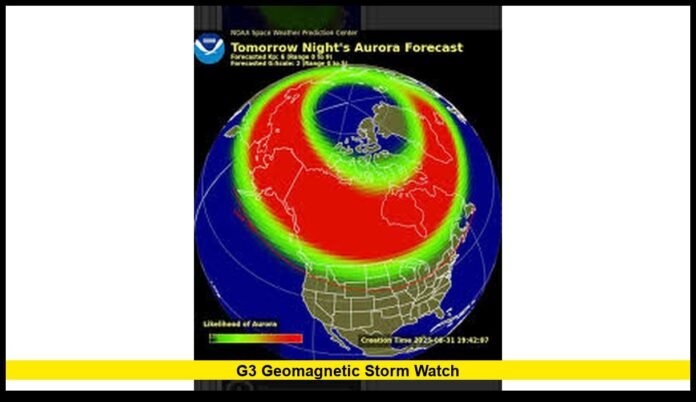

A G3 geomagnetic storm watch is now in place as space weather forecasters track a powerful coronal mass ejection expected to influence Earth this week. The watch highlights the potential for strong geomagnetic conditions that can affect power grids, communication systems, navigation tools, and aurora visibility across portions of the country. With interest in solar activity increasing as the Sun approaches a period of heightened intensity, this watch has drawn national attention and created a new wave of public awareness about how solar storms interact with daily life.
The current watch comes after a series of recent solar events that demonstrated how quickly conditions can shift. Forecasters have been monitoring the evolution of these disturbances to assess their speed, density, and trajectory. The latest update indicates that a significant burst of solar material is traveling through space and expected to interact with Earth’s magnetic field. When this interaction occurs, geomagnetic activity strengthens and can reach levels seen only a few times per year. A G3 level, categorized as strong, places many industries on alert while also exciting skywatchers hoping to see auroras far from polar regions.
Understanding What a G3 Watch Means for the U.S.
A G3 classification signals that geomagnetic conditions could create noticeable effects on several types of systems. While not extreme, G3 activity is strong enough to create operational challenges for infrastructure and communication technologies. For the United States, the focus rests on power networks, satellite operators, aviation communication, maritime navigation, and emergency services. Each of these sectors depends heavily on stability, precision, and reliability—elements that can temporarily weaken during strong geomagnetic disturbances.
Power companies often pay close attention to these alerts because rapid changes in Earth’s magnetic field can induce electric currents in long transmission lines. These currents can stress equipment, alter voltage, and require operators to adjust loads or activate safeguards. Although widespread outages are not expected during G3 activity, protective strategies are commonly reviewed in advance to ensure continuity.
Satellite systems also experience increased drag when geomagnetic activity heats and expands Earth’s upper atmosphere. Drag alters orbits, forcing operators to make small adjustments to maintain proper alignment. In addition, satellites that rely on sensitive electronics may face interference from energetic particles, prompting many operators to revisit their protection procedures during watches.
Navigation tools, including GPS receivers, can experience short-lived accuracy issues when geomagnetic conditions change rapidly. Because the United States relies heavily on satellite navigation for transportation, agriculture, communication timing networks, and logistics, even temporary disturbances can influence operations. These effects tend to vary by location and intensity but remain a concern for industries that depend on highly precise data.
How the Current Watch Developed
This watch was issued after a significant outburst of solar energy created a coronal mass ejection capable of impacting Earth. When these ejections are directed toward our planet, they carry magnetic fields and charged particles that interact with Earth’s magnetic shield. The speed and orientation of the ejecta determine the severity of geomagnetic conditions.
The solar eruption responsible for this watch displayed characteristics consistent with a strong event. Observers noted the rapid expansion of plasma and the direction of the outflow, which indicated an Earth-facing trajectory. As models calculated its path, forecasters determined that a watch designation was necessary due to the potential strength of the incoming disturbance. Watches of this magnitude are less frequent than smaller alerts, making them more noteworthy for both specialists and the public.
As space weather predictions narrowed, the expected arrival window became more defined. The CME is forecast to reach Earth within a specific timeframe that places the United States in a prime observation zone for possible effects. The strength of the disturbance is expected to increase quickly once interaction begins, which is typical for fast-moving solar ejecta. These details allowed forecasters to update the watch and emphasize that preparations should be underway for industries most likely to be influenced.
Why This Watch Matters Right Now
Public interest in geomagnetic activity has grown in recent years due to an increasing recognition of how dependent modern systems are on technologies vulnerable to space weather. Whether people realize it or not, geomagnetic conditions influence countless aspects of daily life—from flight paths to data timing networks to communication infrastructure.
The current G3 watch arrives during a cycle in which solar eruptions have become more frequent. As the Sun approaches its next activity peak, watches and warnings are expected to become more common. This makes the present watch not only relevant to the coming days but also instructive for understanding future events. It provides a timely example of how U.S. agencies and industries prepare for elevated geomagnetic conditions and how residents can stay informed about potential short-term disruptions.
For many people, the most visible effect of a strong geomagnetic disturbance is the possibility of witnessing bright auroras. During G3 conditions, auroras can extend well beyond northern border states. In some instances, residents in the Midwest, Northeast, and even central states have reported colorful skies. This watch could create similar opportunities if skies remain clear and the storm reaches forecasted strength.
Expected Effects by Sector
Power Infrastructure
Power grids are designed to handle large-scale electrical loads, but geomagnetic storms introduce irregular currents that can affect long-distance lines. Operators monitor transformer temperatures, adjust power flow, and coordinate with regional control centers to maintain balance. A G3 event is unlikely to cause failures, yet it requires extra vigilance to prevent equipment stress or voltage fluctuations.
Aviation and HF Communications
High-frequency radio plays an essential role in aviation, especially for long-distance flights. Geomagnetic disturbances can reduce signal clarity or create temporary dropouts. Flight crews typically follow updated communication advisories and may adjust routes or altitudes to preserve reliability. While these adjustments rarely disrupt travel for passengers, they require careful coordination.
GPS and Timing Systems
GPS accuracy can shift during geomagnetic storms due to disturbances in the ionosphere. Timing signals—used by financial markets, cellular networks, and transportation systems—may lose precision for brief periods. Most services are built with safeguards that compensate for these fluctuations, but technicians monitor readings carefully during heightened activity.
Maritime Navigation
Ships that rely on both satellite navigation and radio-based communication may experience mild disruptions, especially in high-latitude waters. Mariners are familiar with routine space weather advisories and adjust systems or procedures as needed.
Pipeline Operations
Geomagnetic storms can increase the rate of corrosion by introducing electrical currents along pipelines. Operators track these variations and activate protective methods to maintain safe operation.
Satellite Operators
A G3 storm increases atmospheric drag, which influences orbit calculations. Even small changes can require repositioning satellites to preserve mission objectives. Operators often place sensitive instruments into protective modes to reduce exposure during heightened conditions.
Aurora Potential Across the United States
One of the most exciting effects of a strong geomagnetic event is the possibility of widespread auroras. During G3 conditions, auroras can extend far beyond traditional viewing areas. States across the northern tier—including Montana, North Dakota, Minnesota, Wisconsin, Michigan, and Maine—often see brilliant displays. Under the right conditions, residents in the Midwest, Northeast, and Pacific Northwest may also catch a glimpse.
Aurora visibility depends on several factors:
- Cloud cover
- Local light pollution
- Storm intensity
- Timing of geomagnetic peaks
Clear skies and darker environments greatly increase viewing success. Many residents enjoy tracking updates and heading outside during late evening hours when activity tends to strengthen.
How U.S. Residents Can Prepare
Preparation for a G3 storm is straightforward and does not require major adjustments. However, a few simple steps can enhance readiness:
- Charge essential devices in case of localized power fluctuations.
- Use surge protectors for sensitive electronics.
- Allow extra time for GPS-based navigation.
- Keep backup communication methods available if you rely on HF or satellite tools.
- If interested in auroras, monitor local cloud forecasts and choose a dark viewing location.
These actions are not mandatory but can reduce inconvenience and improve safety, particularly for those in fields that depend on uninterrupted communication or navigation.
What Forecasters Will Monitor Next
The evolution of a geomagnetic storm depends heavily on the orientation of the incoming magnetic field. If the field aligns southward as it interacts with Earth’s magnetosphere, conditions strengthen quickly. If it aligns northward, the impact weakens. Before the CME arrives, forecasters cannot determine this orientation with certainty. Once the material reaches monitoring satellites near Earth, analysts will be able to pinpoint the storm’s true potential.
Other elements being tracked include:
- Solar wind speed
- Particle density
- Magnetic pressure around Earth
- Ongoing solar activity that may accompany the event
Updates are typically issued as these measurements become available and allow forecasters to refine expectations for the United States.
The Bigger Picture: Rising Solar Activity
This G3 geomagnetic storm watch also highlights the broader trend of rising solar activity. The Sun follows an 11-year cycle, and the current cycle is approaching its most active phase. During peaks, solar eruptions become more frequent and can produce stronger storms. Although most cause minimal disruption, a small percentage can reach levels that test the resilience of modern infrastructure.
By understanding and preparing for these events now, industries and communities strengthen their ability to manage future storms. The present watch serves as a reminder of how interconnected our technologies are with natural processes in space. It also emphasizes the value of consistent monitoring and public communication during times of elevated activity.
Final Thoughts
The current G3 geomagnetic storm watch has captured nationwide attention due to its potential impact on several vital systems and its timing during an active solar period. While strong storms can produce challenges for communications, navigation, and power infrastructure, they also inspire widespread curiosity and offer a chance for millions to witness rare aurora displays. With preparation, awareness, and continued monitoring, the United States is well positioned to navigate the effects of this incoming disturbance.
If you experience noticeable effects or capture aurora photos during the event, feel free to share your observations and join the conversation.