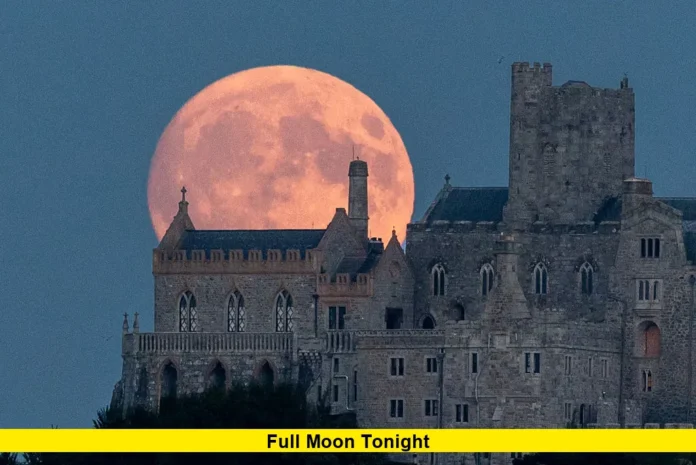

The full moon tonight Buck Moon is continuing to attract attention across the United States as July 2026 comes to a close. Although the Moon reached its precise astronomical full phase on Wednesday, July 29, it remains exceptionally bright and appears nearly full to the unaided eye on Thursday night, July 30.
July’s full moon is traditionally known as the Buck Moon, a seasonal name associated with the period when new antlers are growing rapidly on male deer. The celestial event reached peak illumination at approximately 10:35-10:36 a.m. EDT on July 29, 2026, or about 14:35 UTC.
That means anyone searching for the full moon tonight on July 30 has not completely missed the spectacle. The exact instant of fullness has passed, but the lunar disk remains prominently illuminated and should continue to provide an impressive sight wherever skies are reasonably clear.
Is There a Full Moon Tonight?
Technically, the exact full moon occurred on July 29, 2026.
Astronomers define a full moon as a specific instant when the Moon is positioned opposite the Sun from Earth’s perspective, with its Earth-facing hemisphere fully illuminated. The July full moon reached that point at approximately 14:35 UTC on July 29.
However, the difference between an exact full moon and the Moon seen shortly before or afterward can be difficult to detect without careful measurement. On the night of July 30, the Moon is moving into its waning phase but can still look essentially full to casual observers.
So, if you look outside tonight and think you are seeing a full moon, that impression is understandable. The Buck Moon remains one of the dominant objects in the nighttime sky even though its official peak has passed.
When Was the Buck Moon Full in 2026?
The 2026 Buck Moon reached its fullest phase on:
Date: Wednesday, July 29, 2026
Time: Approximately 10:35-10:36 a.m. EDT
UTC: Approximately 14:35 UTC
Because the precise full-moon moment occurred during daylight hours for much of the United States, nighttime viewing was naturally centered on the evenings surrounding July 29.
The Moon rose around sunset and remained a commanding presence throughout the night. Viewers on July 30 can still enjoy a remarkably bright Moon as it begins the gradual transition toward the third-quarter phase.
Why Is July’s Full Moon Called the Buck Moon?
The name Buck Moon is tied to the natural seasonal cycle of deer.
During this part of summer, male deer, known as bucks, are growing new antlers. Bucks shed their antlers and regrow them, and by midsummer the developing antlers are becoming increasingly prominent.
This seasonal connection helped give July’s full moon its familiar Buck Moon name.
Full-moon names have long been associated with seasonal events, agriculture, animals, weather and other changes in the natural environment. Today, names such as the Buck Moon, Strawberry Moon, Harvest Moon and Hunter’s Moon remain widely used in popular astronomy.
Does the Buck Moon Still Look Full Tonight?
Yes. Even though July 30 is after the precise full-moon moment, the Moon can still appear extremely close to full.
A full moon is technically an instantaneous astronomical event rather than something that lasts throughout an entire night. But the change in illumination from one evening to the next is gradual.
As a result, most observers cannot easily distinguish an exactly full Moon from one that is only slightly past full without comparing photographs or carefully examining the lunar terminator—the boundary between the illuminated and darker portions of the Moon.
For casual skywatchers, the July 30 Moon should therefore continue to deliver much of the visual impact associated with the 2026 Buck Moon.
Where Should You Look for the Buck Moon Tonight?
The Moon is one of the easiest celestial objects to locate, and no telescope is necessary.
As the evening progresses, look toward the part of the sky where the Moon is rising. Because moonrise times and directions vary according to location, viewers should check a local moonrise forecast for the most precise timing.
One of the most dramatic opportunities comes when the Moon is relatively low near the horizon.
A low Moon can look surprisingly large when seen beside trees, buildings, hills or other familiar objects. This apparent enlargement is commonly called the Moon illusion. The Moon itself has not suddenly expanded; it is a perceptual effect associated with viewing it near the horizon.
Why Can the Buck Moon Look Orange or Yellow?
Some observers may notice that the Buck Moon takes on a yellow, gold, orange or reddish appearance shortly after moonrise.
This does not mean the Moon has physically changed color.
When the Moon is close to the horizon, its light travels through a greater amount of Earth’s atmosphere before reaching an observer. Shorter wavelengths of light are scattered more efficiently, while warmer colors can become more prominent.
Atmospheric conditions—including haze, smoke, dust and moisture—can further affect its appearance.
As the Moon climbs higher, it generally appears whiter and brighter.
This combination of atmospheric color and the Moon illusion is one reason moonrise can be an especially photogenic period during a full moon.
Is the July 2026 Buck Moon a Supermoon?
The term “supermoon” is commonly used when a full moon occurs relatively close to the Moon’s nearest point to Earth in its elliptical orbit.
Not every full moon qualifies as a supermoon, and the Buck Moon name itself has nothing to do with the Moon’s physical size or distance.
The name refers to the season rather than an unusual astronomical enlargement.
Claims that every especially impressive full moon is automatically a supermoon can therefore be misleading. A Moon can appear enormous near the horizon simply because of the Moon illusion, even when it is not classified as a supermoon.
What Makes a Full Moon Happen?
The Moon does not produce visible light of its own. Instead, moonlight is sunlight reflected from the lunar surface.
As the Moon orbits Earth, the amount of its illuminated hemisphere visible from Earth changes. This creates the familiar sequence of lunar phases.
The cycle includes:
- New Moon
- Waxing Crescent
- First Quarter
- Waxing Gibbous
- Full Moon
- Waning Gibbous
- Third Quarter
- Waning Crescent
One complete cycle takes approximately 29.5 days.
At full moon, the Sun and Moon are positioned on opposite sides of Earth in the sky, allowing observers to see nearly the entire illuminated hemisphere facing Earth.
After the full phase, the illuminated portion visible from Earth gradually decreases, producing the waning phases.
Why Doesn’t Every Full Moon Cause a Lunar Eclipse?
A full moon requires the Sun, Earth and Moon to be arranged generally in that order, but a lunar eclipse does not happen every month.
That is because the Moon’s orbit is tilted relative to Earth’s orbital plane around the Sun.
During most full moons, the Moon passes above or below Earth’s shadow. A lunar eclipse occurs only when the geometry is sufficiently precise for the Moon to enter Earth’s shadow.
The July 2026 Buck Moon is therefore a normal full-moon event rather than a lunar eclipse.
Best Way to See the Full Moon Tonight
Unlike faint meteor showers, galaxies or nebulae, a bright Moon does not require exceptionally dark skies.
People in major cities can see it easily as long as clouds do not block the view.
For the most visually dramatic experience, try finding a location with an unobstructed horizon. Parks, waterfronts, open fields and elevated viewpoints can provide particularly attractive views.
The Moon can also be observed without any equipment.
Binoculars, however, reveal considerably more surface detail. A small telescope can show prominent lunar features such as large dark plains known as maria, bright crater systems and long rays of material created by ancient impacts.
One important difference is that shadows along lunar mountains and crater walls are generally more dramatic during partial phases than at full moon, because sunlight strikes the lunar landscape from a lower angle during those phases.
How to Photograph the Buck Moon
The bright Moon can be surprisingly challenging to photograph because phone cameras often expose the darker surroundings correctly while turning the Moon itself into a featureless white circle.
Using a camera’s manual controls can improve the result.
Reducing exposure, stabilizing the device and avoiding excessive digital zoom can help preserve lunar details. Photographers using interchangeable-lens cameras may get stronger results with a telephoto lens and a tripod.
Moonrise can be especially attractive for photography because buildings, trees, mountains and landmarks can be incorporated into the composition.
Planning the viewing position in advance is important if the goal is to photograph the Moon behind a specific landmark.
The Buck Moon and Other July Skywatching Events
The Buck Moon is not the only celestial attraction around the end of July.
The Southern Delta Aquariid and Alpha Capricornid meteor showers are active around this period, creating additional interest for summer skywatchers.
There is one drawback: a bright, nearly full Moon produces substantial natural light pollution. That moonlight can wash out many faint meteors, making meteor-shower observing more difficult than it would be under a darker Moon.
Bright meteors can still be visible, but observers should not expect ideal dark-sky conditions while the Buck Moon dominates the sky.
The end-of-July sky also offers opportunities to identify bright planets, depending on the observer’s location and viewing time.
What Does “Buck Moon” Actually Mean?
It is important to separate the traditional name from the astronomy.
A Buck Moon is not a scientifically distinct category of Moon. It is simply a widely used name for the full moon occurring in July.
The Moon does not develop a different physical composition, color or astronomical behavior because it is called the Buck Moon.
The name provides a seasonal and cultural reference point.
Other names associated with July’s full moon include Thunder Moon, Raspberry Moon and Salmon Moon, reflecting different seasonal observations and traditions.
When Is the Next Full Moon After the Buck Moon?
After July’s Buck Moon, the lunar cycle continues through the waning phases, third quarter, waning crescent and new moon before beginning to wax again.
The next full moon is scheduled for August 28, 2026.
That means July 30 represents one of the final opportunities to see the 2026 Buck Moon looking almost completely illuminated before the waning phase becomes increasingly obvious.
Night by night, the Moon will rise later and its illuminated portion will gradually decrease.
Full Moon Tonight Buck Moon: What U.S. Skywatchers Need to Know
For Americans searching “full moon tonight Buck Moon” on Thursday, July 30, the most important point is simple: the precise full moon has already occurred, but the show is not over.
The Buck Moon officially reached peak illumination during the morning of July 29, 2026, at approximately 10:35-10:36 a.m. EDT. It subsequently dominated the night sky after sunset and remains strikingly bright as it moves into its waning phase.
No telescope, binoculars or special viewing equipment is required. If local skies are clear, simply stepping outside and locating the Moon should be enough.
People hoping to photograph it may want to take advantage of the period when the Moon is closer to the horizon, when atmospheric color and foreground scenery can produce more dramatic images.
Buck Moon 2026 Remains a Bright July Sky Highlight
The full moon tonight Buck Moon remains an eye-catching sight on July 30 even though the exact astronomical full phase occurred one day earlier. July’s Buck Moon peaked on July 29 at roughly 14:35 UTC and is now beginning its waning journey through the remainder of the lunar cycle.
For viewers across the United States, the practical takeaway is that there is still plenty to see. The Moon remains bright enough to dominate the night sky, while its position near the end-of-July meteor-shower period adds even more interest for anyone spending time outdoors after dark.
The next several nights will make the waning phase progressively easier to recognize, eventually leading toward the next stages of the lunar cycle and another full moon on August 28.
Did you see the Buck Moon from your area? Share what it looked like in the comments, and stay updated for the next major night-sky event.