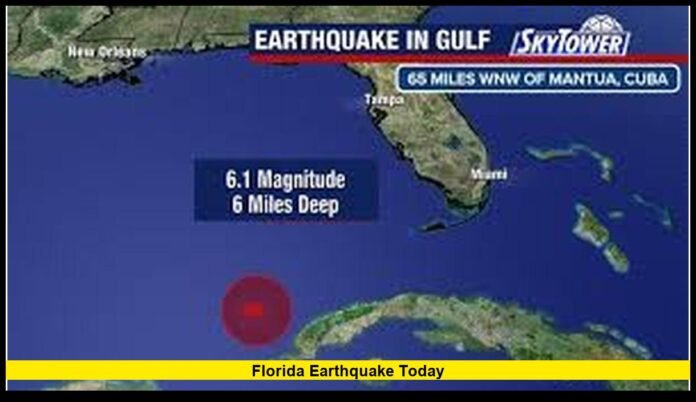

Florida earthquake today quickly became a major topic of discussion after a strong 6.1 magnitude earthquake near Cuba sent tremors across large parts of the Sunshine State. Residents from Miami to Jacksonville reported feeling buildings sway, furniture shake, and floors move as seismic waves traveled hundreds of miles from the earthquake’s epicenter.
The earthquake occurred on June 8, 2026, near western Cuba and was widely felt throughout Florida. While the event did not cause significant damage in the state, it generated thousands of reports from residents surprised by a phenomenon that remains relatively rare in Florida. Emergency officials confirmed there was no tsunami threat, and no major injuries were reported in connection with the shaking.
For many Floridians, the earthquake served as an unusual reminder that seismic activity in the Caribbean can sometimes be felt far beyond its origin.
Strong Earthquake Near Cuba Reaches Florida
The earthquake struck near the Cuban town of Mantua and produced enough energy to send seismic waves across the Florida Straits.
Although Florida was not the location of the earthquake itself, the state’s proximity to Cuba allowed residents to experience noticeable shaking. Reports began appearing within minutes as people described feeling vibrations in homes, apartments, office buildings, hotels, and public spaces.
Many residents initially questioned whether the movement was caused by construction work, heavy traffic, or strong winds. As reports spread across social media and emergency monitoring systems confirmed the event, it became clear that a significant earthquake had occurred in the region.
The quake’s final confirmed magnitude was listed at 6.1, making it one of the stronger seismic events felt by Florida residents in recent years.
Where Was the Earthquake Felt in Florida?
Reports came from nearly every major region of the state.
Residents in South Florida experienced some of the strongest effects due to their closer location to Cuba. However, tremors were also reported hundreds of miles away.
Areas where residents reported feeling shaking included:
- Miami
- Miami Beach
- Fort Lauderdale
- Hollywood
- Boca Raton
- West Palm Beach
- Naples
- Fort Myers
- Sarasota
- Tampa
- St. Petersburg
- Orlando
- Daytona Beach
- Gainesville
- Jacksonville
The widespread nature of the reports highlighted how far seismic energy can travel when a powerful earthquake occurs in the Caribbean region.
In many cases, people living on higher floors of apartment buildings and office towers reported stronger sensations than those at ground level.
Residents Describe Unusual Shaking
People across Florida shared remarkably similar experiences.
Many described a gentle rolling motion that lasted several seconds. Others reported hearing faint rattling sounds before noticing movement inside their homes.
Common observations included:
- Ceiling fans swaying
- Hanging decorations moving
- Windows vibrating
- Furniture shaking
- Light fixtures swinging
- Floors feeling unsteady
Some residents said the movement felt similar to standing on a boat in calm water. Others compared it to the sensation of a large truck passing nearby.
Because earthquakes are uncommon in Florida, many people had never experienced one before.
No Tsunami Threat Issued
Following any sizable earthquake near coastal waters, concerns often arise about the possibility of a tsunami.
Officials monitoring the June 2026 event quickly confirmed that there was no tsunami threat to Florida, Cuba, or neighboring regions.
This announcement provided reassurance to residents living along Florida’s Atlantic Coast and Gulf Coast, where tsunami warnings can trigger emergency response measures.
The absence of a tsunami threat allowed authorities to focus on monitoring aftershocks and collecting reports from affected areas.
Why Florida Felt a Distant Earthquake
One of the most common questions after the Florida earthquake today involved how a quake centered outside the United States could still be felt throughout the state.
Earthquakes release enormous amounts of energy when rocks deep underground suddenly shift along faults.
That energy travels outward through the Earth in waves.
Large earthquakes can generate seismic waves that travel hundreds of miles from the epicenter. When conditions are favorable, those waves remain strong enough to produce noticeable shaking far from the source.
Florida’s geographic location places it relatively close to several active seismic zones in the Caribbean. As a result, powerful earthquakes occurring in nearby regions can occasionally be felt across the state.
While such events are not common, they are not unprecedented.
How Rare Are Earthquakes in Florida?
Florida is generally considered one of the least earthquake-prone states in the nation.
Unlike California, Alaska, Washington, Oregon, and Nevada, Florida does not sit near a major tectonic plate boundary.
Most earthquakes felt in Florida originate elsewhere.
The state occasionally experiences:
- Caribbean earthquakes
- Offshore Atlantic earthquakes
- Gulf of Mexico seismic activity
- Distant earthquakes from neighboring regions
Because of this, earthquakes that generate noticeable shaking often receive significant public attention.
Many residents go years without feeling any seismic activity at all.
Geology Behind the Event
The Caribbean region contains several active fault systems where tectonic plates interact.
These geological boundaries create conditions that can produce earthquakes ranging from minor tremors to major seismic events.
The June 2026 earthquake occurred within one of these active zones.
When stress builds underground over time, rocks eventually break or shift, releasing stored energy. The resulting seismic waves spread outward from the rupture point.
In this case, the earthquake generated enough energy to cross the waters separating Cuba and Florida.
The event demonstrates how geological processes occurring outside U.S. borders can still have noticeable effects on American communities.
Read More – Earthquake Walnut Creek Just Now
Impact on Florida Communities
Despite the widespread reports of shaking, Florida escaped serious consequences.
Emergency management agencies monitored the situation closely following the earthquake.
The latest assessments indicated:
| Category | Status |
|---|---|
| Major Structural Damage | None Reported |
| Serious Injuries | None Reported |
| Tsunami Threat | None |
| Large Power Outages | None Reported |
| Transportation Disruptions | Minimal |
| Emergency Evacuations | Not Required |
Most impacts were limited to temporary concern among residents and brief interruptions as people attempted to determine the source of the shaking.
Businesses, schools, airports, and transportation systems continued operating normally.
Social Media Reactions Spread Quickly
Within minutes of the earthquake, social media platforms filled with posts from Florida residents.
Many users asked whether others had felt shaking.
Others shared videos showing:
- Swaying chandeliers
- Moving ceiling lights
- Rippling swimming pool water
- Vibrating decorations
The large number of posts helped demonstrate just how broadly the earthquake was felt.
Residents from different parts of the state compared experiences and quickly realized that the unusual movement was not isolated to a single neighborhood or city.
The event became one of the most discussed topics online in Florida during the hours following the quake.
Aftershocks Remain a Possibility
After a significant earthquake, smaller earthquakes known as aftershocks often occur.
Aftershocks happen as the Earth’s crust adjusts following the main seismic event.
These secondary earthquakes can continue for days or even weeks.
Most aftershocks are considerably weaker than the original earthquake.
Experts expect additional seismic activity in the region near the epicenter, though most of these events are unlikely to have any meaningful impact on Florida.
Only unusually strong aftershocks would have the potential to produce noticeable shaking across the state.
Earthquake Preparedness in Florida
Although earthquakes are rare in Florida, emergency planners encourage residents to understand basic earthquake safety procedures.
Knowing how to react during unexpected shaking can reduce injuries and improve safety.
Recommended actions include:
If You Are Indoors
- Drop to the ground.
- Take cover under sturdy furniture.
- Protect your head and neck.
- Stay away from windows.
- Remain inside until shaking stops.
If You Are Outside
- Move to an open area.
- Stay clear of buildings.
- Avoid power lines.
- Watch for falling debris.
If You Are Driving
- Pull over safely.
- Avoid stopping under bridges.
- Remain inside the vehicle.
- Wait until shaking ends.
Even in states where earthquakes are uncommon, understanding these basics can prove valuable during unexpected events.
How Earthquakes Are Detected So Quickly
Modern seismic monitoring networks operate continuously around the world.
Thousands of instruments track ground movement and transmit information in real time.
When an earthquake occurs, scientists can rapidly determine:
- Magnitude
- Location
- Depth
- Potential hazards
- Areas likely to feel shaking
These systems allow emergency officials to provide accurate public information within minutes.
Rapid analysis played an important role in confirming details of the June 2026 earthquake and reassuring residents that no tsunami threat existed.
Historical Earthquakes Felt in Florida
Florida has experienced several instances where distant earthquakes generated noticeable tremors.
Notable examples have included earthquakes originating in:
- Cuba
- Haiti
- The Caribbean Sea
- The Gulf of Mexico
- Offshore Atlantic regions
Most of these events caused little or no damage within Florida.
However, they often produced widespread reports from residents who felt shaking.
The June 2026 earthquake joins a relatively short list of seismic events that were experienced across large portions of the state.
Why High-Rise Buildings Feel More Movement
Many people who live in tall buildings reported stronger shaking than those in single-story homes.
This difference is normal during distant earthquakes.
High-rise structures can sway slightly when seismic waves pass through the ground.
The motion remains well within engineering limits but can make shaking feel more noticeable.
As a result, residents on upper floors often experience stronger sensations even when an earthquake occurs hundreds of miles away.
This explains why many reports came from apartment towers, office buildings, and hotels throughout South Florida.
Latest Situation Following the Earthquake
The situation remains stable following the earthquake near Cuba.
Authorities continue monitoring the region for aftershocks and collecting data from seismic networks.
Current confirmed information indicates:
- A magnitude 6.1 earthquake occurred near Mantua, Cuba.
- Tremors were felt across much of Florida.
- No tsunami warning was issued.
- No major damage has been reported in Florida.
- No significant injuries have been reported in Florida.
- Infrastructure systems remain operational.
The event stands as a reminder that earthquakes occurring in neighboring regions can occasionally be felt throughout the Sunshine State, even when the epicenter is located outside the United States.
For many residents, the Florida earthquake today was an unusual experience that highlighted the powerful reach of natural forces beneath the Earth’s surface.
Did you feel the Florida earthquake today? Share your experience in the comments and follow the latest updates as more information becomes available.