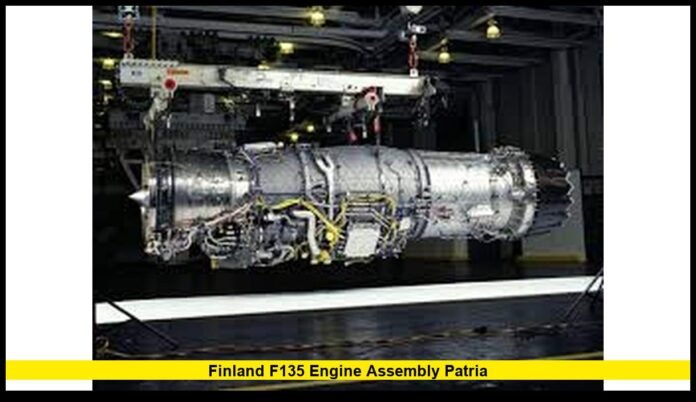

Finland F135 engine assembly Patria has reached a major milestone as the country completes its first locally assembled F135 fighter engine at the company’s new facility in Linnavuori, Nokia. The engine was completed on September 3, 2026, marking a significant step in Finland’s preparation for its incoming F-35A fleet.
The achievement comes at an important moment for Finland’s military aviation program. The country is preparing to receive its first F-35A aircraft at the Lapland Air Wing in Rovaniemi toward the end of 2026. At the same time, Patria is establishing the domestic industrial capability needed to support the aircraft’s propulsion systems.
The Linnavuori facility is designed to handle the F135 engine during different stages of its service life. Initial work centers on assembly, while the facility is expected to transition toward maintenance and overhaul operations beginning in 2030.
First F135 Engine Completed in Finland
Patria completed the first Finnish-assembled F135 engine at its new Linnavuori facility in Nokia. The milestone was formally marked during an event held at the site on September 3.
The achievement represents the first completed F135 engine assembled by Patria for Finland’s F-35 program.
The project brings together Patria, Pratt & Whitney, the Finnish Defence Forces and Finland’s Ministry of Defence. Pratt & Whitney is the RTX business responsible for the F135 propulsion system.
Patria and Pratt & Whitney reached their agreement for final assembly of the first Finnish F135 engines in February 2026. Production had already begun at Linnavuori before the September milestone was announced.
The assembly program is scheduled to continue through 2030.
That schedule gives Patria several years to establish and expand its technical experience before the facility moves toward its next major role.
Linnavuori Becomes a Key F135 Location
The Linnavuori facility has been developed specifically to support F-35 engine activities.
Construction of the assembly and maintenance facility was completed in October 2025. Defence Properties Finland constructed the facility and handed it over to Patria.
The building was developed under strict security requirements associated with the F-35 program and the F135 engine.
Its location in Nokia, near Tampere, provides Finland with a dedicated site for engine-related industrial work.
The facility initially focuses on assembly. Later, the same site is expected to support maintenance and overhaul operations.
That planned progression gives Linnavuori a role that extends well beyond the production of Finland’s first engines.
Assembly Is Only the Beginning
The first completed engine is an important production achievement, but Patria’s planned responsibilities are broader.
The company is responsible for initially assembling the F135 engines for Finland. Its future responsibilities include maintaining and repairing the engines as the Finnish F-35 fleet enters sustained operations.
A framework agreement covering future maintenance, repair, overhaul and upgrade work was signed by Patria and Pratt & Whitney in 2024.
The production and sustainment arrangement is designed around the long operational life of Finland’s F-35 fleet.
The initial assembly period is expected to run through 2030. The transition toward broader engine sustainment is planned from 2030 onward.
This means the Linnavuori facility is being developed as a long-term aerospace capability rather than a temporary production line.
Finland Prepares for Its First F-35A Aircraft
The timing of the first completed engine is closely linked to Finland’s aircraft delivery schedule.
Finland selected the F-35A to replace its F/A-18 Hornet fleet. The first Finnish F-35A aircraft are scheduled to arrive at the Lapland Air Wing base in Rovaniemi toward the end of 2026.
That makes the completion of the first engine particularly significant.
Finland is establishing its propulsion support infrastructure just as the new fighter aircraft begin entering the country.
The F-35 transition requires extensive preparation. Aircraft deliveries must be supported by trained personnel, secure facilities, technical systems and maintenance capabilities.
Engine support forms an essential part of that infrastructure.
Patria’s work at Linnavuori therefore provides an important domestic element of Finland’s wider F-35 preparation.
Why Domestic Engine Capability Matters
The F135 is a critical part of the F-35A system. Without reliable propulsion support, aircraft availability and operational readiness can be affected.
For Finland, maintaining important engine capabilities domestically provides a stronger national support base.
The country’s industrial participation program has a clear security-of-supply objective. Domestic capabilities can provide Finland with greater access to specialized technical expertise and infrastructure.
The Linnavuori project also creates a permanent location where Finnish personnel can develop experience with the F135.
That expertise will become increasingly valuable as Finland moves from aircraft acquisition toward long-term fleet operations.
The objective is not simply to assemble engines. It is to build the technical foundation required to support the propulsion systems throughout their service life.
Patria’s Experience Supports the New Program
Patria enters the F135 program with significant experience in military aviation support.
The company previously assembled General Electric engines for Finland’s Hornet fleet. It has also performed demanding maintenance, structural repair and lifecycle upgrade work for Finnish military aircraft.
That background provides an established technical base for its F-35 responsibilities.
The transition from Hornet support to F-35 support represents a major technological step.
The F-35 uses a highly advanced propulsion system and operates within a tightly controlled international industrial network.
Patria’s previous experience nevertheless provides an important foundation as Finnish specialists move into the new program.
The company has also been expanding its role in F-35 industrial cooperation beyond engine activities.
Its work includes F-35 forward fuselage assembly and manufacturing of structural components.
The engine program adds another major element to that industrial participation.
The Role of Pratt & Whitney
Pratt & Whitney remains central to the F135 program.
The company developed the F135 propulsion system used by the F-35 family and is working with Patria to establish Finnish assembly and sustainment capabilities.
Under the Finnish arrangement, Patria handles local engine assembly while working within Pratt & Whitney’s broader F135 support structure.
This model allows Finland to develop domestic expertise while remaining connected to the global F135 industrial network.
The cooperation is also important for maintaining common technical standards across the program.
As Finnish technicians gain experience with assembly work, that expertise can support the transition toward future maintenance operations.
Production Through 2030
The current production plan gives Patria several years of activity at Linnavuori.
Engine assembly is scheduled to continue until 2030.
During this period, Patria will continue building its workforce and technical knowledge around the F135.
The production phase is also expected to establish the foundation for the facility’s later sustainment role.
The company has estimated a direct employment impact of approximately 50 people between 2025 and 2030 under the agreement.
While that figure represents direct employment at Patria, the wider industrial significance extends to training, technical knowledge and the development of specialized aerospace capabilities.
The project therefore has value beyond the individual engines assembled at the facility.
Linnavuori’s Future After 2030
The next major stage begins around 2030.
At that point, the facility is expected to transition from its initial assembly role toward F135 maintenance, repair, overhaul and upgrade operations.
That change is important because Finland’s F-35 fleet will require continuous support after the initial aircraft deliveries.
Military aircraft engines need regular inspections, maintenance and specialized servicing throughout their operational lives.
Keeping this capability in Finland gives Patria a continuing role in supporting the country’s aircraft.
The facility is expected to remain involved throughout the lifecycle of Finland’s F-35 fleet.
That long-term commitment makes the current assembly work particularly important. The skills developed today are intended to support a much broader sustainment mission in the future.
A New Industrial Capability for Finland
The first engine also demonstrates how Finland’s F-35 acquisition is creating new domestic industrial capabilities.
Buying a modern fighter aircraft involves more than receiving aircraft from a manufacturer.
Finland has been developing infrastructure, production arrangements and technical expertise to support the F-35 over the long term.
The Linnavuori project is one of the clearest examples of that approach.
The facility gives Finnish industry a direct role in one of the aircraft’s most important systems.
It also deepens the relationship between Finnish defense industry and major U.S. aerospace companies.
For Finland, the project supports national supply security. For the wider F-35 program, it adds another specialized location within the international production and sustainment network.
Importance for Finland’s Air Force
The Finnish Air Force is preparing for a major transition as the F/A-18 fleet gives way to the F-35A.
That transition involves changes across training, infrastructure, logistics and maintenance.
The new aircraft require new support arrangements, including specialized engine capabilities.
Patria’s work helps address that requirement before Finland begins receiving its first F-35As.
The first locally assembled engine therefore arrives at an important point in the transition.
Finland now has a completed F135 engine produced through its own domestic industrial capability.
The achievement demonstrates that the program has moved from planning and facility construction into active production.
The U.S.-Finland Defense Connection
The Linnavuori project also has significance for the broader U.S.-Finland defense relationship.
The F-35 program connects Finland to a large international network involving aircraft production, engine manufacturing, maintenance and technical support.
Patria’s work places Finnish industry directly within that network.
The relationship with Pratt & Whitney provides a specific link between Finnish aerospace expertise and the U.S. company responsible for the F135 engine.
The project also supports Finland’s integration into the wider F-35 community.
For U.S. observers, the development illustrates how F-35 procurement increasingly involves industrial participation in customer countries.
Finland is not simply receiving completed aircraft. It is developing capabilities to support them domestically.
What the September Milestone Changes
The September 3 completion confirms that Patria’s F135 assembly capability is now operational.
The company has moved from facility preparation to completed engine assembly.
That distinction matters because the Linnavuori project had been under development for several years.
The facility was completed in 2025. The final assembly agreement followed in February 2026. Production then progressed toward the first completed engine.
The September milestone provides a visible result from that preparation.
It also comes before the first Finnish F-35A aircraft arrive in Rovaniemi.
As a result, Finland is entering the next stage of its fighter transition with a domestic engine assembly capability already established.
Long-Term Significance of the Program
The long-term importance of the Linnavuori program will extend beyond the first group of engines.
Finland intends to operate the F-35A for decades. The country will therefore need dependable technical support throughout the aircraft’s service life.
Patria’s planned transition into engine maintenance and overhaul provides part of that long-term structure.
The program also gives Finnish personnel an opportunity to build specialized expertise in F135 technology.
Over time, the knowledge developed through assembly can support more advanced maintenance responsibilities.
This creates continuity between production and sustainment.
Instead of treating the two activities as separate programs, Finland is establishing a pathway from initial engine assembly to long-term support.
Current Status of Finland’s F135 Program
As of September 6, 2026, Patria has completed Finland’s first F135 engine at Linnavuori.
Production remains scheduled through 2030.
The facility is expected to transition toward broader engine maintenance and overhaul activities beginning around 2030.
Finland’s first F-35A aircraft remain scheduled to arrive at the Lapland Air Wing in Rovaniemi toward the end of 2026.
The sequence is significant.
Finland has established the engine facility, started production and completed its first engine before the country begins receiving its new fighter aircraft.
That gives the F-35 program a domestic propulsion-support capability at the beginning of the aircraft’s introduction into Finnish service.
A Milestone With Long-Term Consequences
The first F135 assembled in Finland represents a major development for Patria and Finland’s defense industry.
The Linnavuori facility now has a demonstrated ability to assemble the engine that will power Finland’s F-35A fleet.
Its future role is even broader, with maintenance, repair, overhaul and upgrade activities planned as the program develops.
For Finland, the project strengthens domestic expertise and supply security. For Patria, it creates a long-term role in the international F-35 industrial network.
The September milestone also arrives just before Finland’s first F-35As are scheduled to reach Rovaniemi.
That makes the achievement an important marker in Finland’s transition to its new fighter fleet.
The program has now entered a practical phase in which aircraft deliveries, engine production and domestic support capabilities are developing together.
The first Finnish-assembled F135 engine is more than a production milestone—it marks the beginning of a long-term capability that will shape Finland’s F-35 support network for years to come.
What do you think about Patria’s new F135 role in Finland’s F-35 program? Share your thoughts and stay informed as the next stage of the Finnish fighter transition unfolds.