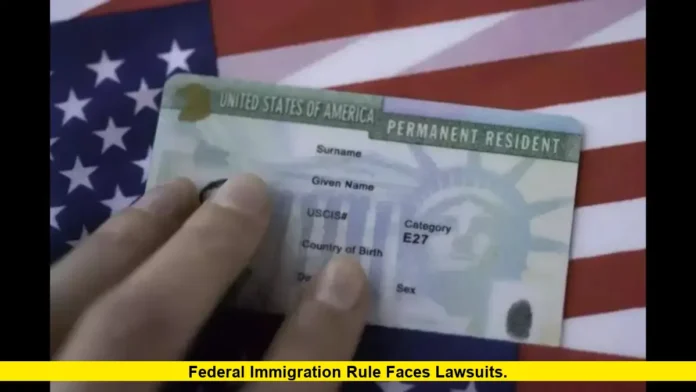

A new federal immigration rule is facing major legal challenges from states, cities and counties just days before it is scheduled to take effect. The Department of Homeland Security’s revised “public charge” policy would give immigration officers broader discretion to consider an applicant’s use or potential use of means-tested public benefits when deciding whether the person is likely to become a public charge.
The lawsuits were filed on September 14 by a coalition of 22 states and the District of Columbia, along with a separate group of local governments led by New York City. Both cases were filed in the U.S. District Court for the Southern District of New York and seek to stop the policy before its scheduled September 18 effective date.
What Is the New Federal Immigration Rule?
The policy concerns the long-standing immigration concept known as the public charge ground of inadmissibility. Under federal immigration law, certain people seeking admission to the United States or adjustment of status can be found inadmissible if immigration authorities determine they are likely at any time to become a public charge.
The new DHS rule rescinds the regulatory framework adopted in 2022 and returns immigration officers to a broader, case-by-case assessment of the circumstances surrounding an applicant. DHS says the change will restore officer discretion and better reflect Congress’s requirement that immigrants be self-reliant.
The final rule was published in the Federal Register on July 20, 2026. It is scheduled to become effective on September 18, 2026. Applications for admission made on or after that date and adjustment-of-status applications postmarked or submitted electronically on or after that date are covered by the new framework.
Why Public Benefits Are at the Center of the Dispute
One of the biggest changes involves the range of government assistance that immigration officers may consider.
Under the 2022 framework, the public charge analysis was considerably narrower. The new rule removes the regulatory definitions and exclusions that limited which benefits could be considered. DHS states that officers may consider means-tested public benefits as part of the totality of an applicant’s circumstances.
The Federal Register specifically says that benefits such as Medicaid are not automatically determinative. Instead, officers may consider their relevance alongside factors such as age, health, family circumstances, assets, resources, financial condition, education and skills.
That distinction is important. Using a public benefit does not automatically mean an immigrant will be denied a green card or visa. Rather, the benefit can become one factor in the broader public charge assessment.
Which Benefits Could Be Considered?
The revised framework potentially allows immigration officers to consider a wider range of means-tested public benefits than under the 2022 regulations.
Government assistance discussed in connection with the new policy includes programs involving:
- Medicaid and certain health coverage
- SNAP and food assistance
- Housing assistance
- Other means-tested government benefits
DHS has stated that no single benefit is necessarily outcome-determinative. Instead, officers are expected to examine the applicant’s circumstances as a whole.
The rule also establishes an important transition provision. Public benefits received before September 18, 2026, are to be considered under the 2022 framework, while the new framework applies to relevant benefits received or applied for on or after the effective date.
Why 22 States and the District of Columbia Filed Suit
New York Attorney General Letitia James is leading the multistate lawsuit. The coalition includes New York, California, Illinois, Colorado, Connecticut, Delaware, Hawaii, Maine, Maryland, Massachusetts, Michigan, Minnesota, New Jersey, New Mexico, Nevada, Oregon, Pennsylvania, Rhode Island, Vermont, Virginia, Washington and Wisconsin, along with the District of Columbia.
The states argue that DHS exceeded its legal authority by substantially expanding how public benefits can influence immigration decisions.
The lawsuit also argues that the rule could discourage immigrant families from using benefits they are legally eligible to receive. State officials say that could have consequences beyond immigration cases, including increased pressure on hospitals, health systems and state-funded programs.
California Attorney General Rob Bonta’s office argues that the federal government’s approach goes beyond the historical concept of a person being primarily dependent on government assistance and unlawfully changes longstanding immigration policy.
Cities and Counties File a Separate Lawsuit
A separate legal challenge was filed by New York City, Chicago, San Francisco, Santa Clara County and Seattle, together with King County, Washington. The local-government coalition is represented in part by the Public Rights Project.
The local governments argue that the policy could produce a “chilling effect,” causing eligible families to avoid healthcare, food assistance and other programs because they fear that participation could eventually affect immigration applications.
They also contend that reduced use of public programs could shift costs to local governments and healthcare providers. The coalition points to potential increases in uncompensated care and other expenses if people stop using programs that help cover basic services.
What the Trump Administration Says
The Trump administration has defended the federal immigration rule as an effort to reinforce the principle that immigrants should be able to support themselves rather than depend on taxpayer-funded government assistance.
USCIS said the 2022 regulations restricted officers’ ability to review all relevant facts and that the new rule restores broader discretion for individualized determinations.
DHS also maintains that public benefits should not serve as an incentive for immigration and that immigration officers should have the ability to evaluate an applicant’s complete financial and personal circumstances.
What the Lawsuits Are Asking the Court to Do
The state coalition is asking the federal court to declare the new rule unlawful and prevent it from taking effect.
The states argue that the Department of Homeland Security’s action violates the Administrative Procedure Act and exceeds the agency’s authority under federal immigration law. California and other plaintiffs also contend that the rule is arbitrary and inadequately justified.
The local-government lawsuit similarly seeks judicial intervention before the September 18 implementation date. Its case number is 1:26-cv-07982, and the case is pending in federal court in New York.
What Happens Before September 18?
The immediate issue is whether the courts will block the federal immigration rule before it takes effect.
As of the latest verified information available on September 15, the lawsuits have been filed, but the rule remains scheduled to become effective on September 18. The Federal Register continues to list September 18 as the effective date.
That means the next few days could be significant. The courts could consider requests for emergency relief, including an order temporarily preventing implementation while the lawsuits proceed.
Until a court issues an order changing the situation, the scheduled effective date remains September 18.
How the Rule Could Affect Green Card Applicants
For people seeking permanent residence through adjustment of status, the most important change is the broader discretion immigration officers will have when assessing whether an applicant could become a public charge.
The new framework does not establish a simple rule saying that receipt of Medicaid, SNAP, housing assistance or another benefit automatically results in a green card denial. Instead, those factors can potentially be evaluated together with the applicant’s financial resources, health, family situation, education, skills and other circumstances.
For that reason, applicants should avoid assuming that participation in a particular program automatically makes them ineligible for permanent residence. Individual circumstances and the specific immigration category involved remain important.
What About Visa Applicants?
The public charge ground of inadmissibility can also be relevant to people seeking admission to the United States, including certain visa applicants.
The new DHS rule applies to applications for admission made on or after September 18, 2026, while adjustment-of-status applications submitted on or after that date are also subject to the new framework.
The lawsuits therefore have implications beyond green card applicants already living in the United States. The broader public charge assessment may also affect certain people seeking admission from abroad.
A Major Immigration Policy Dispute Is Now Before the Courts
The dispute over the federal immigration rule represents another major legal battle over how the government evaluates financial self-sufficiency in immigration cases.
DHS argues that restoring broader discretion will allow officers to make more complete and individualized decisions. The states and local governments challenging the policy argue that the approach is too broad, could discourage lawful use of public programs and exceeds the authority Congress gave the agency.
The outcome of the litigation could determine whether the new framework takes effect as scheduled, is temporarily blocked, or ultimately survives in its current form.
For immigrants and families watching the issue closely, September 18 remains the key date to watch unless a federal court intervenes beforehand.
The federal immigration rule is moving toward a crucial September 18 deadline, so stay tuned for the latest court developments and share your thoughts in the comments.