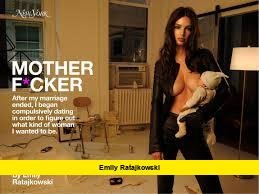

Emily Ratajkowski — supermodel, bestselling author, actress, and one of the most fearlessly outspoken voices in celebrity culture — has once again ignited conversation with a bold, provocative move. The 34-year-old appeared topless and staged a symbolic ‘breastfeeding’ of a baby doll as part of a striking visual essay for New York Magazine, exploring what it means to be a sexual being and a single mother at the same time. The imagery and accompanying essay are raw, layered, and unmistakably EmRata — and predictably, the internet has opinions.
Who Is Emily Ratajkowski? A Quick Recap
Born on June 7, 1991, in London and raised in San Diego, California, Emily O’Hara Ratajkowski first rose to global fame after appearing in Robin Thicke’s controversial “Blurred Lines” music video in 2013. From there, she became one of the most recognizable faces in the fashion and entertainment industry — appearing on the covers of dozens of major magazines, walking runways for Marc Jacobs, starring in David Fincher’s Gone Girl (2014), and building a multimillion-dollar swimwear brand, Inamorata.
But Ratajkowski has always refused to be a one-note figure. Her 2020 essay for New York Magazine’s The Cut, titled “Buying Myself Back: When Does a Model Own Her Own Image?”, became the publication’s most-read story of that year and catapulted her into a new dimension of public discourse — as a writer and intellectual force. The essay became the cornerstone of her New York Times bestselling book My Body (2021), which cemented her reputation as one of the most thoughtful commentators on female sexuality, power, and the male gaze.
The New York Magazine Essay: What We Know
The latest New York Magazine piece finds Ratajkowski in a place that is both deeply personal and culturally loaded. The topless imagery — featuring the model cradling and appearing to breastfeed a baby doll — is not shock value for its own sake. It is the kind of deliberately crafted visual provocation that Ratajkowski has become known for: imagery that forces the viewer to sit with the discomfort of seeing a beautiful, sexual woman also occupying the role of caregiver and mother.
The central question the essay appears to wrestle with is one that millions of single mothers quietly grapple with: Can a woman be openly sexual and also be a good mother? Can desire, desirability, and devoted parenthood coexist — or does society demand that mothers leave their sexuality at the door?
It is a conversation Ratajkowski is uniquely positioned to have. Since her divorce from film producer Sebastian Bear-McClard was finalized after the couple split in 2022, she has been raising their son, Sylvester Apollo Bear (born March 2021, and affectionately known as “Sly”), largely on her own — all while remaining one of the world’s most photographed women.
The Symbolism Behind the Baby Doll
The use of a baby doll rather than an actual infant is a deliberate artistic and ethical choice. It creates distance — protecting Sly’s privacy while still centering the emotional truth of motherhood. It also taps into a rich history of provocative art using dolls as surrogates for real human vulnerability and tenderness.
The juxtaposition of toplessness and the nursing act is the essay’s sharpest edge. It confronts the cultural double standard head-on: society is simultaneously obsessed with Emily Ratajkowski’s body as a sexual object and deeply uncomfortable with that same body performing the natural, biological act of nurturing. The essay essentially asks: why can’t these two things exist in the same body, in the same moment?
Emily on Being a Single Mom: In Her Own Words
Ratajkowski has never hidden the challenges and contradictions of single motherhood in the public eye. Speaking to Elle UK, she said: “It feels like I should always be choosing him over anything I do, but if I want to make money, I have to take jobs. Especially now, as a single mom, where I’m the breadwinner. But I feel pulled in many directions. You sacrifice so much of your identity when you become a mother. And I feel like my life is just beginning.”
She has also spoken about the impossible standards placed on mothers specifically. In early 2024, after commenters flooded her posts with messages telling her she didn’t “deserve to be a mom,” she hit back publicly with two words: “Shame on you.”
And yet, Ratajkowski has been steadfast in her refusal to perform conventional motherhood for public approval. She has been photographed in micro bikinis on beach days with Sly. She has taken him to Paris Fashion Week. She posed topless for Mother’s Day. She has twerked in a New York bodega. She once said: “I will wear whatever the hell I want, as much makeup as I want, and make myself feel good — which sometimes means being sexy and sometimes doesn’t.”
The New York Magazine essay is, in many ways, the most fully articulated version of that philosophy yet.
A History of Provocative Storytelling
This is far from the first time Ratajkowski has used her body and her writing to challenge cultural norms. Her 2020 New York Magazine essay “Buying Myself Back” examined how her image had been repeatedly claimed, monetized, and weaponized by others without her consent — from paparazzi who sued her for posting her own photo, to photographer Jonathan Leder, who published intimate Polaroids of her taken during a 2012 shoot without her knowledge or agreement. The essay sparked widespread conversation about copyright, consent, and the exploitation of women’s bodies in the image economy.
Her My Body essay collection went further, tracing the complicated terrain of growing up beautiful, being sexualized from a young age, and learning — painfully and slowly — that the “empowerment” she was told her sexuality represented was, in many ways, a carefully constructed illusion designed to serve everyone but her.
The new essay continues that arc, but from a new vantage point: single motherhood in her thirties, with a child watching, a public watching, and an internal self that refuses to be diminished by either.
What’s Next for Emily Ratajkowski
Beyond the essay, Ratajkowski’s career is entering one of its most exciting chapters. In August 2025, it was announced that Apple TV+, in partnership with A24, is in early development on an untitled series exploring female identity and modern motherhood. Ratajkowski is co-writing and executive producing the project alongside bestselling Sweetbitter author Stephanie Danler, with Girls creator Lena Dunham serving as executive producer. It will mark Ratajkowski’s screenwriting debut and reunites her with Dunham following their work together on the Netflix series Too Much.
She also walked the runway at New York Fashion Week for Tory Burch in early 2026, appeared backstage at the Victoria’s Secret Fashion Show in late 2025, and continues to front major campaigns including L’Oréal’s Kérastase hair care line.
Her podcast, High Low with EmRata, remains a destination for candid conversations about culture, politics, feminism, and life — amassing millions of listeners since its launch.
The Conversation She’s Forcing Us to Have
What makes the New York Magazine essay so potent is not just the imagery — it is the refusal to apologize for the contradiction. Emily Ratajkowski is a topless woman nursing a baby doll, and she is daring you to decide what that means. Is it art? Is it feminism? Is it exploitation? Is it healing?
The answer, if Ratajkowski’s body of work is any guide, is: all of the above — and that’s exactly the point. Mothers are sexual. Sexual women are mothers. The discomfort that creates is a cultural problem, not a personal one. And few people in the public eye are as well-equipped — or as willing — to hold that discomfort up to the light and refuse to let it go.
What do you think about Emily Ratajkowski’s bold New York Magazine essay? Is she redefining the narrative around motherhood and sexuality — or is this too far? Drop your thoughts in the comments below, and follow us for more updates as this story develops!