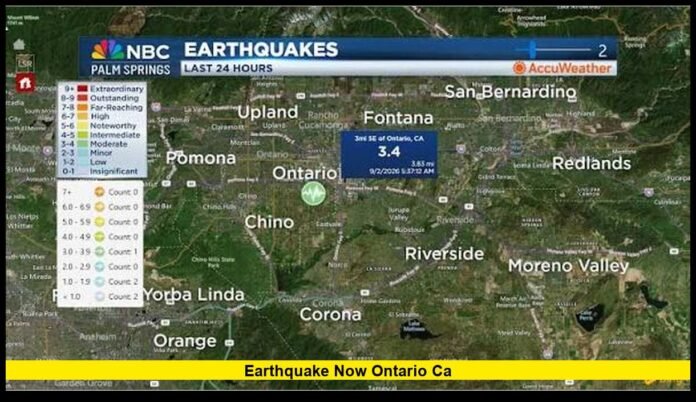

earthquake now ontario ca reports are drawing attention after a magnitude 3.4 earthquake struck southeast of Ontario early Wednesday morning. The quake occurred at approximately 5:37 a.m. Pacific time on September 2, 2026, at a depth of nearly four miles. The shaking was felt across parts of the Inland Empire and nearby Southern California communities. No injuries or damage were immediately reported.
The earthquake was centered about six kilometers southeast of Ontario. Its shallow depth helped make the movement noticeable to people living near the epicenter. Residents in communities including Fontana and Chino reported feeling the shaking during the early morning hours.
The event was strong enough to wake some people from sleep, but it did not produce the type of widespread impact associated with a major earthquake. Initial reports described light shaking across much of the affected area.
Latest Earthquake Update Near Ontario
The latest confirmed information places the earthquake southeast of Ontario in San Bernardino County. The event registered magnitude 3.4 and occurred shortly after 5:37 a.m. local time.
The earthquake’s depth was approximately 6.16 kilometers, or about 3.8 miles. That makes it a shallow earthquake, meaning the seismic activity occurred relatively close to the Earth’s surface.
The combination of location and depth explains why residents noticed the event despite its moderate size. Ontario and surrounding Inland Empire communities are relatively close to the epicenter.
Initial reports found no injuries or property damage. Emergency conditions were not reported across Ontario following the shaking.
Earthquake measurements can receive minor revisions as seismic agencies process additional data. The latest available information continues to identify the event as a magnitude 3.4 earthquake.
Where the Earthquake Happened
The epicenter was approximately six kilometers southeast of Ontario.
The location placed the earthquake close to several populated communities in the Inland Empire. Ontario, Chino and Eastvale are among the communities located near the reported epicenter.
The earthquake’s position also explains why reports came from beyond Ontario itself. Seismic waves travel outward from an earthquake’s source, allowing people several miles away to feel the movement.
Early reports indicated that people in Fontana and Chino noticed the shaking. Residents in other parts of Southern California also reported feeling movement.
The intensity was not identical everywhere. Distance from the epicenter, local ground conditions and building characteristics can influence how an earthquake feels.
Someone near the epicenter may experience a sharper jolt. A resident farther away may notice only a brief vibration or rolling movement.
When the Ontario Earthquake Struck
The earthquake occurred at about 5:37 a.m. PDT on September 2.
The early morning timing made the event particularly noticeable for people who were asleep. Residents in nearby communities reported being awakened by the shaking.
At that hour, many homes were quiet and occupants were stationary. A short burst of ground movement can therefore feel more dramatic than it might during a busy daytime period.
The earthquake lasted only a short time, but residents quickly began sharing reports about what they had experienced.
The timing also helped explain the rapid attention surrounding the event. People who woke up to rattling or movement often checked earthquake tracking services to determine what had happened.
How Strong Was the Earthquake?
The earthquake measured magnitude 3.4.
That is considered a relatively small earthquake, although earthquakes of this size can be clearly felt when they occur close to populated communities.
Magnitude describes the size of an earthquake at its source. It does not tell the complete story about how people experience the shaking.
Depth and distance also matter. A shallow earthquake close to a city can produce noticeable shaking even without causing significant structural damage.
The Ontario earthquake provides a clear example. Its magnitude was modest, but its epicenter was only a few miles from Ontario.
Residents close to the event could therefore feel the shaking more clearly than people much farther away.
Why So Many People Felt the Shaking
The earthquake happened beneath an area with a large population.
Ontario and neighboring Inland Empire cities contain thousands of homes, businesses and other structures. A quake occurring nearby can therefore generate many public reports even when its magnitude remains relatively low.
The shallow depth was another important factor.
The earthquake occurred at about 6.16 kilometers beneath the surface. That relatively shallow depth put the source close enough to the surface for nearby residents to notice the movement.
People can experience the same earthquake in very different ways. One person may describe a quick jolt, while another may feel a short period of vibration.
The building itself can also affect the experience. Upper floors may move differently from ground-level rooms, and loose objects can amplify the impression of shaking.
Communities That Reported Shaking
Reports following the earthquake came from multiple Inland Empire communities.
Fontana and Chino were among the areas where residents reported feeling the earthquake. Other locations in Southern California also appeared within the broader felt area.
The shaking did not mean that every resident in those cities experienced it. Earthquake effects can vary significantly even within the same community.
People closer to the epicenter generally have a greater chance of noticing a small earthquake.
Residents farther away may only notice movement under favorable conditions, such as being indoors in a quiet room.
Public earthquake reports help show this variation by collecting observations from people in different locations.
No Injuries or Damage Immediately Reported
The latest reports did not identify injuries or property damage from the earthquake.
That is an important distinction because earthquakes can be widely felt without becoming destructive.
A magnitude 3.4 event can rattle windows, move small objects or briefly shake furniture. Those experiences can be startling, particularly when they happen before sunrise.
They do not necessarily indicate structural damage.
Initial reports from the Ontario area did not point to a major emergency. There were also no immediate reports of widespread infrastructure problems connected to the quake.
Officials and residents can still discover minor issues after an earthquake. People may notice objects that fell from shelves or small items that shifted during the shaking.
For that reason, residents should remain alert after feeling an earthquake even when the initial reports appear reassuring.
What Residents Felt During the Quake
The descriptions from residents varied.
Some people described enough movement to wake them from sleep. Others noticed lighter shaking or vibration.
The difference is normal during an earthquake.
A person near the epicenter may feel a sudden jolt. Someone farther away may experience a slower or less noticeable movement.
Buildings can also change how shaking feels. A structure can sway or transmit vibration differently depending on its construction and height.
Loose objects can provide additional clues. Windows, doors, hanging fixtures and items on shelves can move during even a relatively small earthquake.
These details help explain why residents sometimes report dramatically different experiences from the same seismic event.
What the Earthquake Data Shows
The latest earthquake information identifies the event as a magnitude 3.4 earthquake approximately six kilometers southeast of Ontario.
The reported coordinates place the epicenter in the Ontario area of Southern California. The event occurred at approximately 5:37:12 a.m. local time.
The depth was approximately 6.16 kilometers.
Those measurements provide the basic profile of the event:
- Magnitude: 3.4
- Date: September 2, 2026
- Local time: approximately 5:37 a.m. PDT
- Epicenter: about 6 kilometers southeast of Ontario
- Depth: approximately 6.16 kilometers
- Region: San Bernardino County and Inland Empire
- Immediate injuries: none reported
- Immediate major damage: none reported
These figures represent the latest available information and may receive minor adjustments as earthquake data undergoes further review.
Earthquake Activity Around Ontario
The magnitude 3.4 event was not the only small earthquake recorded near Ontario in recent days.
Seismic monitoring data showed smaller events in the Ontario and surrounding Inland Empire area before the September 2 earthquake. A magnitude 1.0 earthquake was recorded about five kilometers southeast of Ontario on September 1.
Other small events were also recorded near Fontana and Lytle Creek.
Small earthquakes are common enough in Southern California that seismic monitoring systems regularly detect events that residents never feel.
Most earthquakes are too small to cause noticeable movement.
The September 2 event received more attention because its magnitude and location allowed people in several nearby communities to feel it.
Could More Shaking Happen?
Earthquake sequences can sometimes include additional seismic activity. However, the available information does not establish a significant aftershock sequence associated with the Ontario earthquake.
Residents should not assume that every small earthquake occurring afterward is automatically an aftershock.
Scientists evaluate the timing and location of seismic events when determining whether they belong to the same sequence.
The safest approach for residents is simple. If additional shaking occurs, people should respond to the shaking rather than trying to determine its classification in the moment.
That means protecting yourself first and checking official information afterward.
What to Do If Another Earthquake Happens
Residents who experience another earthquake should immediately focus on personal safety.
The standard approach is to drop, take cover and hold on.
Getting down helps prevent a person from being knocked over. Taking cover under a sturdy table or desk can provide protection from falling objects.
People should also stay away from windows and other objects that could break or fall.
Running outside while the ground is moving can create additional risks. Falling debris, glass and other hazards can make doorways, streets and exterior areas dangerous during active shaking.
Once the shaking stops, residents can assess their surroundings and check for immediate hazards.
People should avoid damaged buildings until they are considered safe.
Why the Earthquake Attracted Attention
The earthquake received immediate attention because it occurred close to Ontario and several other heavily populated communities.
Small earthquakes can become major local news events when residents feel them unexpectedly.
The early morning timing added to the surprise. Many people were asleep when the shaking began, and reports from residents quickly confirmed that the movement was not isolated to a single home.
The event also generated public interest because Southern California residents are accustomed to monitoring seismic activity.
When people feel unexpected shaking, one of the first questions is often whether others experienced the same thing.
In this case, reports from multiple Inland Empire communities showed that the earthquake was felt beyond the immediate epicenter.
How Earthquake Reports Develop After a Quake
Earthquake information often changes during the first several hours after an event.
Initial systems can identify an earthquake quickly. Scientists then continue reviewing seismic readings to improve the location, depth and magnitude.
That process can result in small changes to the original numbers.
Public reports can also increase after an earthquake becomes widely known. Residents may submit their experiences several minutes or hours after the event.
As more reports arrive, scientists can develop a clearer picture of how widely the shaking was felt.
For the Ontario earthquake, the initial information already showed a clear pattern of light shaking across portions of the Inland Empire.
Ontario Residents Continue to Watch for Updates
For people in Ontario and surrounding communities, the most important information remains the current status of the earthquake.
The event measured magnitude 3.4 and occurred southeast of Ontario shortly after 5:37 a.m. Wednesday.
Its shallow depth helped make the earthquake noticeable across nearby communities.
People in Fontana and Chino reported feeling the movement, while the broader felt area extended into other portions of Southern California.
No injuries or major damage were immediately reported.
Residents should still pay attention to updated earthquake information because preliminary measurements can change as additional data becomes available.
The current picture, however, remains that of a small but widely felt earthquake rather than a major damaging event.
What the Latest Update Means
The latest information provides several clear takeaways for Ontario residents.
First, the earthquake was real and occurred close to the city. Second, its magnitude was 3.4. Third, it was relatively shallow at roughly 3.8 miles deep.
Fourth, the shaking reached communities beyond the immediate epicenter. Finally, there were no immediate reports of injuries or significant damage.
Those details help put the event into perspective.
A noticeable earthquake does not automatically mean a dangerous earthquake. At the same time, every earthquake serves as a reminder that residents should know how to respond when shaking begins.
The September 2 event was strong enough to wake people and generate widespread reports, but the latest information does not show evidence of a major emergency.
As earthquake agencies continue monitoring Southern California, residents can use updated seismic information to understand any new activity near Ontario.
The latest Ontario earthquake was widely felt but caused no immediate reports of major damage, and residents can share what they experienced while staying alert for verified updates.