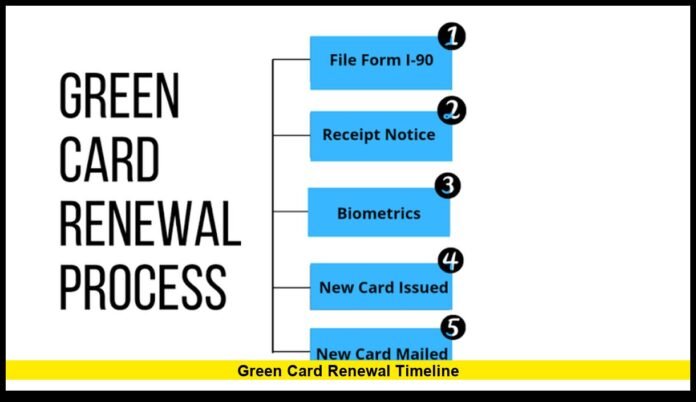

Green card renewal timeline information shows that U.S. permanent residents filing Form I-90 should currently expect a wait of about 10.5 months for most 10-year renewals. The latest USCIS processing data available in August 2026 places the 80th-percentile processing time at 10.5 months, while the case-inquiry threshold reaches 12.5 months for that category.
That represents a significant change from the much shorter processing periods seen in earlier fiscal years. USCIS historical data shows a national median of 8.5 months for Form I-90 cases during fiscal year 2026 through May 31, compared with 4.1 months in fiscal year 2025 and 1.1 months in fiscal year 2024.
For people with an expiring 10-year Permanent Resident Card, the longer wait makes early preparation especially important. At the same time, USCIS has a 36-month extension for eligible I-90 applicants through their receipt notices, helping permanent residents document their status while the renewal remains pending.
Green card holders have specific rights and restrictions when it comes to participating in U.S. elections. Read more about whether green card holders can vote and what the law says here.
Current processing time for a 10-year Green Card renewal
The latest USCIS processing information separates Form I-90 into different categories.
For a standard 10-year renewal, USCIS currently reports:
| I-90 category | Current processing information |
|---|---|
| 10-year renewal | 10.5 months |
| Case inquiry threshold | 12.5 months |
| Initial issuance or replacement | 6 months |
| Initial issuance or replacement inquiry threshold | 9 months |
The 10.5-month figure represents the time USCIS recently took to complete 80% of cases in the applicable category. It is not a guaranteed deadline for every applicant.
The 12.5-month figure has a different purpose. It indicates the point at which an applicant may be able to submit a case inquiry because the application has remained pending beyond the agency’s normal processing period. Current data lists August 23, 2025 as the receipt date associated with the 93% inquiry threshold for the 10-year renewal category.
These numbers can change when USCIS publishes new processing information.
Why the renewal wait has become longer
Recent USCIS historical figures show that Form I-90 processing has moved considerably over the past few fiscal years.
The national median processing times were:
- FY2024: 1.1 months
- FY2025: 4.1 months
- FY2026 through May 31: 8.5 months
USCIS defines the median as the point at which half of the cases were completed within the reported period. Therefore, the historical median should not be confused with the current 80th-percentile processing figure for a specific I-90 category.
The latest category-specific figure is more useful for someone preparing a standard 10-year renewal today.
The current 10.5-month estimate also explains why older online articles may give applicants an unrealistic expectation. Processing information can change substantially over time.
When to file Form I-90
A regular 10-year Permanent Resident Card can be renewed when it is expired or within six months of its expiration date.
Permanent residents should pay close attention to the expiration date printed on the card. Because the current processing period can extend close to a year, waiting until the final weeks before expiration can create avoidable pressure.
Form I-90 is the application used to replace or renew an existing Permanent Resident Card. USCIS also uses the form for certain replacement situations involving a card that has been lost, stolen, damaged, or contains other problems.
The correct filing category matters because USCIS reports different processing times for different I-90 classifications.
How the renewal process begins
The process starts when USCIS receives Form I-90.
Applicants can file Form I-90 online or by paper, depending on their circumstances and eligibility.
Once USCIS accepts the application, the agency issues a receipt notice. The receipt contains the case’s unique receipt number, which can be used to track the application.
USCIS says applicants generally should receive a receipt notice within 30 days after filing at a service center or lockbox.
The receipt notice is particularly important when the physical Green Card is approaching expiration.
The 36-month extension is especially important
One of the most significant current rules for applicants with pending I-90 cases involves the validity extension printed on qualifying receipt notices.
USCIS has updated the language on Form I-90 receipt notices to provide a 36-month extension of Green Card validity for individuals with newly filed I-90 applications that remain pending.
The agency says applicants can present the receipt notice together with their expired Green Card as evidence of continued lawful permanent resident status while waiting for the renewed card.
This provision is particularly relevant when processing takes many months.
A permanent resident therefore does not necessarily need to receive the new physical card before the original card’s expiration date to have documentation supporting continued permanent resident status.
Applicants should keep both documents together and avoid discarding the expired card.
What happens after the receipt notice
Receiving the receipt notice does not mean the application has been approved.
It confirms that USCIS has accepted the filing into its processing system.
The applicant may then receive additional notices depending on the circumstances of the case.
USCIS may reuse previously collected biometrics or require an applicant to appear for biometric services. Applicants should follow the instructions on any appointment notice and continue checking their USCIS account if they use online case management.
The agency may also send a Request for Evidence or another notice if additional information is required.
USCIS specifically advises applicants to check their case status before submitting an inquiry about a notice that they believe has not arrived.
Biometrics and case review
Biometrics can be part of the I-90 process, although applicants should not assume that every renewal requires a new appointment.
If USCIS schedules an appointment, the applicant should follow the appointment instructions carefully.
After the required identity and security steps, USCIS continues reviewing the application.
A case can remain in processing for an extended period without producing frequent status updates. That does not by itself mean the application has been denied or lost.
Applicants should continue monitoring their case through official USCIS tools.
How to check your renewal case
The USCIS online case-status system allows applicants to check the latest status associated with their receipt number.
The receipt number is a 13-character identifier containing three letters followed by 10 numbers. USCIS uses the number to identify and track the application.
Applicants can also use a USCIS online account for available case-management features.
Checking the case periodically can help applicants identify important updates, including requests for additional information, appointment notices, decisions, or card-production activity.
When can an applicant contact USCIS about a delay?
The current processing-time information includes a case-inquiry threshold.
For the 10-year renewal category, the latest published information lists a 12.5-month inquiry threshold. This means applicants should distinguish between being concerned about a long wait and actually being eligible to submit an outside-normal-processing-time inquiry.
USCIS provides an online “Check Case Processing” service for applicants who believe their case is taking longer than expected.
The agency does not treat every pending case as eligible for an inquiry.
Applicants should use the current USCIS processing-time information and their own filing date when determining whether an inquiry is available.
What the 10.5-month figure really means
It is important not to interpret the 10.5-month figure as a promise that every renewal will be completed exactly 10.5 months after filing.
USCIS processing-time figures are based on cases the agency has already completed.
Individual applications can finish sooner or remain pending longer.
The difference between a processing-time estimate and a guaranteed deadline is particularly important for immigration applications because cases can require different levels of review.
For example, an application that requires additional information may not follow the same path as a straightforward case.
Renewal fees in 2026
The current USCIS fee schedule lists the standard Form I-90 filing fee as:
- $415 for online filing
- $465 for paper filing
Some applicants may qualify for a fee waiver or a different fee category based on their circumstances.
Applicants should verify the fee immediately before filing because USCIS fees can change.
Using an amount from an older immigration article can lead to an incorrect payment and potentially delay the filing.
Online filing versus paper filing
The current fee schedule makes online filing less expensive than paper filing for the standard Form I-90 fee.
Online filing also allows applicants to use a USCIS online account to access available electronic case-management features.
Paper filing remains available for applicants who need or prefer that filing method.
Regardless of the method chosen, the applicant should carefully review the completed application before submission.
Errors in names, dates, addresses, or other information can create problems later.
What happens if the physical Green Card expires first?
An expiring physical card does not necessarily mean an eligible permanent resident loses permanent resident status.
For a pending Form I-90 renewal, USCIS provides the 36-month extension through the qualifying receipt notice. The expired card and receipt notice together can serve as evidence of continued lawful permanent resident status.
This documentation can be particularly important when a permanent resident needs to demonstrate immigration status.
Applicants should keep the original receipt notice and expired card in a secure location.
If an individual needs additional evidence of immigration status, USCIS provides contact and appointment options for certain situations, including cases involving proof of status needed for work or travel.
Travel during the renewal process
A pending renewal does not automatically mean a permanent resident cannot travel.
However, travel involving an expired physical Green Card requires careful attention to the documents being carried.
USCIS states that an eligible Form I-90 receipt notice can be presented with an expired Green Card as evidence of continued lawful permanent resident status.
Permanent residents should make sure they have the required documentation before international travel and should avoid relying on a screenshot or incomplete copy of an immigration notice.
The physical documents should be kept secure throughout the trip.
Keep your mailing address current
USCIS may send important notices and the replacement card by mail.
A change of address should therefore be reported through the appropriate USCIS process.
The agency provides online tools for changing an address and for reporting missing immigration mail.
Keeping the address current can reduce the possibility of missing a Request for Evidence, appointment notice, decision notice, or newly produced Green Card.
Applicants should also monitor their mail after receiving an approval notice.
What if the new card does not arrive?
USCIS provides an online service for certain situations involving a card that was not delivered.
The agency says applicants should not immediately submit an inquiry about a recently approved card. For recently approved applications, USCIS instructs applicants to wait at least 90 days after receiving the approval notice before submitting a non-delivery inquiry.
This is separate from the processing period for the application itself.
Once USCIS approves an I-90 application, card production and delivery become the next stages.
Applicants should keep checking their case status and mail for delivery information.
How the current timeline compares with older estimates
The latest data makes clear that Green Card renewal cannot be accurately described using one permanent processing period.
USCIS historical I-90 data changed from a 1.1-month median in FY2024 to 4.1 months in FY2025 and 8.5 months during FY2026 data available through May 31.
The category-specific August 2026 data then placed the 10-year renewal processing period at 10.5 months for 80% of recently completed cases, with 12.5 months serving as the inquiry threshold.
That progression shows why applicants should not rely on articles written several years ago.
A timeline that was realistic in one fiscal year may be very different from the current USCIS estimate.
A practical timeline for applicants
While individual cases can vary, the current process can be understood in broad stages:
Filing: The applicant submits Form I-90 and pays the applicable fee.
Receipt: USCIS accepts the filing and sends Form I-797C.
Biometrics: USCIS either reuses eligible biometrics or sends instructions for a new appointment.
Review: USCIS examines the application and any required supporting information.
Additional request: If needed, USCIS may issue a Request for Evidence or another notice.
Decision: USCIS completes adjudication and issues a decision.
Card production: After approval, USCIS produces and mails the new Permanent Resident Card.
The overall current benchmark for a standard 10-year renewal is about 10.5 months, but that figure should not be treated as a guaranteed individual completion date.
What applicants should do while waiting
The most useful approach is to stay organized throughout the pending period.
Applicants should:
- Keep the I-90 receipt notice.
- Keep the expired Green Card.
- Monitor the USCIS case status.
- Check the USCIS online account when applicable.
- Respond promptly to any USCIS request.
- Keep the mailing address current.
- Save copies of important immigration documents.
- Check current processing times if the case remains pending for an extended period.
- Use the USCIS case-inquiry system when the application reaches the applicable inquiry threshold.
These steps cannot guarantee faster processing, but they can help prevent avoidable problems during a lengthy renewal.
The latest outlook for Green Card renewals
The latest 2026 information points to a much longer I-90 process than the short timelines many permanent residents may remember.
For standard 10-year renewals, the current 80th-percentile processing figure is 10.5 months. The published inquiry threshold is 12.5 months.
The 36-month receipt-notice extension remains an important protection for eligible applicants whose physical cards expire during the wait.
For permanent residents approaching renewal, the key is to begin within the permitted filing window, retain all USCIS notices, and monitor the case throughout the process.
Processing times can change as USCIS updates its data, so applicants should always use the latest available agency information when planning around an expiring card.
Are you currently waiting for your renewed Green Card? Share your experience and stay informed as the latest USCIS processing times change.