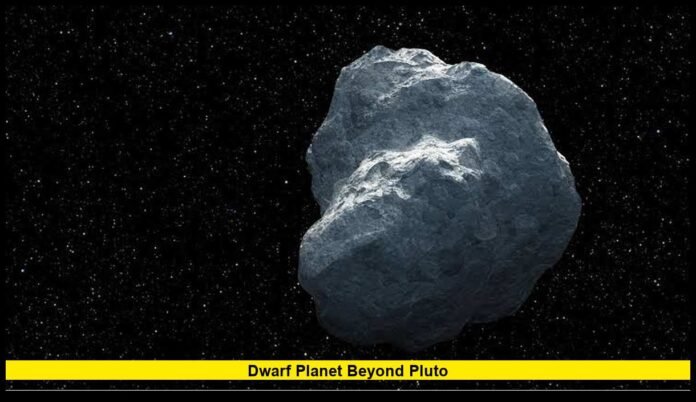

A dwarf planet beyond Pluto remains one of the most fascinating subjects in modern astronomy, and the reported identification of 2026 ED138 has brought renewed attention to the distant reaches of our solar system. Announced in late October 2026, this trans-Neptunian object has attracted interest because preliminary estimates suggest it could be a substantial icy world. However, scientists must establish its physical properties before they can confirm whether it qualifies as an officially recognized dwarf planet.
The candidate’s provisional designation, 2026 ED138, distinguishes it from established dwarf planets such as Pluto, Eris, Haumea, and Makemake. Astronomers identified it through an analysis of observations associated with the Vera C. Rubin Observatory in Chile. The discovery highlights the growing role of advanced telescopes and computer-assisted searches in locating faint objects that move slowly across the sky.
The initial estimates place the object’s diameter between approximately 600 and 1,500 kilometers, or about 370 to 930 miles. That range remains uncertain because an object’s apparent brightness depends on its surface reflectivity as well as its size and distance. Additional measurements will help researchers determine its actual dimensions and refine their understanding of its orbit.
For now, ED138 should be described as a dwarf planet candidate rather than a confirmed new member of the recognized group. Its discovery nevertheless provides an opportunity to examine the population of icy bodies beyond Neptune and learn more about the formation and evolution of the outer solar system.
What Is 2026 ED138?
2026 ED138 is a distant solar system object that astronomers are examining because of its estimated size and orbital characteristics. It belongs to the broad category of trans-Neptunian objects, which orbit the Sun beyond Neptune.
The designation is provisional. Astronomers commonly assign such designations to newly identified objects so that researchers can track their observations and calculate their paths before a permanent name is considered.
The reported discovery followed an analysis of observations collected earlier in 2026. Matthew Holman, an astronomer at the Center for Astrophysics | Harvard & Smithsonian, identified the candidate while examining data from the Rubin Observatory. The discovery was announced on October 27, 2026.
The object’s estimated dimensions have made it particularly interesting to researchers. If the higher size estimates prove accurate, ED138 could rank among the larger objects identified in the distant outer solar system. However, scientists need more precise measurements before drawing conclusions about its place among other large trans-Neptunian bodies.
Its discovery also demonstrates why astronomers continue to search for previously unidentified objects. Even after decades of planetary research, the distant solar system contains faint bodies that remain difficult to detect from Earth.
How Far Is the New Candidate From the Sun?
Preliminary orbital information places 2026 ED138 at approximately 46 astronomical units from the Sun. An astronomical unit, abbreviated AU, represents the average distance between Earth and the Sun, or about 93 million miles.
At 46 AU, the object lies farther from the Sun than Pluto’s average orbital distance of approximately 39.5 AU. A simple conversion puts 46 AU at roughly 4.3 billion miles, although ED138’s actual distance changes as it travels along its orbit.
This distance helps explain why astronomers find such objects difficult to study. Sunlight becomes much weaker as it travels outward, leaving distant bodies with little light to reflect toward Earth. Their apparent motion across the sky is also slow, so researchers often need observations taken over extended periods to establish an orbit.
ED138’s estimated location places it among the distant bodies that help scientists investigate the outer solar system. Its precise orbital characteristics matter because an object’s path can reveal how it interacts gravitationally with other bodies.
Astronomers refine these calculations as they collect additional observations. A more accurate orbit will help researchers establish the object’s location over time and compare its movement with that of other trans-Neptunian objects.
Why the Discovery Matters to Astronomy
The discovery of a substantial object beyond Pluto matters because the outer solar system preserves evidence of the processes that shaped the planets. Many distant icy bodies formed from material left over after the major planets developed.
Some of these bodies remained in relatively stable orbits. Others experienced gravitational disturbances that changed their paths and moved them into different regions of the solar system.
By measuring their orbits, sizes, brightness, and physical characteristics, astronomers can test theories about the early solar system. A newly identified object adds another data point to this research.
ED138 is especially interesting because its preliminary size estimate suggests that it could be more substantial than many smaller bodies found beyond Neptune. A better understanding of its dimensions and orbit could help researchers compare it with established dwarf planets and other large trans-Neptunian objects.
The discovery does not, by itself, reveal the object’s composition or geological history. Those questions require separate observations and careful interpretation. Scientists must distinguish confirmed measurements from conclusions that remain uncertain.
Nevertheless, finding ED138 reinforces an important point: the outer solar system is not an empty region beyond the planets. It contains a diverse population of icy worlds, small bodies, and objects whose properties can improve our understanding of planetary formation.
How the Vera C. Rubin Observatory Identified ED138
The NSF–DOE Vera C. Rubin Observatory stands on Cerro Pachón in Chile. Its survey telescope and large digital camera allow astronomers to photograph broad areas of the sky and revisit them repeatedly.
This observing strategy is valuable for identifying moving objects. Stars and distant galaxies generally remain fixed relative to one another over short periods, while solar system bodies change their apparent positions as they travel around the Sun.
Computer programs can compare observations taken at different times and search for detections that follow a consistent moving path. These methods help astronomers identify faint asteroids and distant objects that might otherwise remain unnoticed.
Matthew Holman identified ED138 on October 13, 2026, while analyzing observations gathered earlier that year. He used specialized software developed with Kevin Napier to search through large numbers of detections and identify potential moving objects.
The candidate stood out because its apparent brightness and estimated distance suggested that it could be a relatively large body. Researchers then examined the observations further to assess the identification and improve their understanding of its movement.
Additional detections in archival images dating back to 2016 helped extend the period over which astronomers could trace the object’s position. A longer observational record generally helps researchers calculate a more reliable orbit.
The discovery was announced on October 27, 2026. The provisional designation provides a consistent way for astronomers to discuss the object while they continue studying it.
The observatory’s role also illustrates the importance of systematic sky surveys. Rather than relying only on individual observations, astronomers can combine repeated images, automated analysis, and archival data to identify objects across large and crowded regions of the sky.
What Makes an Object a Dwarf Planet?
Size alone does not determine whether an object qualifies as a dwarf planet. Astronomers follow a formal classification established by the International Astronomical Union in 2006.
Under that definition, a dwarf planet must meet several conditions:
- It must orbit the Sun.
- Its own gravity must give it a nearly round shape.
- It must not have cleared the neighborhood around its orbit.
- It must not be a moon or satellite of another body.
The distinction between a planet and a dwarf planet centers partly on the object’s gravitational influence over its orbital neighborhood. A major planet dominates its orbital region, while a dwarf planet shares its region with other objects.
Pluto illustrates this difference. Its gravity gives it a nearly spherical shape, but it exists within a region containing many other icy bodies. Astronomers therefore classify it as a dwarf planet rather than one of the eight major planets.
For ED138, researchers need sufficient evidence to determine whether its physical characteristics meet the relevant criteria. The estimated size makes it an interesting candidate, but an estimate cannot establish its shape with certainty.
Scientists must also account for the difference between discovering an object and formally recognizing its classification. A provisional designation allows observations to accumulate while astronomers improve their measurements and assess the available evidence.
As of October 30, 2026, ED138 has not been established as an officially recognized sixth dwarf planet. Describing it as a candidate accurately reflects that distinction.
The Five Officially Recognized Dwarf Planets
The five recognized dwarf planets offer useful comparisons for understanding the new candidate. Each occupies a different region or has distinctive physical characteristics.
| Dwarf planet | Location | Important characteristic |
|---|---|---|
| Ceres | Main asteroid belt | The only officially recognized dwarf planet in the inner solar system |
| Pluto | Beyond Neptune | Has a complex surface and five known moons |
| Haumea | Beyond Neptune | Rotates rapidly and has an elongated shape |
| Makemake | Kuiper Belt region | A distant icy world with a known moon |
| Eris | Far beyond Neptune | A large, distant object with a known moon |
Ceres: A Dwarf Planet Near the Inner Planets
Ceres orbits the Sun in the main asteroid belt between Mars and Jupiter. Its location separates it from the more distant recognized dwarf planets.
NASA’s Dawn spacecraft studied Ceres and returned detailed observations of its craters, bright deposits, and geological features. Those findings helped scientists understand the complexity of small planetary bodies.
Ceres demonstrates that dwarf planets do not all occupy the same region. Their classification depends on their physical characteristics and orbital circumstances rather than a single location in the solar system.
Pluto: The Most Familiar Dwarf Planet Beyond Neptune
Pluto became a major focus of planetary research when NASA’s New Horizons spacecraft flew past it in July 2015.
The mission revealed mountains, broad icy plains, impact craters, and a distinctive heart-shaped region. Its observations showed that Pluto has a complex surface and an active geological history.
Pluto has five known moons, including Charon, its largest companion. These features make Pluto a valuable reference point when researchers study other large objects beyond Neptune.
Haumea: A Rapidly Rotating World
Haumea stands out because it rotates in approximately four hours. Its rapid spin contributes to its elongated shape.
The dwarf planet has two known moons and a ring. These characteristics make it useful for investigating the relationship between rotation, shape, and the physical structure of distant worlds.
Makemake: An Icy Body in the Kuiper Belt
Makemake is a distant object associated with the Kuiper Belt. Its surface contains frozen materials, and astronomers have identified a moon orbiting it.
Researchers study Makemake to understand the properties of icy bodies that formed in the outer solar system. Its size and distance also provide useful context for evaluating candidates such as ED138.
Eris: A Discovery That Influenced Planetary Classification
Eris was discovered in the early 2000s and became central to the debate over Pluto’s classification.
Its discovery showed that Pluto was not the only substantial object in the distant solar system. Astronomers needed a consistent framework for distinguishing major planets from other large bodies.
Eris has a known moon named Dysnomia. Its discovery helped shape the discussion that led to the International Astronomical Union’s formal planet definition in 2006.
How Large Could ED138 Be Compared With Pluto?
Pluto measures approximately 2,377 kilometers across. ED138’s preliminary diameter estimate ranges from 600 to 1,500 kilometers, which would make it smaller than Pluto if those estimates are accurate.
The range remains broad, however. An object’s brightness depends on both its size and its surface reflectivity, making it difficult to calculate a precise diameter from visible observations alone.
A smaller object with a highly reflective surface can appear brighter than a larger object with a darker surface. Scientists therefore need additional measurements to determine how much of ED138’s brightness comes from its physical dimensions and how much comes from its surface properties.
Thermal observations may help refine the estimate. By measuring heat emitted by a distant object, researchers can improve their understanding of its size and energy balance.
The Atacama Large Millimeter/submillimeter Array, or ALMA, is one possible resource for follow-up research. Observations at longer wavelengths can provide information that complements visible-light measurements.
Until those measurements establish a narrower range, ED138’s diameter should remain an estimate rather than a confirmed physical measurement.
Is ED138 Part of the Kuiper Belt?
The Kuiper Belt is a broad region beyond Neptune that contains icy bodies, dwarf planets, and smaller remnants from the solar system’s formation. Pluto and Makemake are associated with this distant population.
ED138 belongs to the broader class of trans-Neptunian objects because it orbits the Sun beyond Neptune. Its estimated distance and orbital properties make it relevant to research into the outer solar system.
Astronomers use orbital measurements to distinguish different populations of distant objects. Their paths can reflect the gravitational influence of Neptune and other bodies over long periods.
ED138’s reported orbital inclination is nearly 25 degrees relative to the plane of the solar system. Researchers have described its preliminary orbital characteristics as consistent with a hot-classical trans-Neptunian object.
More observations can improve that classification and help scientists understand how its current orbit developed. Researchers must avoid drawing conclusions about its history that go beyond the available orbital evidence.
Could ED138 Become the Sixth Official Dwarf Planet?
ED138 has attracted attention because its estimated size makes it a candidate worth investigating. However, its discovery does not automatically grant it official dwarf planet status.
The recognized group currently consists of Ceres, Pluto, Haumea, Makemake, and Eris. ED138 would need to meet the applicable scientific criteria and receive the appropriate recognition before it could join that group.
Its estimated dimensions suggest that it may be large enough for gravity to shape it into a nearly round body. Yet researchers still need evidence about its physical characteristics before making a definitive determination.
The provisional designation also does not represent a permanent name. Astronomers commonly track new objects under provisional designations while observations and orbital calculations improve.
For now, the most accurate description is that ED138 is a dwarf planet candidate. Its eventual classification depends on the evidence gathered through further study.
What Astronomers Need to Learn Next
Several research priorities will help clarify ED138’s nature.
- A more precise diameter: Additional measurements could narrow the current size estimate.
- Better information about reflectivity: Understanding its surface brightness will help researchers estimate its dimensions.
- Improved orbital calculations: Continued observations can refine its path and distance over time.
- More physical measurements: Thermal and other observations could help constrain its surface properties.
- A reliable classification: Scientists must establish whether the object meets the criteria for a dwarf planet.
These steps are common in the study of newly identified solar system objects. Astronomers often need years of observations to refine an object’s orbit and determine its physical characteristics.
The Vera C. Rubin Observatory’s planned decade-long Legacy Survey of Space and Time is designed to repeatedly observe the sky and identify changing or moving objects. Its capabilities could help researchers find more distant bodies and improve estimates of the outer solar system’s population.
ED138 therefore represents an important opportunity for further research, even while its status remains unresolved.
Frequently Asked Questions
What is the dwarf planet beyond Pluto discovered in 2026?
The object is 2026 ED138, a distant trans-Neptunian body identified through analysis of observations associated with the Vera C. Rubin Observatory. Scientists are investigating whether it qualifies as a dwarf planet.
Is 2026 ED138 officially recognized as a dwarf planet?
No. As of October 30, 2026, ED138 remains a candidate. Its physical characteristics and classification require further confirmation.
How large is 2026 ED138?
Preliminary estimates place its diameter between approximately 600 and 1,500 kilometers, or 370 to 930 miles. The actual size remains uncertain because surface reflectivity affects the estimate.
How far is ED138 from the Sun?
Initial orbital information places it at approximately 46 astronomical units from the Sun. This is farther than Pluto’s average distance of about 39.5 AU.
Who identified 2026 ED138?
Matthew Holman of the Center for Astrophysics | Harvard & Smithsonian identified the candidate while analyzing Rubin Observatory data on October 13, 2026. Its discovery was announced on October 27.
Which observatory helped discover ED138?
The NSF–DOE Vera C. Rubin Observatory in Chile provided the observations used in the search. Researchers combined astronomical data and specialized software to identify the candidate.
How many officially recognized dwarf planets are there?
There are five officially recognized dwarf planets: Ceres, Pluto, Haumea, Makemake, and Eris. ED138 has not yet joined this group.
Is ED138 bigger than Pluto?
Current estimates indicate that ED138 is smaller than Pluto. Its estimated diameter is 600 to 1,500 kilometers, compared with Pluto’s diameter of approximately 2,377 kilometers.
What makes ED138 different from Planet Nine?
ED138 is an observed object with a provisional designation. Planet Nine remains a hypothesized planet that astronomers have not confirmed.
What happens next in the study of ED138?
Researchers need additional observations to refine its size, physical properties, and orbit. Those findings will help determine whether it qualifies for official dwarf planet recognition.
Conclusion
The reported identification of 2026 ED138 has renewed interest in the distant solar system and the possibility of identifying additional dwarf planets. Its estimated size, remote location, and orbital characteristics make it an important candidate for continued research.
Scientists have not yet confirmed its dwarf planet status, and further measurements will be necessary to establish its physical properties. Nevertheless, ED138 illustrates how modern astronomical surveys can uncover distant objects that earlier observations missed.
As researchers improve their measurements, they will gain a clearer picture of how ED138 compares with Pluto and other icy bodies beyond Neptune.
What do you think about the possibility of another dwarf planet beyond Pluto? Share your thoughts in the comments and follow future developments as astronomers continue investigating 2026 ED138.