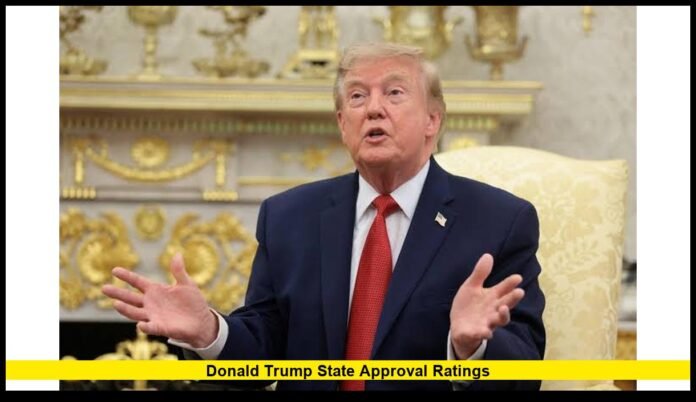

Donald Trump state approval ratings remain sharply divided across the United States, with the latest polling showing a clear difference between the president’s strongest Republican states and the competitive states that could shape the 2026 midterm elections. Current Civiqs tracking through August 19 shows Trump at 41% approval and 56% disapproval nationally, while a recent Reuters/Ipsos survey put his approval at 33%, his lowest level of the second presidency.
The latest numbers point to a complicated political landscape. Trump continues to command strong support in parts of the Republican base, particularly in deeply conservative states. At the same time, his approval has fallen below 50% across major battlegrounds.
That distinction matters as voters move closer to the November midterm elections. Presidential approval does not predict an election by itself, but it can provide an important measure of the political environment.
The Latest National Picture
The national polling picture has weakened for Trump during August.
Civiqs’ latest national tracking shows 41% of registered voters approving of Trump’s job performance, while 56% disapprove. That leaves him with a net approval rating of -15 points.
A separate Reuters/Ipsos survey conducted shortly before the latest Civiqs update produced an even lower result. It found Trump with 33% approval and 64% disapproval.
The difference between those surveys reflects the normal variation that occurs between pollsters. They use different samples, field dates and methodologies.
The broader direction is more important than any single reading. Several major surveys now show Trump’s approval well below the level he enjoyed at the beginning of his second term.
Economic concerns have become especially important.
Voters have expressed dissatisfaction with inflation, the cost of living, gasoline prices and the broader direction of the economy. Foreign policy has also become a major source of concern.
A Deeply Divided State Map
The state-by-state numbers reveal a much more complicated picture than the national average.
Trump remains popular in several states that have become reliable Republican territory. His approval reaches majority levels in some of the most conservative parts of the country.
The situation changes significantly in competitive states.
Recent Civiqs tracking shows Trump underwater in major battlegrounds including Arizona, Georgia, Michigan, Nevada, North Carolina, Pennsylvania and Wisconsin.
That pattern is important because these states have played major roles in recent presidential elections.
It also means that Trump’s national standing cannot be understood simply by looking at his strongest supporters. The voters who decide closely contested races often include independents and less committed partisans.
Battleground States Remain a Problem
The latest state data show negative approval balances across the major presidential battlegrounds.
The available July Civiqs state comparison recorded the following results:
| State | Approval | Disapproval | Net Approval |
|---|---|---|---|
| Arizona | 42% | 53% | -11 |
| Georgia | 36% | 57% | -21 |
| Michigan | 38% | 57% | -19 |
| Nevada | 38% | 56% | -18 |
| North Carolina | 41% | 54% | -13 |
| Pennsylvania | 41% | 54% | -13 |
| Wisconsin | 41% | 55% | -14 |
These figures should be treated as polling snapshots rather than permanent measurements. State numbers can change as new respondents enter rolling surveys.
Still, the pattern is notable. No major battleground in that comparison gives Trump majority approval.
Georgia Shows a Significant Negative Balance
Georgia is among the states where the gap is particularly pronounced.
The latest comprehensive Civiqs comparison placed Trump at 36% approval and 57% disapproval. That produced a net rating of -21 points.
Georgia has become one of the country’s most closely watched political states. Presidential elections, Senate contests and statewide races have all demonstrated how competitive its electorate can be.
The state’s current numbers therefore carry considerable political significance.
A low approval rating does not guarantee that Democrats will win future elections in Georgia. It does indicate that Trump currently faces substantial resistance among voters in the state.
Michigan Remains Difficult Territory
Michigan also shows a substantial gap between approval and disapproval.
The Civiqs comparison put Trump at 38% approval and 57% disapproval, giving him a net rating of -19.
Michigan has repeatedly demonstrated that its voters can move between the two major parties. That makes changes in presidential approval particularly relevant.
The state’s political environment is influenced by economic concerns, industrial employment, inflation and national policy debates.
Trump’s current standing suggests that his support in Michigan is not broad enough to produce majority approval.
Wisconsin Shows Another Negative Rating
Wisconsin presents a similar picture.
The available Civiqs figures show 41% approval and 55% disapproval. Trump’s net rating stands at -14 points.
Wisconsin has remained one of the country’s most closely divided presidential states.
Small changes in voter preferences can matter considerably in such an electorate. A president with negative approval among Wisconsin voters therefore faces a more challenging political environment than one with majority support.
The numbers also highlight the importance of independent voters.
Pennsylvania Remains Closely Watched
Pennsylvania is another major state where Trump remains underwater.
The latest comparison places his approval at 41%, while 54% disapprove. His net rating is -13 points.
Pennsylvania’s large electorate and competitive political history make it one of the most important states on any national political map.
The current figures show that Trump’s support is substantial, but it does not reach a majority.
That distinction could become important as congressional campaigns intensify and voters begin focusing more heavily on individual candidates.
Arizona and Nevada Also Show Negative Ratings
Arizona’s current figures show 42% approval and 53% disapproval.
That creates a net approval rating of -11 points.
Nevada is somewhat weaker, with 38% approval and 56% disapproval. Its net rating is -18.
Both states have become important parts of the modern battleground map.
Arizona has experienced major political competition in presidential and Senate races. Nevada has also remained closely contested, particularly in national elections.
The latest numbers suggest that Trump has work to do among voters outside his strongest partisan supporters.
North Carolina Is Not Immune to the Shift
North Carolina has historically been more Republican than several other battleground states, but it remains competitive in statewide politics.
The latest Civiqs comparison records 41% approval and 54% disapproval for Trump.
That produces a net rating of -13 points.
The figure demonstrates that negative presidential approval is not limited to traditionally Democratic states.
North Carolina’s political importance has increased because of its role in Senate and presidential contests. The state’s voters include a large Republican base, but the overall electorate is not uniformly supportive of the president.
Florida and Ohio Show Important Changes
Florida and Ohio remain strongly associated with Republican presidential politics, yet recent polling has shown that Trump’s personal approval is not necessarily as high as his electoral support in those states.
Civiqs’ recent state tracking has placed Trump below 50% approval in both states.
Florida recorded roughly 43% approval and 53% disapproval in the available comparison. Ohio recorded about 42% approval and 52% disapproval.
Those figures are significant because both states have moved toward Republicans in recent presidential elections.
They also demonstrate why election results and presidential approval should not be treated as identical measurements.
A voter can support Republican candidates while expressing dissatisfaction with the president.
Where Trump Remains Strongest
Trump’s strongest approval continues to come from deeply Republican states.
Wyoming and North Dakota have been among the states with the highest approval levels in recent Civiqs tracking. Other strongly conservative states, including Oklahoma, West Virginia, Alabama, Idaho and South Dakota, have also shown comparatively strong support.
Recent state estimates have placed Trump’s approval around the high 50s in Wyoming and North Dakota, with several other Republican states above 50%.
The contrast with battleground states is striking.
It suggests that Trump’s political coalition remains firmly rooted in the Republican base even as his broader approval declines.
Democratic States Remain Firmly Opposed
The opposite pattern appears in heavily Democratic states.
Recent Civiqs tracking has shown Trump’s approval in the 20s in several Democratic strongholds.
California has been among the states with particularly low approval. The latest available Civiqs state result listed 26% approval and 69% disapproval there.
Other Democratic-leaning states have also recorded approval levels well below the national average.
This reinforces the highly polarized nature of American politics.
Trump’s strongest and weakest states are separated by enormous differences in public opinion.
The Economy Is a Major Factor
Economic concerns are playing a central role in the president’s current approval ratings.
Recent national polling has found particularly weak ratings for Trump’s handling of inflation and the cost of living.
Gasoline prices have also become an important political issue.
Voters tend to judge presidents heavily on economic conditions, especially when they experience higher prices in everyday purchases.
The latest polling indicates that economic dissatisfaction is reaching beyond traditional Democratic voters.
That creates a more difficult environment for Trump because economic issues can influence independents and moderate voters who do not consistently support either party.
Immigration Remains a Stronger Area
Immigration continues to be one of Trump’s stronger issues, although his advantage has narrowed.
Recent polling has shown that voters remain more supportive of Trump’s handling of border security than several other policy areas.
That gives Republicans an issue where they can still compete effectively with Democrats.
However, strong ratings on immigration have not been enough to offset weaker ratings on economic matters and other major issues.
The state polling reflects that broader balance.
Trump retains significant support in conservative states, but his approval does not consistently reach majority levels in competitive states.
Foreign Policy Is Affecting Public Opinion
Foreign policy has also become increasingly important to Trump’s approval.
Recent polling has shown significant concern over the ongoing conflict involving Iran and its effects on energy prices.
Many Americans have questioned how long the conflict could continue and what consequences it could have for the United States.
The issue has become particularly relevant because international developments can quickly affect gasoline prices.
That creates a connection between foreign policy and domestic economic sentiment.
For voters, the two issues are no longer completely separate.
Approval Is Different From Election Support
One of the most important points when reading state polling is that approval ratings are not election forecasts.
Approval surveys ask voters whether they approve of a president’s job performance.
Election polls ask whom voters intend to support.
The two measurements can move differently.
A voter may disapprove of Trump but still vote for a Republican congressional candidate. Another voter may approve of Trump’s presidency but choose a different candidate in a primary.
State approval figures should therefore be viewed as indicators of political sentiment rather than predictions of specific election results.
What the Current Numbers Mean for 2026
The current state polling creates a challenging environment for Trump and Republicans heading toward the 2026 midterms.
The president’s strongest support remains concentrated in deeply conservative states.
His weakest support is found in Democratic strongholds.
Between those two groups sits the most politically important category: the battleground states.
Arizona, Georgia, Michigan, Nevada, North Carolina, Pennsylvania and Wisconsin all show more disapproval than approval in the latest comprehensive state comparison.
That creates potential pressure for Republican candidates in closely contested districts and statewide races.
Recent political analysis has already identified Trump’s low approval as a potential vulnerability for Republicans, particularly in areas that normally lean Republican but are becoming competitive.
Why State-Level Numbers Matter
National approval provides a broad measurement of Trump’s standing, but state polling offers a more detailed picture.
The United States does not hold presidential elections based on a single national vote total. Political outcomes depend heavily on individual states.
That makes changes in battleground states particularly important.
If Trump’s approval improves in several competitive states, Republicans could benefit from a more favorable political environment.
If his numbers remain underwater, Democratic candidates may have more opportunities to challenge Republican incumbents and compete in districts that previously appeared safer.
Neither outcome is guaranteed.
The state numbers simply show where public sentiment stands at this stage of the election cycle.
The Current Political Divide
The latest polling presents a country that remains deeply polarized.
Trump has not lost the loyalty of his core Republican base. In several conservative states, his approval remains above 50%.
However, his support is considerably weaker outside those strongest areas.
Major battlegrounds show negative approval balances. Democratic states remain strongly opposed to his presidency.
That produces a political map with three distinct zones: strong Republican support, strong Democratic opposition and competitive states where Trump’s standing is considerably weaker than his performance in the Republican heartland.
The battleground zone is likely to receive the most attention as the 2026 election approaches.
What to Watch Next
Future state polling will be important because the current numbers are not static.
Economic conditions could change voter attitudes. Gasoline prices could move higher or lower. Foreign-policy developments could alter perceptions of Trump’s leadership.
New congressional campaigns could also affect the political environment.
For now, the most consistent finding is that Trump’s approval remains strongest among voters in conservative states and weakest in Democratic states, while major battlegrounds sit between those extremes but remain negative overall.
The national picture is also unsettled.
Civiqs currently shows 41% approval and 56% disapproval, while a recent Reuters/Ipsos survey produced a significantly lower 33% approval reading.
Those differences underline why voters, campaigns and political observers will continue watching multiple polls instead of relying on a single number.
The Road Ahead
The latest state polling shows that Trump’s political strength remains real, but it is unevenly distributed across the country.
His strongest states continue to provide a solid Republican foundation. Yet the negative numbers in competitive states reveal a more difficult challenge.
The coming months will determine whether the president can improve his standing among independents and voters concerned about the economy, or whether the current state-level pattern continues into the midterm campaign.
For now, the map shows a president with a loyal base, significant opposition and a difficult path in several of the states most likely to shape the next major national political test.
What do you think the latest polling says about Trump’s standing across the country? Share your thoughts in the comments and stay informed as new state numbers emerge.