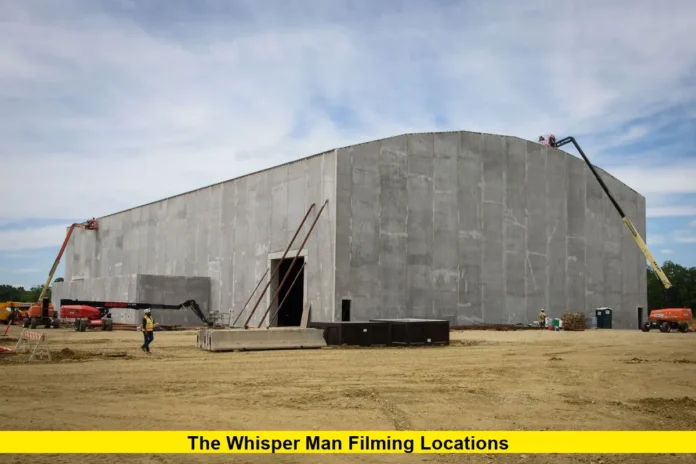

The whisper man filming locations are almost entirely in New Jersey, where Netflix transformed 22 cities and towns into the unsettling world of its 2026 psychological thriller. The movie, starring Adam Scott, Robert De Niro, Michelle Monaghan and Michael Keaton, arrived on Netflix on August 28, 2026, and its production made extensive use of real neighborhoods, public buildings, schools, parks, transportation sites and other recognizable locations across the Garden State.
Rather than relying heavily on studio sets, the production used New Jersey itself to create the fictional community surrounding the story. That approach gave the film a grounded American atmosphere while allowing different parts of the state to represent locations that serve very different purposes in the plot.
Where was The Whisper Man filmed?
The Whisper Man was filmed across New Jersey during a 45-day production. Principal photography took place in spring 2025, with filming running from April into June.
Netflix has confirmed that production traveled through 22 New Jersey cities and towns. Those locations stretched across several counties, including Union, Essex, Passaic, Hudson, Bergen, Somerset and Middlesex.
The confirmed communities included:
- Allendale
- Bayonne
- Hoboken
- Jersey City
- Kearny
- Montclair
- Newark
- North Plainfield
- Paterson
- Plainfield
- Rahway
- Scotch Plains
- Summit
- Westfield
- Westwood
- Woodland Park
- Carlstadt
- Moonachie
- Roseland
- Springfield
- Avenel
- Colonia in Woodbridge
This wide geographic footprint helped filmmakers create a fictional setting without making the movie feel like it was shot in one small area.
Plainfield became one of the movie’s most important locations
Plainfield played a major role in the production and was among the first New Jersey communities used for filming.
The city’s historic neighborhoods offered the production a useful combination of older architecture, established residential streets and recognizable downtown scenery. Those characteristics were especially valuable for a thriller built around a family moving into an unfamiliar community.
A private Plainfield residence was used as the home of Tom Kennedy, played by Adam Scott, and his young son Jake. The property’s older character became an important visual part of the family’s environment.
The production also used areas around Plainfield’s downtown and historic districts. These locations helped create the larger fictional community in which the story unfolds.
The filmmakers did not need to construct an artificial American town from scratch. Instead, Plainfield and neighboring communities provided authentic streets and buildings that could be adapted to the story.
Westfield provided the school setting
Westfield is another particularly recognizable location for viewers searching for the filming sites.
Wilson Elementary School was used during production and was transformed for the movie’s fictional school setting. Adam Scott and young actor Acston Luca Porto were photographed filming there with the production team.
Several nearby Westfield streets were also used during the shoot.
The town’s residential character made it a natural fit for the movie. The story requires an environment that initially appears ordinary and comfortable before the darker elements begin to emerge.
That contrast is important to the film’s visual identity. Familiar suburban streets can make a thriller feel more immediate because the surroundings look like places audiences could encounter in everyday life.
Scotch Plains was used for another major residence
Scotch Plains also contributed to the film’s residential world.
A private property in the township was used for scenes involving Robert De Niro’s character, Pete Willis. The residence helped establish a different side of the story while maintaining the same northeastern American atmosphere found throughout the production.
The use of real homes in several communities allowed the filmmakers to give individual characters distinct environments.
Because many of these properties are privately owned, exact residential addresses have not been broadly disclosed. That also means visitors should not treat private houses used in filming as public attractions.
Rahway supplied the prison location
One of the production’s more striking locations was East Jersey State Prison in Rahway.
The facility was used for scenes connected to the story’s convicted serial killer, adding an authentic correctional environment to the movie. The imposing appearance of a real prison provides a very different visual experience from the suburban streets used elsewhere.
Rahway is particularly significant because the prison setting connects the film’s present-day investigation with the older criminal case at the center of the story.
Using an actual correctional facility also gave the production a setting that would have been difficult to reproduce convincingly without extensive construction.
Kearny provided additional correctional scenes
The production also used the Hudson County Correctional Facility in Kearny.
Working inside an active correctional facility required additional planning and security measures. Cast and crew access had to be carefully managed, making this more complicated than filming at an ordinary exterior location.
The Kearny location helped supplement the prison-related material and gave the filmmakers another authentic institutional environment.
Together, the Rahway and Kearny locations helped create the film’s darker visual spaces without relying entirely on traditional soundstage sets.
Montclair became a major interior filming site
Montclair played an important role behind the scenes.
A former United Way building on South Fullerton Avenue was adapted for production. Rather than simply using the property as it existed, filmmakers transformed its interior to serve the needs of the story.
The building was used for police-related material and also incorporated a constructed prison-style environment.
This is a good example of how The Whisper Man combined real locations with production design. A building did not necessarily have to resemble its final screen identity. The crew could alter an existing space and make it appear to belong somewhere else in the fictional world.
Montclair therefore became more than a simple exterior filming location. It provided an adaptable interior environment for several important sequences.
Newark supplied landmark and neighborhood footage
Newark added another layer to the movie’s New Jersey setting.
Branch Brook Park and the Cathedral Basilica of the Sacred Heart are among the recognizable Newark locations associated with the production. The combination of the park and cathedral provides a distinctive visual identity that differs from the quieter suburban communities used elsewhere.
The production also used residential areas in Newark for story-related scenes.
These locations helped widen the movie’s geography. Instead of presenting the fictional community as an isolated suburban pocket, the filmmakers could establish connections to the broader New Jersey environment.
Paterson brought Robert De Niro to City Hall
Paterson City Hall was another identifiable filming site.
Robert De Niro was seen filming around the building during production. The historic municipal architecture offered a more formal setting than the residential streets used for much of the story.
Paterson also gave the production access to an urban environment without leaving New Jersey.
For fans interested in recognizable public locations, City Hall is one of the more straightforward sites associated with the movie because it is a prominent civic landmark rather than a private residence.
Woodland Park and Garrett Mountain Reservation
Woodland Park supplied one of the film’s most atmospheric outdoor environments.
Garrett Mountain Reservation was used for filming involving Robert De Niro and director James Ashcroft. The natural landscape provided woods, open spaces and rugged terrain that contrasted sharply with the suburban neighborhoods.
The location was especially useful for a thriller because natural areas can create a sense of isolation without requiring elaborate sets.
The production also used mobile battery power at Garrett Mountain, reflecting Netflix’s effort to use cleaner power solutions for some location work.
Summit brought the production to a train station
Summit was another important stop during filming.
The city’s train station was used for scenes involving commuter transportation. A working rail environment gave the movie another authentic setting and helped connect the fictional community to the wider region.
Train stations can be particularly useful in crime thrillers because they provide natural movement, public activity and a strong sense of place.
The Summit location also demonstrates how widely the production moved. The filmmakers were not simply searching for houses or forests. They needed locations representing different aspects of everyday life.
Bayonne, Hoboken and Jersey City
The production also visited several Hudson County communities.
Bayonne provided a decommissioned motel location, while Hoboken and Jersey City contributed streets and urban environments.
These settings offered a visual contrast with the quieter neighborhoods of Westfield, Plainfield and Scotch Plains.
A motel, for example, can immediately suggest a very different atmosphere from a family residence. Meanwhile, Hoboken and Jersey City’s denser streets helped broaden the film’s geographic palette.
The ability to find such different environments within a relatively compact area was one of New Jersey’s biggest advantages for the production.
Westwood supplied a diner location
Westwood Diner Pancake House was another recognizable filming site.
The diner environment fits naturally into the kind of American setting required by the movie. Restaurants and diners can function as practical storytelling spaces because characters can meet, talk and investigate without requiring elaborate production design.
The Westwood location also added another recognizable piece of everyday New Jersey life to the film.
Instead of making every location look deliberately sinister, the production often placed its dark story inside ordinary environments. That approach makes the contrast between normal life and the film’s disturbing events more effective.
Why did The Whisper Man film so extensively in New Jersey?
New Jersey offered the production an unusually broad range of locations within a manageable geographic area.
The story needed residential neighborhoods, schools, government buildings, prisons, forests, transportation facilities, restaurants and urban streets. New Jersey could provide all of those environments without requiring the production to travel across multiple states.
The state’s mix of older communities and modern urban areas was also valuable.
The filmmakers could move from a historic house in Plainfield to a train station in Summit, then to a wooded location in Woodland Park or an urban setting in Newark.
That variety allowed the fictional world to feel larger than the production footprint might suggest.
How large was the production?
The Whisper Man was a substantial New Jersey production.
More than 140 cast and crew members worked on the movie, while approximately 1,400 extras and daily hires were involved. Production also worked with more than 650 vendors and businesses during the 45-day shoot.
That scale meant the movie’s presence extended well beyond the actors and primary crew.
Local businesses, weather services, equipment suppliers, background performers and other vendors all contributed to the production. The filming therefore became part of the broader New Jersey film industry rather than simply a short Hollywood visit.
The real locations helped shape the movie’s atmosphere
One of the most interesting aspects of the filming strategy is how little the movie depends on obviously artificial environments.
The Whisper Man requires a world that feels familiar before it becomes frightening. Real New Jersey neighborhoods provide exactly that quality.
A school looks like a school. A diner looks like a diner. A train station operates like a real train station. Residential streets appear lived-in rather than designed specifically for a thriller.
That realism supports the story’s tension.
The film can place an unsettling mystery inside ordinary American surroundings, making the fictional events feel closer to the viewer.
Is The Whisper Man filmed in New Jersey or England?
The film adaptation was filmed in New Jersey, despite the original novel’s English setting.
Alex North’s 2019 novel takes place in a fictional English community, but the Netflix adaptation relocated the story to New Jersey.
That change allowed the filmmakers to create an American setting around the characters while preserving the central father-and-son story and crime-thriller elements.
Current production information identifies New Jersey as the key filming base, with the movie using 22 communities across the state.
The Whisper Man filming locations in context
The full list of locations shows how ambitious the production was. Instead of choosing one town and using it for nearly every scene, the filmmakers assembled the fictional world from communities throughout New Jersey.
The most notable sites include Plainfield for residential and downtown material, Westfield for the school setting, Rahway and Kearny for correctional scenes, Montclair for interiors, Newark for landmark and neighborhood footage, Paterson for municipal scenes, Woodland Park for outdoor sequences, Summit for train scenes and Westwood for the diner.
Other communities filled in smaller pieces of the fictional landscape.
That approach helped The Whisper Man achieve a sense of geographic depth while keeping production centered in one state.
Final thoughts
The Whisper Man uses New Jersey as far more than a simple backdrop. The production turned 22 communities into pieces of a fictional world, combining suburban streets, historic homes, schools, prisons, parks, diners, train stations and urban landmarks.
For viewers interested in the real places behind the Netflix thriller, the most significant locations include Plainfield, Westfield, Scotch Plains, Rahway, Montclair, Newark, Paterson, Woodland Park, Summit, Westwood, Bayonne, Kearny, Hoboken and Jersey City.
The result is a thriller whose unsettling atmosphere comes partly from its familiar surroundings. Instead of hiding the story inside an entirely artificial setting, the filmmakers placed the mystery within real New Jersey communities that audiences can recognize.
Have you spotted another New Jersey location in The Whisper Man? Share your thoughts in the comments and stay updated on the latest filming-location news.