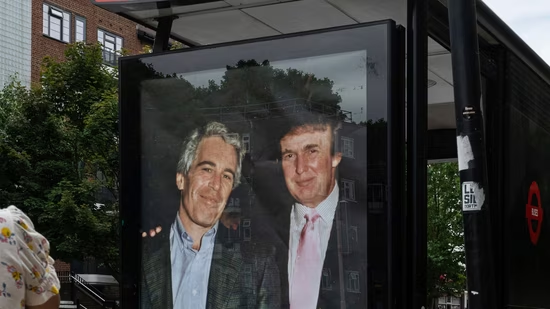

The Justice Department’s release of previously withheld Donald Trump Epstein files this week has thrown Washington back into one of the most politically explosive controversies of the modern era. A batch of FBI interview summaries — quietly absent from an earlier mass disclosure — was published on Thursday, March 6, 2026, after journalists discovered that dozens of pages were missing from the public database. The documents contain uncorroborated allegations made by a woman against President Trump and shed new light on how federal investigators handled her claims over the course of four separate interviews.
The White House has forcefully denied the allegations. Legal experts caution that the documents do not reflect guilt. And yet, the story continues to grow — fueled by government missteps, political pressure, and millions of pages that remain hidden from the public.
Read on — this is one of the most consequential government transparency battles of the year, and new details are still emerging.
How the Missing Documents Came to Light
For weeks, investigative journalists noticed a significant discrepancy. A list of FBI interview summaries that prosecutors had provided to attorneys representing Epstein co-conspirator Ghislaine Maxwell referenced four separate conversations with a woman who had come forward with allegations. But when reporters cross-checked that list against what had actually been published in the Justice Department’s Epstein Files database, only one of those summaries was there.
The other three — along with an intake form and additional supporting documents — were nowhere to be found.
After media pressure mounted, the Justice Department acknowledged the gap. Officials said the missing files had been coded incorrectly as duplicate records during the review process, and that once the error was identified, they moved to publish the remaining documents. A batch of more than 1,000 pages went live on Thursday, with the previously missing interview summaries included.
What the FBI Interviews Actually Contain
The woman at the center of these documents first contacted federal law enforcement shortly after Jeffrey Epstein’s arrest in July 2019. In her initial conversation with FBI agents, she described being sexually assaulted on Hilton Head Island, South Carolina, when she was approximately 13 years old in the mid-1980s. At the time of the assault, she told agents, she did not know the identity of her attacker. Decades later, she said she recognized him as Epstein after seeing his photo in news coverage of his arrest.
That first interview was the only one previously made public. The three newly released summaries go considerably further.
In a follow-up interview, the woman expanded her account and introduced allegations involving President Trump. She described being transported by Epstein — either driven or flown — to a tall building in New York or New Jersey, where she says Epstein introduced her to Trump. Her account of what allegedly happened there was graphic and detailed in the FBI summaries. She also alleged that Epstein had beaten her on separate occasions, arranged for her to be used in sexual encounters with other powerful men, and had worked to have her mother imprisoned as a form of control.
It is important to state clearly: these allegations are uncorroborated. The newly released documents contain no indication that FBI agents assessed the woman’s claims as credible or pursued the Trump-related allegations further. In the fourth and final interview, when agents asked whether she would be willing to share more about her alleged encounter with Trump, the woman reportedly declined, questioning whether anything would come of it.
President Trump has denied any wrongdoing related to Epstein, consistently and repeatedly, throughout this entire process.
The White House Hits Back
The administration wasted no time responding to the document release. Press Secretary Karoline Leavitt issued a direct statement, calling the allegations completely baseless and pointing out that the previous administration’s Justice Department had been aware of the woman’s claims for four years and took no action. Leavitt framed the lack of prosecution under the Biden DOJ as proof that investigators found no merit in the accusations.
The department itself, in a post on its official social media account, added that some of the material in the broader Epstein file release — including claims against Trump — consists of submissions made to the FBI by the general public ahead of the 2020 election, and that the documents may include fabricated or unverified content.
Congress Turns Up the Heat
The document release did not calm the political storm on Capitol Hill — it intensified it.
Days before the Thursday publication, the House Oversight Committee voted to subpoena Attorney General Pam Bondi. The move was remarkable not only for its substance, but because it passed with bipartisan support, including five Republicans joining Democrats in backing the measure. Bondi will be required to testify under oath before the committee, though no hearing date has been set.
Democrats on the committee were blunt in their reaction to the Thursday release. While they welcomed the disclosure of the previously withheld interview summaries, they characterized it as an incomplete response to a much larger problem. They pointed out that even after the new batch, an estimated 37 additional pages remain missing from the public database — including interview notes, a law enforcement report, and license records.
Beyond those 37 pages, the scale of what has not been released is staggering. The Justice Department has published roughly 3.5 million pages in response to the Epstein Files Transparency Act, which President Trump signed into law in November 2025. But of the approximately 6 million total pages in the government’s possession, nearly half have yet to be disclosed. Democrats have demanded a full release of everything.
A Chaotic Rollout with Real Consequences
The handling of the Epstein file releases has been messy from the start. In previous batches, the Justice Department inadvertently published nude photographs showing the faces of potential victims — people whose identities should have been protected. Names, email addresses, and other personally identifying information also appeared in documents that were either unredacted or only partially obscured.
In a particularly alarming development, it emerged that the DOJ had been monitoring the search activity of members of Congress who reviewed unredacted files at the Justice Department — something that prompted renewed calls for Bondi’s resignation from ranking committee Democrats.
Department officials have defended their approach, arguing that the sheer volume of material — combined with tight legal deadlines and the need to protect victims — made some errors unavoidable. Critics counter that the pattern of errors suggests either incompetence or deliberate concealment, and they say the subpoena of the attorney general is the only way to get answers.
Where Things Stand Right Now
As of this writing, the picture remains deeply incomplete. The FBI interviewed the woman accusing Trump four times, a level of follow-up that typically signals agents found enough substance to keep pursuing a lead. Yet no charges were ever filed, no public findings were ever released, and the investigation appears to have ended quietly.
What the documents cannot tell us is how investigators weighed the woman’s account, what additional steps if any were taken, or why the Trump-related allegations ended up in a Justice Department PowerPoint presentation summarizing the Epstein and Maxwell cases but never moved beyond that internal stage.
The political battle over transparency, accountability, and what the American public has a right to know is now playing out in real time — in congressional hearings, federal court filings, and a sprawling public database that grows larger with each new release.
The Donald Trump Epstein files have become something bigger than any single allegation or document. They represent a test of whether a government can be trusted to hold itself accountable — and right now, that question does not have a clean answer.
Drop your thoughts in the comments below — this story is developing fast, and there is still a great deal the public has not been told.