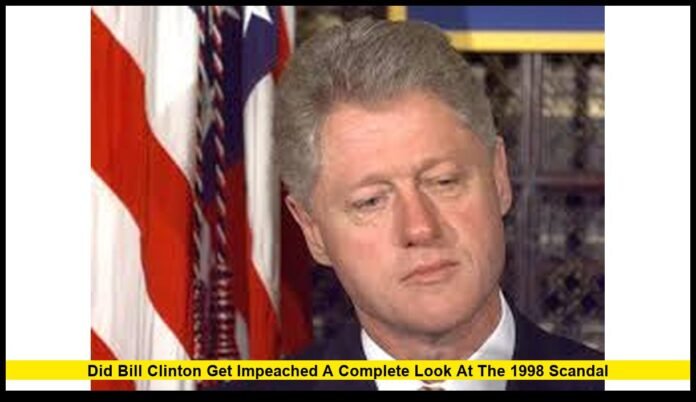

The question did Bill Clinton get impeached remains one of the most frequently searched and debated topics in American political history. The answer is yes—President William Jefferson Clinton was impeached by the U.S. House of Representatives on December 19, 1998, during his second term in office. The impeachment stemmed from charges of perjury and obstruction of justice, both related to his testimony about his relationship with Monica Lewinsky, a former White House intern. However, Clinton was acquitted by the U.S. Senate on February 12, 1999, allowing him to complete his presidency.
As of December 2025, more than 25 years later, the Clinton impeachment continues to be studied as a pivotal moment that defined how the nation views presidential accountability, personal ethics, and political partisanship.
The Background Leading to the Impeachment
Bill Clinton, the 42nd President of the United States, served from January 20, 1993, to January 20, 2001. His presidency oversaw major economic growth, a budget surplus, and global diplomacy successes. Yet, his administration became overshadowed by personal scandal.
The controversy began with the Whitewater investigation, a probe launched in 1994 into a failed Arkansas real estate venture involving Bill and Hillary Clinton. The investigation, led by Independent Counsel Kenneth Starr, initially focused on potential financial misconduct but found no criminal wrongdoing by the Clintons.
However, the scope of the investigation widened. It eventually included inquiries into the president’s conduct in a civil lawsuit filed by Paula Jones, a former Arkansas state employee who accused Clinton of sexual harassment. During a deposition in January 1998, Clinton denied having any sexual relationship with a White House intern named Monica Lewinsky.
This testimony later became central to the impeachment case after evidence showed that the relationship did, in fact, occur.
The Monica Lewinsky Scandal
Monica Lewinsky, who was 22 years old at the time of the alleged affair, worked as an intern in the White House in 1995 and 1996. Her connection with President Clinton remained secret until January 1998, when news outlets began reporting on allegations of an improper relationship.
Clinton initially denied the allegations in a nationally televised statement, declaring, “I did not have sexual relations with that woman, Miss Lewinsky.”
However, by August 17, 1998, facing mounting evidence—including recorded phone calls and physical evidence verified by investigators—Clinton admitted before a grand jury that he had engaged in what he called an “inappropriate relationship” with Lewinsky.
That admission triggered a political firestorm, and Starr’s investigation shifted toward potential perjury and obstruction of justice—whether Clinton had lied under oath and attempted to conceal evidence.
Key Events Timeline
| Date | Event |
|---|---|
| January 17, 1998 | Clinton denies under oath any relationship with Monica Lewinsky. |
| January 21, 1998 | News of the alleged affair breaks publicly. |
| August 17, 1998 | Clinton admits to an inappropriate relationship before a grand jury. |
| September 9, 1998 | Kenneth Starr submits his report to Congress. |
| December 19, 1998 | The House of Representatives impeaches President Clinton. |
| January 7, 1999 | Senate impeachment trial begins. |
| February 12, 1999 | Senate acquits Clinton on all charges. |
Articles of Impeachment and House Vote
On December 19, 1998, the Republican-led House of Representatives voted to impeach Clinton on two of four proposed articles:
- Perjury before a grand jury – for lying about the relationship with Monica Lewinsky.
- Obstruction of justice – for attempting to influence testimony and hide evidence.
Two additional charges—abuse of power and perjury in a civil deposition—failed to receive majority support.
The votes broke largely along party lines:
- Perjury: 228 in favor, 206 against.
- Obstruction of justice: 221 in favor, 212 against.
These results made Clinton the second U.S. president ever impeached, after Andrew Johnson in 1868.
The Senate Trial and Acquittal
Following the House vote, the Senate convened to hold a trial in January 1999, with Chief Justice William Rehnquist presiding.
The trial lasted five weeks, featuring opening arguments, written witness statements, and presentation of evidence. Both sides agreed not to call live witnesses, though video testimony from key figures—including Monica Lewinsky—was submitted for the record.
On February 12, 1999, the Senate delivered its verdict:
- On the perjury charge, 45 senators voted guilty and 55 not guilty.
- On the obstruction of justice charge, 50 senators voted guilty and 50 not guilty.
Since conviction required a two-thirds majority (67 votes), Clinton was acquitted and completed his second term.
Public Reaction and Polling Data
Despite the political drama, public opinion throughout the impeachment process favored allowing Clinton to remain in office.
- In December 1998, Gallup polls showed a 73% approval rating for his job performance.
- Only 35% of Americans believed he should be removed from office.
The majority of Americans viewed the issue as a personal matter rather than one affecting his ability to govern. The strong economy, declining unemployment, and budget surplus also contributed to sustained public support.
The public sentiment ultimately influenced both the Senate’s decision and the political strategy of both parties.
Political Consequences and Fallout
The impeachment of Bill Clinton had lasting political ramifications.
For Republicans, the impeachment process—intended to demonstrate accountability—backfired politically. In the 1998 midterm elections, Democrats gained seats in the House, a rare outcome for a president’s party during a second term.
For Democrats, the ordeal rallied party unity. Many Democrats criticized the impeachment as politically motivated, arguing it was based more on personal misconduct than on abuse of presidential power.
The event marked a turning point in American politics, deepening partisan divisions that continue to influence Washington today.
Clinton’s Post-Impeachment Presidency
After surviving impeachment, Clinton focused on policy achievements during his final two years in office. The U.S. experienced strong economic performance, with unemployment rates falling below 4% and federal budget surpluses recorded for consecutive years.
Clinton’s administration also pursued global diplomatic initiatives, including efforts toward peace in the Middle East and the Balkans. By the time he left office in January 2001, his approval rating stood at 66%, one of the highest for any departing U.S. president.
Despite the scandal, Clinton’s political influence endured. His wife, Hillary Rodham Clinton, was elected U.S. Senator from New York in 2000 and later became Secretary of State under President Barack Obama.
Key Figures and Their Legacies
- Bill Clinton (79) – Remains active through the Clinton Foundation, focusing on global health and economic development.
- Monica Lewinsky (52) – Now an activist and writer, advocating against cyberbullying and public shaming.
- Kenneth Starr (1946–2022) – The independent counsel whose investigation led to the impeachment; passed away in 2022.
- Hillary Clinton (78) – Continues to play an active role in U.S. political discourse and philanthropy.
- Newt Gingrich – Then-Speaker of the House and key Republican strategist behind the impeachment process.
The episode shaped each of their careers and continues to define discussions about power, accountability, and public perception.
Historical Comparisons: Other Presidential Impeachments
Bill Clinton’s impeachment fits into a small but significant category in U.S. history.
| President | Year | Charges | Outcome |
|---|---|---|---|
| Andrew Johnson | 1868 | Violation of the Tenure of Office Act | Acquitted |
| Bill Clinton | 1998 | Perjury, Obstruction of Justice | Acquitted |
| Donald Trump | 2019, 2021 | Abuse of Power, Incitement of Insurrection | Acquitted both times |
Each impeachment reflected the political climate of its era. Clinton’s case focused on personal integrity rather than policy or governance, distinguishing it from others that centered on national or constitutional issues.
Legal and Constitutional Implications
The Clinton impeachment raised fundamental questions about what constitutes an impeachable offense. The Constitution’s standard of “high crimes and misdemeanors” left room for interpretation.
Legal scholars and historians continue to debate whether Clinton’s actions—while morally questionable—met that threshold. The event reinforced the idea that impeachment is not purely a legal matter but a political decision shaped by congressional priorities and public sentiment.
It also led to reforms in how independent counsels operate, influencing later investigations involving executive branch officials.
The Lasting Legacy of the Clinton Impeachment
The impeachment of Bill Clinton continues to impact American politics, serving as a reference point for later controversies involving presidents from both parties. It exposed deep partisan divides and reshaped public expectations of presidential behavior.
In the decades since, Clinton has acknowledged his mistakes and expressed regret for the pain caused to his family and the nation. Yet his presidency remains defined by both economic success and political scandal—a dual legacy that reflects the complexity of modern leadership.
The event also changed how the media and public engage with political scandals, ushering in an era of 24-hour news cycles and internet-driven public judgment.
Conclusion
So, did Bill Clinton get impeached? Yes. He was impeached by the House of Representatives in 1998 on charges of perjury and obstruction of justice, but he was acquitted by the Senate and completed his term in office.
Today, the Clinton impeachment remains one of the most influential events in U.S. political history—a defining episode that continues to shape how Americans view truth, power, and accountability in the presidency.
Its lessons still echo through every modern debate about leadership, integrity, and the rule of law in American democracy.