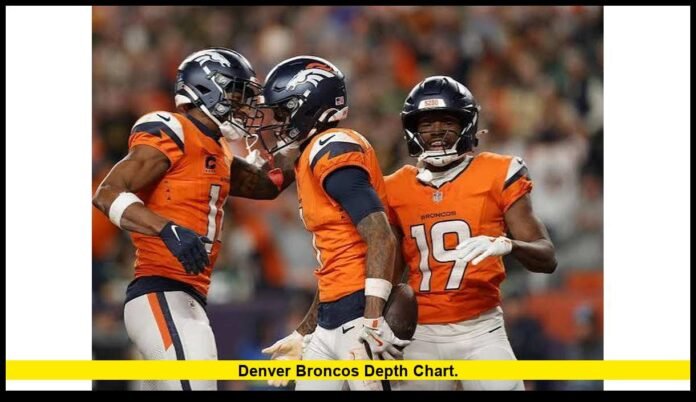

The denver broncos depth chart is taking shape as Denver moves through the 2026 preseason, with Bo Nix leading the quarterback room and several established veterans holding prominent positions across the roster. The Broncos opened preseason with a 27-7 win over the Atlanta Falcons and are continuing their evaluation ahead of the regular season. The team’s initial depth chart remains unofficial, so several backup and rotational positions can still change as training camp and preseason competition continue.
Bo Nix Remains the Starting Quarterback
Bo Nix remains the clear No. 1 quarterback for Denver entering the 2026 season. Jarrett Stidham is listed behind him, with Sam Ehlinger occupying the third quarterback position.
Nix enters his third NFL season as the established starter. His continued development is one of the central pieces of Denver’s offensive plans. The Broncos have built greater continuity around him, while the additions and development of offensive playmakers give the quarterback more options.
Stidham provides experience behind Nix. He has been part of Denver’s quarterback room for multiple seasons and understands the offensive system. His position on the depth chart also makes him an important player during preseason games.
The quarterback order currently stands as:
- QB1: Bo Nix
- QB2: Jarrett Stidham
- QB3: Sam Ehlinger
Unlike several other positions, there is little uncertainty about who Denver expects to lead the offense when the regular season begins.
J.K. Dobbins Leads a Deep Running Back Group
J.K. Dobbins is listed first among Denver’s running backs, with RJ Harvey behind him. Jonah Coleman, Tyler Badie, Jaleel McLaughlin and Cody Schrader provide additional competition.
Dobbins gives the Broncos an experienced option at the top of the group. Harvey also remains an important part of the team’s plans after establishing himself as a young contributor.
Rookie Jonah Coleman has attracted attention during preseason preparation. His physical running style and ability to create yards have added another interesting element to a position group that already has several capable players.
The current running back group includes:
- J.K. Dobbins
- RJ Harvey
- Jonah Coleman
- Tyler Badie
- Jaleel McLaughlin
- Cody Schrader
Adam Prentice is listed separately as the fullback.
The depth at running back gives Denver flexibility with personnel packages. It also creates meaningful competition for roster spots and offensive touches.
Jaylen Waddle Adds Another Major Receiving Option
The receiver room is one of the most closely watched sections of the current lineup.
Jaylen Waddle is listed prominently in Denver’s receiver rotation after joining the Broncos from Miami. His speed gives the offense another established downfield threat and adds a different dimension to the passing game.
Courtland Sutton also remains a major part of the group. Marvin Mims Jr. is another important contributor, while Troy Franklin and Pat Bryant are among the younger receivers competing for larger roles.
The current receiver group includes:
- Courtland Sutton
- Marvin Mims Jr.
- Jaylen Waddle
- Troy Franklin
- Pat Bryant
- Lil’Jordan Humphrey
- Michael Bandy
- Hakeem Butler
- Dane Key
- Kyrese Rowan
- Cameron Ross
- Joseph Manjack IV
- Kolbe Katsis
- Kyre Duplessis
The depth chart lists receivers in separate positional groupings rather than treating the entire room as one simple ranking. That distinction matters because Denver can move players around based on formation, personnel package and individual strengths.
Waddle’s presence is particularly significant because it gives Nix another proven target capable of creating separation and producing explosive plays.
Sutton brings size and experience. Mims provides versatility and return ability. Franklin remains a young receiver with familiarity in the system, while Bryant continues to compete for opportunities.
Evan Engram Headlines the Tight Ends
Evan Engram is listed first at tight end, followed by Adam Trautman.
Nate Adkins, Lucas Krull and Caleb Lohner provide additional depth. Rookie Justin Joly and Dallen Bentley are also part of the competition.
Engram’s role is important because Denver can use him in different formations. His receiving ability allows the Broncos to create mismatches against linebackers and defensive backs.
Trautman gives the team a more experienced option behind Engram. The younger tight ends are competing for roster positions and opportunities on offense and special teams.
The current group consists of:
- Evan Engram
- Adam Trautman
- Nate Adkins
- Lucas Krull
- Caleb Lohner
- Justin Joly
- Dallen Bentley
The tight end position could therefore remain an area to watch as Denver continues trimming its roster.
Offensive Line Still Has Established Veterans
Denver’s offensive line features several familiar starters.
Garett Bolles remains the listed left tackle. Ben Powers is at left guard, Luke Wattenberg is at center, Quinn Meinerz is at right guard and Mike McGlinchey is at right tackle.
That projected starting group provides Denver with experience across all five positions.
The current first unit is:
| Position | Player |
|---|---|
| Left tackle | Garett Bolles |
| Left guard | Ben Powers |
| Center | Luke Wattenberg |
| Right guard | Quinn Meinerz |
| Right tackle | Mike McGlinchey |
Matt Peart is listed behind Bolles. Calvin Throckmorton and Gavin Ortega provide depth at guard, while Kage Casey is also competing for an offensive-line role.
Center deserves particular attention because Michael Deiter was placed on injured reserve after the initial depth chart was released. Denver subsequently added Lecitus Smith to strengthen the position.
Luke Wattenberg remains the first-listed center, while Alex Forsyth is also in the competition.
The center situation demonstrates why the current chart should not be treated as a final regular-season lineup.
Zach Allen Anchors the Defensive Front
Zach Allen is listed at the top of one defensive end group. D.J. Jones leads at nose tackle, while Malcolm Roach is listed at the other defensive end position.
Jordan Jackson, Eyioma Uwazurike, Jordan Miller, Kristian Williams and rookie Tyler Onyedim provide depth across the defensive front.
Denver needs its defensive line to create pressure while controlling the running game. Allen remains a major part of that effort.
The current leading defensive-line configuration is:
- Defensive end: Zach Allen
- Nose tackle: D.J. Jones
- Defensive end: Malcolm Roach
The competition behind those players is important because defensive linemen rotate frequently. Younger players can earn substantial snaps without officially becoming starters.
Nik Bonitto Leads the Outside Linebackers
Nik Bonitto is listed first at one outside linebacker position, while Jonathon Cooper leads the opposite side.
Jonah Elliss, Que Robinson, Johnny Walker, Dondrea Tillman, Drew Sanders and rookie Dasan McCullough provide additional options.
Bonitto has become one of Denver’s key pass-rushing players. His ability to pressure opposing quarterbacks gives the defense an important edge presence.
Cooper also brings experience to the group. Elliss is another young defender whose role remains important as Denver develops its pass rush.
Que Robinson is among the players competing for increased opportunities. The second-year linebacker has been part of Denver’s defensive plans while also contributing on special teams.
Inside Linebacker Competition Remains Important
Alex Singleton and Justin Strnad are the first-listed inside linebackers.
Karene Reid, Jordan Turner, Levelle Bailey, Red Murdock and Taurean York provide additional depth.
Singleton remains one of the most experienced players in the linebacker room. Strnad also has familiarity with Denver’s defensive system.
The younger linebackers have an opportunity to make an impression during preseason action. Red Murdock, a rookie selected with the final pick of the 2026 NFL Draft, made a notable preseason debut against Atlanta and recorded eight tackles.
Those performances matter because linebacker depth can change quickly during preseason roster evaluations.
Pat Surtain II Remains the Cornerstone of the Secondary
Pat Surtain II remains the first-listed left cornerback.
Riley Moss is listed first at right cornerback, while Ja’Quan McMillian leads the nickel group.
Kris Abrams-Draine, Jahdae Barron, Reese Taylor and several younger defensive backs provide additional competition.
The current primary cornerback alignment is:
- Left cornerback: Pat Surtain II
- Right cornerback: Riley Moss
- Nickel: Ja’Quan McMillian
Surtain remains the centerpiece of the secondary. His presence gives Denver an established top corner who can handle difficult assignments.
Moss has continued developing within the defense, while McMillian remains an important option in the slot.
Rookie Jahdae Barron is particularly interesting because of his versatility. His ability to play different positions can help Denver use him in multiple defensive packages.
Barron also made a major impact in the preseason opener by returning an interception 97 yards for a touchdown.
Safety Group Features Experienced Players
Talanoa Hufanga and Brandon Jones are the first-listed safeties.
JL Skinner, Tycen Anderson and Devon Key provide depth, while rookie Miles Scott is also competing for a roster position.
Hufanga gives the defense an experienced presence in the secondary. Jones also has a significant role in Denver’s defensive structure.
The safety position will be important because Denver can use different combinations depending on the opponent and defensive package.
Young players also have an opportunity to earn special-teams roles while competing for defensive snaps.
Special Teams Has Familiar Names
Wil Lutz remains Denver’s listed kicker, while Jeremy Crawshaw is the punter and holder.
Mitchell Fraboni is the primary long snapper, with Luke Basso listed behind him.
Marvin Mims Jr. is prominently listed among the return specialists. Tyler Badie, RJ Harvey and Jaleel McLaughlin also provide kickoff-return options.
Michael Bandy and Cameron Ross are among the punt-return candidates.
Special teams can play a major role in the final roster decisions. Players who do not receive many offensive or defensive snaps can still strengthen their position through coverage teams and return duties.
The Atlanta Preseason Opener Provided New Clues
Denver’s 27-7 preseason victory over Atlanta gave coaches another opportunity to evaluate the roster in a game environment.
The Broncos produced multiple defensive takeaways and received contributions from several young players.
Jahdae Barron’s 97-yard interception return for a touchdown stood out. The play demonstrated the potential impact of Denver’s young defensive backs.
The running game also provided positive signs, while rookie Jonah Coleman received an opportunity to show what he could do against NFL competition.
Jarrett Stidham also received meaningful preseason work behind Nix.
The result does not determine the final lineup, but the game provided additional evidence for coaches making roster decisions.
What the Current Depth Chart Says About Denver
The biggest takeaway from the current denver broncos depth chart is the combination of established veterans and intense competition behind them.
Nix has a clear position at quarterback. Dobbins leads the running back room. Waddle, Sutton and Mims headline a talented receiver group.
Engram gives the offense another established receiving threat, while the offensive line has several experienced starters.
Defensively, Allen and Bonitto remain major pieces up front. Surtain leads the secondary, with Moss, McMillian, Hufanga and Jones providing additional experience.
The uncertainty is concentrated deeper on the roster.
Several young players are fighting for reserve positions, rotational snaps and special-teams responsibilities. Those battles become increasingly important as the regular season approaches.
Why the Depth Chart Can Still Change
Denver’s initial depth chart is explicitly unofficial.
That means a player’s listed position does not guarantee his final role. Preseason performances, injuries, roster moves and coaching decisions can all change the order.
The center position already illustrates that point. Deiter’s move to injured reserve required Denver to add another player to the group.
The same principle applies across the roster. A rookie can move upward after a strong preseason performance, while an established player can lose opportunities if another competitor performs better.
That makes the next preseason games important for players near the middle and bottom of each position group.
The Next Major Evaluation Point
Denver’s second preseason game is scheduled against the Green Bay Packers on Friday, August 21, at Empower Field at Mile High.
That matchup gives the Broncos another opportunity to evaluate their depth chart before the regular season.
Coaches will continue examining quarterback play, offensive consistency, defensive communication and special-teams performance. Young players will also be looking for opportunities to strengthen their cases for roster spots.
For fans following Denver’s roster, the most important names remain familiar. Nix leads the offense, Dobbins heads the running backs, Waddle joins Sutton and Mims in a talented receiver room, and Surtain remains the centerpiece of the secondary.
At the same time, the players listed behind those stars could determine how deep and versatile the team becomes once competitive games arrive.
The current lineup offers a clear snapshot of Denver’s roster entering the next stage of preseason competition, but the final order will not be established until the coaching staff completes its evaluation.
Which Broncos players do you think will make the biggest move up the roster before the regular season? Share your thoughts and stay tuned for the latest lineup changes.