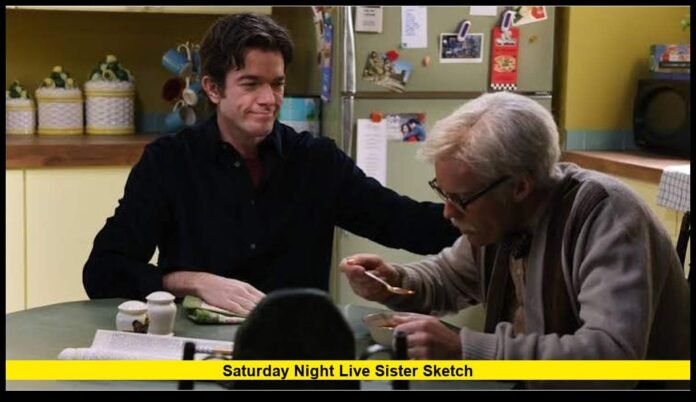

The Saturday Night Live Sister Sketch has emerged as one of the most talked-about comedy moments of November 2026, bringing attention to an everyday family situation that millions of Americans may recognize. Featuring John Mulaney and Jane Wickline, the sketch transforms the challenges of caring for aging parents into a fictional television commercial that exposes the unequal responsibilities often placed on daughters.
The segment aired during the November 14 episode of Saturday Night Live, hosted by John Mulaney. Rather than presenting a traditional comedy storyline, the show created a parody advertisement for an imaginary elder-care service called Sister. The supposed service promises families an inexpensive, convenient way to look after an aging parent. However, the unexpected twist is that the service is not a professional healthcare provider. It is simply the man’s sister, who is expected to handle practically every responsibility associated with caring for their father.
The concept immediately attracted attention because its humor comes from a recognizable family dynamic. In many households, daughters become the primary people responsible for medical appointments, prescription schedules, transportation, household arrangements, and emergency situations involving aging relatives. Meanwhile, other family members may continue their daily routines without understanding how much work goes into providing consistent care.
John Mulaney’s confident commercial presentation and Jane Wickline’s portrayal of the overburdened sister create a memorable contrast. The result is a comedy segment that entertains viewers while encouraging conversations about unpaid caregiving, gender expectations, family relationships, and the financial pressures associated with elder care.
The growing interest in the Saturday Night Live Sister Sketch demonstrates how a short television segment can bring a serious social issue into mainstream entertainment discussions.
What Happened in the Saturday Night Live Sister Sketch?
The Saturday Night Live Sister Sketch begins like a conventional advertisement for a healthcare product or family assistance service. John Mulaney plays a man who explains that his father is getting older and needs additional attention.
He describes a familiar dilemma. He loves his father and wants him to receive proper care, but he does not want to place him in a nursing home. Hiring a private healthcare aide also appears financially difficult because professional assistance can be expensive.
His character then introduces an apparently convenient alternative.
The solution is called Sister.
Instead of paying for a professional caregiver, the man explains that he can rely on his own sister to provide the assistance his father needs. The imaginary service is presented as free, dependable, and available throughout the day and night.
Jane Wickline plays the sister, whose life becomes increasingly centered on caring for their aging father.
She handles the responsibilities that the commercial presents as benefits of the service. These include responding to family messages, managing medical concerns, organizing appointments, and dealing with the practical demands of elder care.
The brother, meanwhile, appears pleased with the arrangement because he can return to his regular activities.
This contrast establishes the sketch’s central joke. One family member receives the convenience of having someone else manage the difficult responsibilities, while the other person is expected to sacrifice personal time and independence.
The advertisement becomes increasingly absurd as it describes the supposed advantages of Sister.
However, the underlying situation is recognizable to viewers who have experienced similar family arrangements.
The sketch does not simply make fun of a brother who avoids helping. It examines how caregiving expectations can become attached to one person without a fair discussion about responsibilities.
John Mulaney’s Role in the Fake Elder-Care Advertisement
John Mulaney plays the commercial spokesperson who introduces the fictional service and explains why families should use it.
His performance relies on the familiar presentation style of television advertising. He speaks confidently, maintains an enthusiastic attitude, and describes the imaginary product as though it offers an innovative solution to a difficult household problem.
The humor comes from the difference between what he says and what the audience sees.
His character presents Sister as a convenient service that eliminates the need to worry about an aging parent’s everyday requirements.
However, the supposed convenience depends entirely on his sister taking responsibility.
The brother does not appear particularly concerned about whether she has enough time, whether she has other commitments, or whether she wants to become the family’s primary caregiver.
His attitude makes the commercial increasingly uncomfortable because he treats his sister’s availability as something that naturally belongs to him and the rest of the family.
Mulaney’s delivery helps make the concept effective. He maintains the cheerful tone of someone selling a product while describing an arrangement that would be unreasonable if presented as an actual family-care plan.
The performance also reflects Mulaney’s ability to build comedy around ordinary conversations and familiar social behavior.
Instead of relying on exaggerated physical comedy throughout the segment, he uses confidence and understatement to make the fictional commercial believable.
That approach allows the audience to understand the joke before the advertisement becomes even more ridiculous.
Jane Wickline’s Performance as the Overworked Sister
Jane Wickline plays the central figure behind the imaginary caregiving service.
Her character is introduced as the woman who will handle the responsibilities that her brother does not want to manage.
The commercial presents her as an almost unlimited source of assistance.
She is expected to rearrange her schedule, respond to family emergencies, coordinate healthcare arrangements, and take care of everyday problems involving their father.
The character’s importance goes beyond the individual jokes.
She represents people who become responsible for family caregiving without receiving enough recognition, financial assistance, or practical support.
The contrast between Wickline’s character and Mulaney’s relaxed spokesperson makes the commercial’s central criticism particularly clear.
The brother sees an affordable solution. The sister experiences a major change in her daily life.
Her responsibilities also extend beyond the immediate needs of her father. The arrangement suggests that the entire family can depend on her whenever something goes wrong.
This is an important part of the sketch because caregiving is rarely limited to one isolated task.
A medical appointment can involve transportation, insurance questions, communication with doctors, prescription refills, and follow-up arrangements.
A family emergency can interrupt work, personal commitments, and household responsibilities.
Wickline’s performance helps viewers recognize the person behind these activities rather than treating caregiving as an effortless family obligation.
Andrew Dismukes and the Other Characters Strengthen the Joke
The Saturday Night Live Sister Sketch uses additional characters to demonstrate how the fictional service benefits other relatives.
Andrew Dismukes appears in a testimonial-style moment that reinforces the commercial’s central argument.
His character explains that loving a parent does not necessarily mean wanting to perform uncomfortable personal-care responsibilities.
The joke is that Sister may not enjoy those responsibilities either, but she will perform them because the family expects her to.
This moment makes the difference between affection and practical caregiving particularly clear.
A person can sincerely love an aging parent while still being unwilling to handle difficult daily tasks.
The sketch also features Kenan Thompson as part of its broader portrayal of family members who benefit from the sister’s involvement.
Mikey Day appears as a fictional doctor who explains the supposed mechanics of the Sister service.
These appearances help develop the advertisement beyond the initial conversation between the brother and sister.
Each character contributes to the same central idea: the family has found a convenient arrangement, but the convenience comes at someone else’s expense.
The commercial treats the sister’s unpaid labor as an ordinary feature of family life.
That is precisely what makes the concept work as social satire.
Dr. Grant’s Explanation of the Sister System
One of the most important moments comes when Mikey Day appears as Dr. Grant, a fictional medical expert associated with the imaginary service.
His character offers an explanation of how the Sister system supposedly works.
Rather than describing an actual medical treatment, the doctor presents a humorous explanation involving years of internalized sexism.
The commercial suggests that a woman can gradually become conditioned to believe that caring for relatives is her responsibility, even when other family members should be participating.
The system supposedly activates when a brother sends a message asking for help.
The sister then becomes responsible for managing the situation.
This section takes the sketch beyond a simple joke about one brother avoiding work.
It points toward a broader cultural expectation that women should naturally become the people who organize family life and provide emotional support.
The doctor presents this arrangement as though it were a scientifically established healthcare process.
The contrast between the medical language and the ridiculous explanation gives the scene much of its comedic impact.
It also encourages viewers to consider whether some family responsibilities are distributed according to actual availability and ability or simply according to traditional expectations.
The Real Meaning Behind the Sister Sketch
The strongest aspect of the Saturday Night Live Sister Sketch is its connection to the unequal distribution of family caregiving.
Although the commercial is fictional, the situation it describes reflects a documented pattern in American households.
When parents become older, relatives may need to provide assistance with transportation, medical appointments, medication management, meals, household activities, and personal care.
These responsibilities can require significant time and attention.
In many families, one person gradually becomes the primary caregiver.
That person may initially help with a few appointments or occasional errands. Over time, however, other relatives begin depending on them for increasingly complicated responsibilities.
The arrangement can develop without a formal agreement.
The person who understands a parent’s medical history may become the default contact. The sibling who lives nearby may handle emergencies. The daughter who has previously organized appointments may receive every new request.
Eventually, one relative may find that caregiving has become a major part of everyday life.
The sketch uses the fictional Sister service to make this imbalance visible.
Its message is particularly relevant because caregiving involves more than physical assistance.
It also requires planning, communication, emotional support, financial decisions, and constant coordination.
These less visible responsibilities can become overwhelming even when other family members believe they are helping.
Why Women Continue to Carry a Larger Share of Caregiving Responsibilities
The gender imbalance presented in the sketch has a real foundation.
Research published in 2025 by AARP and the National Alliance for Caregiving estimated that approximately 63 million Americans provide ongoing care to adults or children with complex medical conditions or disabilities.
That figure represents roughly one in four American adults.
The research also found that women accounted for approximately 61% of family caregivers, compared with 38% of men.
These findings help explain why the fictional Sister commercial has connected with so many viewers.
Women are more likely to provide certain hands-on forms of personal care, including assistance with bathing, dressing, and other daily activities.
The difference is not limited to the number of hours spent providing assistance.
Women may also take responsibility for organizing medical appointments, communicating with healthcare professionals, monitoring prescriptions, and managing family discussions about care arrangements.
Men also provide important caregiving services, and many families have sons or brothers who take primary responsibility for aging relatives.
However, the overall research demonstrates that women continue to carry a disproportionate share of unpaid family care.
The Saturday Night Live segment turns that imbalance into an imaginary commercial.
Instead of discussing the issue through a traditional documentary format, it shows how unreasonable the arrangement looks when presented as a product that one person can purchase for free.
The Growing Challenge of Caring for Aging Parents in America
The United States faces increasing demand for family caregiving as more people live longer and require assistance with health and everyday activities.
Older adults may experience mobility limitations, chronic illnesses, memory difficulties, or other conditions that make independent living more challenging.
Some need only occasional assistance.
Others require extensive support throughout the day.
For families, determining the appropriate level of care can involve difficult conversations about health, finances, living arrangements, and personal preferences.
A parent may want to remain in their own home even when everyday activities become difficult.
Adult children may want to respect that preference while also recognizing that their parent needs additional assistance.
The resulting responsibilities can create pressure across the entire family.
Relatives may need to decide whether to arrange professional home care, consider assisted living, explore community resources, or share caregiving duties themselves.
These decisions are not always easy.
The fictional Sister commercial highlights what happens when a family avoids those discussions and simply expects one person to handle everything.
Its humor comes from the assumption that an aging parent’s care can be organized without a serious conversation about who will provide the assistance.
In reality, successful caregiving usually requires planning and cooperation.
The Financial Burden of Family Caregiving
Another important subject connected to the Saturday Night Live Sister Sketch is the cost of elder care.
The fictional service is marketed as a free alternative to professional assistance.
That idea is central to the commercial because the brother wants his father to receive attention without paying for an expensive healthcare arrangement.
Professional caregiving can be costly, depending on the level of assistance required and the location where a family lives.
Home health services, personal-care assistance, assisted living, and nursing facilities all have different costs and eligibility requirements.
For some households, these expenses create financial pressure.
When professional care becomes unaffordable, family members may take on additional responsibilities themselves.
However, unpaid care does not mean the arrangement has no financial consequences.
A caregiver may need to reduce working hours, use paid leave, decline promotions, or leave a job.
Some individuals also spend their own money on transportation, groceries, medical supplies, household expenses, and other needs.
Recent caregiving research has highlighted the substantial out-of-pocket costs experienced by American families.
The financial consequences can continue even after a caregiving arrangement changes.
Someone who leaves employment may lose income, retirement contributions, and access to employer-sponsored benefits.
These sacrifices can influence long-term financial security.
The fictional Sister service ignores these costs, treating the sister’s time as an unlimited resource.
That is part of the commercial’s criticism.
A family may avoid paying a professional caregiver, but the work still has a cost. It simply falls on someone who may not receive compensation.
The Sandwich Generation Faces an Additional Challenge
The caregiving discussion also connects with the growing challenges faced by the sandwich generation.
This term describes adults who provide support to aging relatives while also raising children or caring for younger family members.
According to the 2025 national caregiving research, approximately 17 million Americans were sandwich-generation caregivers.
They represented about 29% of adult caregivers included in the research.
These individuals often manage multiple responsibilities simultaneously.
A parent may need assistance with medical appointments while a child requires transportation to school, help with homework, or attention to everyday needs.
Employment adds another layer of pressure.
Working caregivers may have to adjust schedules, use leave, or complete professional responsibilities outside normal working hours.
The situation can become especially complicated when an older parent requires frequent supervision.
Unlike an occasional family obligation, caregiving may continue for months or years.
The Saturday Night Live Sister Sketch does not need to explain every aspect of this experience to communicate its central message.
Its fictional character represents the person who is expected to manage everything, regardless of how many other responsibilities already exist in her life.
How Caregiving Can Affect Careers and Employment
Providing regular assistance to an aging parent can change a person’s professional life.
A caregiver may need to leave work early for a medical appointment, respond to an emergency during business hours, or spend part of the day communicating with healthcare providers.
These interruptions can affect productivity and professional opportunities.
Some employees may negotiate flexible schedules or work remotely.
Others may reduce their hours or take unpaid leave.
In more demanding situations, a caregiver may decide to leave employment altogether.
The financial impact can be considerable.
Losing a job or reducing working hours can affect household income, health insurance arrangements, retirement savings, and future career development.
These consequences are particularly important when one sibling becomes the primary caregiver while other relatives continue working without significant interruptions.
The family may recognize that someone is helping an aging parent without fully understanding the professional opportunities that person has sacrificed.
The sketch brings attention to this imbalance through its exaggerated portrayal of the sister’s availability.
It also raises an important question: Should the person providing the most care automatically be expected to make the greatest personal sacrifices?
A fair arrangement should consider the circumstances and abilities of every family member.
The Emotional Pressure of Becoming the Default Caregiver
Caregiving is not only a practical responsibility.
It can also create emotional pressure that affects family relationships and personal well-being.
People who care for aging parents may experience worry, frustration, sadness, and exhaustion.
They may become concerned about a parent’s declining health while trying to maintain their own household and professional responsibilities.
Some caregivers also experience guilt.
They may feel guilty when they cannot provide enough assistance or when they need time away from their responsibilities.
Family disagreements can make these emotions more difficult to manage.
A sibling who provides regular assistance may become frustrated when other relatives offer opinions without contributing meaningful help.
Another family member may believe that occasional visits or financial contributions should be enough.
These disagreements can create tension even when everyone genuinely wants the parent to receive appropriate care.
The Saturday Night Live Sister Sketch uses comedy to highlight one side of this situation.
The brother appears satisfied because the problem has been solved.
The sister, however, has become responsible for the work.
That difference between perception and reality is an important part of the sketch’s message.
Why the Sketch Connected With Viewers So Quickly
The response to the Saturday Night Live Sister Sketch reflects the strength of its everyday subject.
According to coverage published shortly after the episode, the video attracted approximately 2 million YouTube views and 43,000 likes within its first day.
Subsequent reporting placed the view count above 2.2 million.
The early response indicates that the commercial reached audiences beyond people who regularly follow the show.
One reason is that viewers can easily connect the situation with experiences from their own families.
Someone who has organized a parent’s medical appointments may recognize the responsibilities represented by Jane Wickline’s character.
A brother who has relied on a sister for family assistance may recognize the commercial’s exaggerated portrayal of convenience.
Other viewers may identify with the emotional pressure of being the person everyone contacts when something goes wrong.
The sketch also provides an opportunity for people to discuss an uncomfortable subject through humor.
Instead of directly accusing a relative of avoiding responsibility, someone can share the commercial and use it as a starting point for a conversation.
That makes the segment particularly shareable.
It is entertaining, but it also communicates something that many people have struggled to explain.
Social Media Reactions Highlight the Sketch’s Relatability
The online conversation surrounding the sketch quickly moved beyond its performances.
Viewers discussed their experiences with aging parents, sibling disagreements, and the responsibilities involved in providing unpaid care.
Some people described the commercial as an accurate representation of their family situation.
Others appreciated that a major television program had addressed an issue that often receives limited attention in everyday entertainment coverage.
The reactions also highlighted an important distinction.
Not every family has the same caregiving arrangement.
Some siblings divide responsibilities equally. Others make decisions based on geographical distance, employment schedules, financial circumstances, or a parent’s medical needs.
However, the sketch connected with people who believe their family has allowed caregiving responsibilities to fall unfairly on one individual.
The fictional commercial also attracted attention because it presented the brother’s behavior without offering an easy excuse.
He may love his father, but his affection does not automatically translate into practical assistance.
That distinction became one of the most discussed aspects of the segment.
Who Wrote the Saturday Night Live Sister Sketch?
The creative team behind the segment has also received attention.
The reported writing credits include Mikey Day, Streeter Seidell, and former Saturday Night Live writer Simon Rich, with an additional contribution from Chase Rosenberg.
Their work combines the familiar structure of a commercial advertisement with a subject that involves family relationships and social expectations.
The fictional service uses several recognizable advertising elements.
It has a confident spokesperson, a supposedly convenient product, testimonial-style appearances, and a fictional medical expert who explains how the system operates.
Each element contributes to the central joke.
The commercial initially resembles a serious advertisement for a healthcare service. As the segment develops, however, viewers realize that the product is simply a family member being expected to provide unpaid labor.
Streeter Seidell also publicly dedicated the sketch to his sister Heidi.
That personal acknowledgment attracted additional interest because it connected the fictional subject with a real sibling relationship.
The writing demonstrates how a familiar family observation can become the foundation for a larger comedy segment.
Why the Commercial Format Works So Well
Saturday Night Live has a long history of using fictional advertisements to parody consumer products, services, and everyday social behavior.
The format works because viewers already understand how commercials operate.
An advertisement typically identifies a problem, introduces a product, and explains why purchasing it will improve someone’s life.
The Sister sketch follows that structure while reversing its meaning.
The brother introduces a problem involving his aging father.
He then presents a convenient solution.
However, the service does not provide professional assistance. Instead, it transfers the work to his sister.
The commercial’s cheerful tone makes the arrangement appear completely reasonable, even as the audience recognizes its unfairness.
The fictional testimonials strengthen this idea by showing how other relatives benefit from the service.
The doctor adds another layer by presenting gender expectations as though they were part of a medical system.
This approach allows the sketch to address a complicated social issue without becoming a traditional lecture.
The audience understands the criticism through the contrast between the advertisement’s promises and the sister’s actual experience.
What Families Can Learn From the Sister Sketch
Although the segment is designed for entertainment, its central subject offers an opportunity for practical discussion.
Families caring for aging relatives can benefit from establishing clear expectations before responsibilities become overwhelming.
Aging parents may need different forms of support at different stages of life.
One person may handle transportation, another may manage medical paperwork, and another may contribute financially toward professional assistance.
The responsibilities do not need to be identical.
However, they should be discussed openly.
Families can begin by identifying the parent’s actual needs and determining which relatives are available to help.
A useful discussion can include:
- Medical responsibilities: Decide who will coordinate appointments, communicate with healthcare providers, and organize prescription information.
- Financial contributions: Discuss how relatives can share expenses associated with professional assistance and everyday care.
- Transportation: Establish who can provide regular rides to appointments, pharmacies, and other essential destinations.
- Emergency arrangements: Make sure multiple family members understand what to do when an unexpected medical situation develops.
- Time away: Give the primary caregiver opportunities to rest and maintain personal commitments.
- Professional assistance: Consider whether home-care services, community programs, or other resources can reduce the family’s workload.
These steps can help prevent one person from becoming responsible for every aspect of caregiving.
The most important consideration is that family care should be treated as a shared responsibility rather than an automatic obligation assigned to one relative.
Latest Updates on the Saturday Night Live Sister Sketch
As of November 17, 2026, the Saturday Night Live Sister Sketch continues to attract attention following John Mulaney’s November 14 hosting appearance.
The segment has become one of the most discussed moments from the episode because of its combination of commercial-style comedy and social commentary.
Jane Wickline’s performance as the sister and Mulaney’s role as the enthusiastic spokesperson have been central to the audience response.
The sketch has also received attention from caregiving-focused publications because its subject connects with documented patterns in American families.
The early YouTube performance and social media discussions demonstrate the reach of the segment.
The writing credits and Seidell’s dedication to his sister have also become part of the conversation.
At this time, there is no official confirmation of another Sister commercial, a sequel, or a recurring character based on the fictional elder-care service.
The original segment remains the confirmed installment associated with the November 14 episode.
Viewers interested in the sketch can watch it through the official Saturday Night Live YouTube channel.
Will Saturday Night Live Bring Back the Sister Character?
The popularity of the original commercial may lead audiences to wonder whether the show will revisit the concept.
The fictional service offers several possibilities for additional comedy because family caregiving involves many different situations.
A future segment could examine medical appointments, family disagreements, financial arrangements, or the responsibilities that arise when an aging parent needs more assistance.
However, there is no official announcement confirming another installment.
The success of one sketch does not automatically mean that its characters or fictional products will return.
For now, the November 14 segment remains the confirmed appearance.
Any future development should be treated as unconfirmed until Saturday Night Live announces it.
Final Thoughts
The Saturday Night Live Sister Sketch has become more than a memorable comedy advertisement because it addresses a subject that affects millions of American households.
John Mulaney’s confident commercial spokesperson, Jane Wickline’s portrayal of the overworked sister, and the supporting performances create a humorous examination of family caregiving expectations.
Its central joke is easy to understand: a brother wants his aging father to receive proper attention without personally taking on the difficult responsibilities involved.
His sister becomes the solution, even though the arrangement requires her to sacrifice time, energy, and personal independence.
The commercial exaggerates this situation, but the underlying issue is supported by real caregiving research.
Women represent a larger share of family caregivers, and many provide substantial assistance while maintaining jobs, raising children, and managing their own households.
The financial and emotional consequences can be significant, particularly when one person receives little practical support from other relatives.
The sketch succeeds because it makes an invisible responsibility visible.
It encourages viewers to recognize the difference between saying that a parent deserves care and actually participating in the work required to provide it.
It also reminds families that unpaid caregiving should not automatically become one person’s lifelong responsibility.
Ultimately, the segment’s strongest contribution may be the conversation it creates. Families can use its humor to examine their own arrangements, acknowledge the people doing the most work, and develop fairer ways to support aging relatives.
The Saturday Night Live Sister Sketch leaves viewers with an important question: When an aging parent needs help, should one daughter really be expected to take care of everything while everyone else carries on with life?
Share your thoughts about John Mulaney and Jane Wickline’s memorable SNL sketch in the comments, and stay connected for the latest Saturday Night Live news, comedy highlights, and entertainment updates.