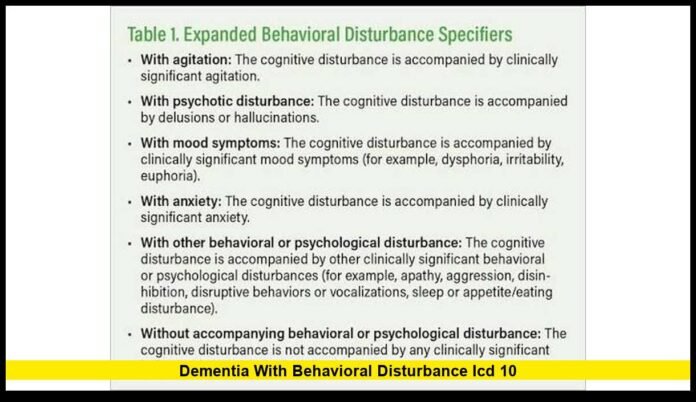

Dementia with behavioral disturbance ICD 10 refers to the medical coding classification used when a person has dementia accompanied by behavioral, psychological, or emotional symptoms. These symptoms may include agitation, anxiety, mood changes, hallucinations, suspiciousness, or other changes that affect daily functioning and interactions with others.
Dementia is not limited to memory loss. It can affect thinking, reasoning, communication, judgment, personality, and the ability to complete everyday activities. When behavioral symptoms are also present, the condition may require more detailed documentation and a specific ICD-10-CM code.
In the United States, dementia coding depends on several factors, including the underlying cause of dementia, the documented severity, and the specific behavioral or psychological symptoms. Understanding the coding structure can help healthcare professionals, medical billing specialists, caregivers, and individuals reviewing medical records identify the information associated with a dementia diagnosis.
Understanding Dementia With Behavioral Disturbance
Dementia is a condition involving a significant decline in cognitive abilities that interferes with a person’s daily life. Depending on the underlying disease, the decline may affect memory, language, attention, problem-solving, reasoning, and decision-making.
Behavioral disturbance refers to changes in behavior or psychological functioning that may occur alongside dementia. These changes can affect a person’s ability to communicate, interact socially, follow routines, or respond to their surroundings.
Some individuals may experience mild behavioral changes, while others may develop symptoms that require additional care and supervision.
Common behavioral symptoms associated with dementia include:
- Agitation and restlessness
- Irritability and anger
- Verbal aggression
- Physical aggression
- Anxiety and fear
- Depression or mood changes
- Hallucinations
- Delusions or suspiciousness
- Wandering or exit-seeking
- Sleep disturbances
- Repetitive behaviors
- Resistance to caregiving
- Social disinhibition
- Changes in personality
These symptoms may develop gradually or fluctuate over time. Behavioral changes are not necessarily intentional. Dementia may affect the person’s ability to understand situations, communicate needs, process information, or regulate emotions.
Dementia With Behavioral Disturbance ICD-10-CM Codes
The ICD-10-CM system includes different codes for dementia depending on the documented severity and the type of behavioral or psychological manifestation.
For unspecified dementia, the classification distinguishes between dementia without specified behavioral or psychological symptoms and dementia associated with agitation, other behavioral disturbance, psychotic disturbance, mood disturbance, or anxiety.
| ICD-10-CM Code | Description |
|---|---|
| F03.90 | Unspecified dementia, unspecified severity, without behavioral, psychotic, mood disturbance, or anxiety |
| F03.911 | Unspecified dementia, unspecified severity, with agitation |
| F03.918 | Unspecified dementia, unspecified severity, with other behavioral disturbance |
| F03.92 | Unspecified dementia, unspecified severity, with psychotic disturbance |
| F03.93 | Unspecified dementia, unspecified severity, with mood disturbance |
| F03.94 | Unspecified dementia, unspecified severity, with anxiety |
The code should reflect the diagnosis and symptoms documented in the medical record. Behavioral symptoms are not automatically interchangeable for coding purposes.
For example, agitation may be classified differently from anxiety or psychotic disturbance. The most appropriate code depends on the provider’s documentation and the applicable coding guidelines.
Mild Dementia With Behavioral Disturbance
Mild dementia may involve cognitive difficulties that interfere with some daily activities but do not necessarily eliminate a person’s ability to live independently. Individuals may still perform many familiar tasks while needing additional assistance with complicated activities, organization, or decision-making.
Possible difficulties may include forgetting appointments, misplacing belongings, managing finances, organizing medications, following complex instructions, or completing unfamiliar tasks.
Behavioral symptoms can also occur during this stage. A person may become frustrated when struggling with familiar activities, feel anxious about changes, or experience irritability and emotional distress.
The following codes apply to unspecified dementia documented as mild:
| ICD-10-CM Code | Description |
|---|---|
| F03.A0 | Unspecified dementia, mild, without behavioral, psychotic, mood disturbance, or anxiety |
| F03.A11 | Unspecified dementia, mild, with agitation |
| F03.A18 | Unspecified dementia, mild, with other behavioral disturbance |
| F03.A2 | Unspecified dementia, mild, with psychotic disturbance |
| F03.A3 | Unspecified dementia, mild, with mood disturbance |
| F03.A4 | Unspecified dementia, mild, with anxiety |
Mild dementia does not mean that behavioral symptoms are absent. Some people may experience anxiety, restlessness, irritability, suspiciousness, or mood changes even when their cognitive impairment is relatively early.
Moderate Dementia With Behavioral Disturbance
Moderate dementia generally involves more noticeable cognitive impairment and greater difficulty performing daily activities. Patients may require regular assistance from family members, caregivers, or healthcare professionals.
Activities that may become more difficult include preparing meals, managing medications, dressing, bathing, organizing household responsibilities, maintaining personal hygiene, and navigating unfamiliar locations.
Behavioral symptoms may become more noticeable during this stage. Some individuals may experience agitation, repetitive questioning, confusion, resistance to care, anxiety, or emotional changes.
The following codes apply to unspecified dementia documented as moderate:
| ICD-10-CM Code | Description |
|---|---|
| F03.B0 | Unspecified dementia, moderate, without behavioral, psychotic, mood disturbance, or anxiety |
| F03.B11 | Unspecified dementia, moderate, with agitation |
| F03.B18 | Unspecified dementia, moderate, with other behavioral disturbance |
| F03.B2 | Unspecified dementia, moderate, with psychotic disturbance |
| F03.B3 | Unspecified dementia, moderate, with mood disturbance |
| F03.B4 | Unspecified dementia, moderate, with anxiety |
The severity level should be based on the healthcare provider’s assessment and documentation. Medical coders should not assign a severity level based solely on assumptions about the patient’s behavior or functional abilities.
Severe Dementia With Behavioral Disturbance
Severe dementia may substantially affect a person’s memory, communication, judgment, recognition, and ability to perform basic activities of daily living.
Individuals may require extensive assistance with personal care, eating, bathing, dressing, mobility, and other daily needs. They may also require continuous supervision depending on their condition and safety concerns.
The following codes apply to unspecified dementia documented as severe:
| ICD-10-CM Code | Description |
|---|---|
| F03.C0 | Unspecified dementia, severe, without behavioral, psychotic, mood disturbance, or anxiety |
| F03.C11 | Unspecified dementia, severe, with agitation |
| F03.C18 | Unspecified dementia, severe, with other behavioral disturbance |
| F03.C2 | Unspecified dementia, severe, with psychotic disturbance |
| F03.C3 | Unspecified dementia, severe, with mood disturbance |
| F03.C4 | Unspecified dementia, severe, with anxiety |
Severe dementia does not automatically mean that a patient is aggressive or experiences psychotic symptoms. The behavioral manifestation must be documented separately when applicable.
What Is Agitation in Dementia?
Agitation is one of the behavioral symptoms commonly associated with dementia. It may involve restlessness, emotional distress, repetitive movements, verbal behavior, or physical actions.
Examples of agitation may include:
- Pacing or walking repeatedly
- Rocking or repetitive movement
- Shouting or yelling
- Irritability
- Anger
- Resistance to care
- Repeated attempts to leave
- Threatening language
- Combative behavior
- Physical aggression
Agitation may occur when a person feels confused, frightened, uncomfortable, overwhelmed, or unable to communicate their needs. It may also be associated with changes in surroundings, disrupted routines, fatigue, pain, medication effects, or other medical factors.
The ICD-10-CM system recognizes agitation as a specific dementia manifestation. This is why a code for dementia with agitation may differ from a code for other behavioral disturbance.
Dementia With Other Behavioral Disturbance
Behavioral symptoms associated with dementia are not always classified as agitation. Other disturbances may involve different patterns of behavior or changes in social interaction.
Examples may include:
- Social disinhibition
- Inappropriate behavior
- Sleep-related behavioral changes
- Repetitive actions
- Unusual behavioral patterns
- Other documented behavioral symptoms
For unspecified dementia, the applicable code may depend on whether the condition is documented as unspecified severity, mild, moderate, or severe.
Examples of codes for other behavioral disturbance include F03.918, F03.A18, F03.B18, and F03.C18, when supported by the documented diagnosis and severity.
The coding distinction is important because a patient with agitation may not have the same behavioral classification as a patient with other documented behavioral changes.
Dementia With Psychotic Disturbance
Some people living with dementia may experience psychotic symptoms that affect their perception of reality or interpretation of their surroundings.
These symptoms may include hallucinations, delusions, paranoia, suspiciousness, or false beliefs.
Hallucinations may involve seeing, hearing, or experiencing something that others do not perceive. Delusions may involve firmly held beliefs that are not supported by reality. A person may believe that personal belongings have been stolen, that someone is entering their home, or that a familiar person is unfamiliar.
Psychotic symptoms may create emotional distress for the patient and challenges for caregivers. The symptoms may also require medical assessment to determine their cause and appropriate management.
ICD-10-CM includes dementia with psychotic disturbance as a separate coding category. The appropriate code depends on the underlying dementia diagnosis and the documented severity.
Dementia With Mood Disturbance
Mood disturbances may accompany dementia and can affect emotional expression, motivation, interest in activities, and relationships.
Possible symptoms include:
- Depression
- Persistent sadness
- Apathy
- Reduced motivation
- Emotional changes
- Loss of interest in activities
- Increased emotional sensitivity
A person may become withdrawn, lose interest in hobbies, or show reduced participation in social activities. Other individuals may experience sadness, frustration, or changes in emotional responses.
Mood symptoms should not automatically be attributed to dementia without appropriate evaluation. Depression, other medical conditions, medication effects, and environmental factors may also contribute to changes in mood.
The ICD-10-CM classification provides dementia codes with mood disturbance when the manifestation is documented and supported by the applicable coding rules.
Dementia With Anxiety
Anxiety is another psychological symptom that may occur in people with dementia. It can involve worry, fear, nervousness, restlessness, or distress when a person is unable to understand a situation.
Anxiety may become noticeable during changes in routine, unfamiliar environments, separation from familiar caregivers, or situations that require the person to remember or process information.
Common symptoms may include:
- Excessive worry
- Fear
- Nervousness
- Restlessness
- Difficulty relaxing
- Repeated questioning
- Distress in unfamiliar environments
- Anxiety during changes in routine
Some individuals may become anxious when they cannot remember where they are, recognize familiar people, or understand what is happening around them.
The coding classification recognizes dementia with anxiety as a distinct manifestation. The appropriate code depends on the severity of dementia and the underlying diagnosis documented in the medical record.
Different Types of Dementia and Their ICD-10 Coding
Dementia may develop from several underlying neurological conditions. Identifying the cause can affect the coding process because different dementia categories may have different instructions.
Alzheimer’s Disease
Alzheimer’s disease is a progressive neurological condition that affects memory, thinking, reasoning, language, and other cognitive abilities.
As the condition progresses, patients may experience increasing difficulty with everyday activities. Behavioral or psychological symptoms may also develop, including anxiety, agitation, irritability, mood changes, hallucinations, or suspiciousness.
When dementia is associated with Alzheimer’s disease, the coding process may require the underlying Alzheimer’s disease code and an additional dementia manifestation code, depending on the applicable official instructions.
Vascular Dementia
Vascular dementia is associated with damage to the brain’s blood supply. It may develop following strokes, multiple vascular injuries, or other conditions affecting blood flow to the brain.
Possible symptoms include memory difficulties, problems with attention, impaired judgment, challenges with planning, and changes in daily functioning.
The ICD-10-CM F01 category is used for vascular dementia. Code selection may depend on severity and whether agitation, other behavioral disturbance, psychotic disturbance, mood disturbance, or anxiety is documented.
Dementia Associated With Parkinson’s Disease
Parkinson’s disease is primarily associated with movement-related symptoms, but cognitive impairment and dementia may also occur in some individuals.
Patients may experience changes in attention, memory, reasoning, judgment, or problem-solving. Behavioral symptoms may also develop.
The coding approach may require identifying the underlying Parkinson’s disease and using the applicable dementia code according to official coding instructions.
Dementia With Lewy Bodies
Dementia with Lewy bodies is a neurological condition that may involve cognitive changes, fluctuations in attention, visual hallucinations, and movement-related symptoms.
Some individuals may experience changes in alertness or concentration, while others may have hallucinations or difficulties with everyday functioning.
Coding should reflect the documented diagnosis and the applicable ICD-10-CM classification rather than relying only on individual symptoms.
Frontotemporal Dementia
Frontotemporal dementia affects brain regions involved in personality, behavior, language, and executive functioning.
Some patients may experience personality changes, impulsive behavior, reduced social awareness, emotional changes, or communication difficulties.
Behavioral symptoms can sometimes be noticeable before significant memory impairment develops. The coding approach depends on the diagnosis documented by the healthcare provider and the applicable classification instructions.
How Dementia Severity Is Determined
Dementia severity is a clinical assessment based on the patient’s cognitive abilities, functional limitations, and overall condition. The severity level is not determined simply by the number of symptoms a patient experiences.
Healthcare professionals may consider several factors, including:
- Memory and attention
- Reasoning and judgment
- Communication abilities
- Ability to complete daily activities
- Independence with personal care
- Medication management
- Need for supervision
- Safety awareness
- Changes in functional abilities
The ICD-10-CM classification includes unspecified severity, mild, moderate, and severe dementia in applicable coding categories.
A person with mild dementia may still perform many daily activities independently but need assistance with complex tasks. Someone with moderate dementia may require regular assistance with daily routines. Severe dementia may involve substantial dependence on caregivers for personal care and essential activities.
The provider’s documentation is important because medical coders should not independently determine dementia severity without following the applicable coding rules.
Why Accurate Dementia Coding Matters
Accurate coding is important for medical documentation, healthcare communication, insurance claims, reporting, and care planning.
Medical Records
Diagnosis codes help healthcare professionals understand a patient’s condition. More specific coding may communicate the dementia severity and behavioral symptoms more clearly.
Insurance Claims and Billing
ICD-10-CM codes are used in healthcare billing and insurance claims. Incorrect or incomplete codes may result in claim rejections, delays, additional reviews, or requests for supporting documentation.
Care Planning
Documentation of behavioral symptoms and dementia severity may help healthcare teams understand the patient’s needs and develop appropriate care plans.
Healthcare Data and Reporting
Diagnosis codes are used in healthcare databases, research, reporting, and population-level analysis. Accurate coding helps improve the quality of the information collected.
Caregiver Communication
Detailed documentation may help families and caregivers communicate more effectively with healthcare professionals about behavioral changes, functional limitations, supervision requirements, and daily care needs.
How the Correct ICD-10-CM Code Is Selected
Selecting an appropriate dementia code requires reviewing the medical record and identifying several important details.
Confirm the dementia diagnosis: The provider must document the diagnosis. Memory problems or confusion alone do not automatically establish dementia.
Identify the underlying cause: When the cause is known, such as Alzheimer’s disease, vascular disease, Parkinson’s disease, or another neurological condition, the coding category may differ from unspecified dementia.
Determine documented severity: The medical record should identify the applicable severity when required, such as mild, moderate, or severe.
Identify the behavioral manifestation: The documentation should specify whether symptoms involve agitation, other behavioral disturbance, psychotic disturbance, mood disturbance, anxiety, or another recognized manifestation.
Review coding instructions: The final code should be checked against the applicable ICD-10-CM Alphabetic Index, Tabular List, and official coding guidelines. Some diagnoses may require additional codes or specific sequencing.
Behavioral Changes and Caregiver Considerations
Dementia-related behavioral symptoms can be challenging for patients, families, and caregivers. Understanding that cognitive impairment may affect communication, judgment, emotional responses, and the ability to process information can help caregivers approach difficult situations with greater patience.
Identifying Possible Behavioral Triggers
Behavioral changes may be associated with physical, environmental, or emotional factors.
Possible triggers may include:
- Pain or discomfort
- Hunger or thirst
- Fatigue
- Poor sleep
- Unfamiliar surroundings
- Loud noises
- Changes in daily routines
- Difficulty understanding instructions
- Medication changes
- Overstimulation
Caregivers may find it useful to keep a record of when behavioral symptoms occur, what happened beforehand, and how the individual responded. This information may help healthcare professionals identify patterns or possible contributing factors.
Creating a Calm and Familiar Environment
A predictable daily routine may help some individuals with dementia feel more comfortable. Familiar surroundings, simple communication, adequate time to respond, and reduced distractions may help minimize unnecessary stress.
Caregivers should remember that a person with dementia may not always understand what is being asked of them. Resistance to care, repeated questions, or emotional reactions may be associated with confusion, fear, discomfort, or difficulty communicating.
When a Medical Evaluation May Be Necessary
Sudden changes in behavior should not automatically be attributed to dementia progression. New confusion, unusual agitation, extreme sleepiness, fever, weakness, severe pain, or other concerning symptoms may require prompt medical evaluation.
A healthcare professional may need to investigate possible infections, medication effects, dehydration, pain, sleep problems, or other medical conditions that could contribute to the change.
Latest Updates on Dementia With Behavioral Disturbance ICD-10-CM
The current U.S. ICD-10-CM classification provides more detailed dementia coding than older references that relied on broad descriptions of behavioral disturbance.
The FY 2027 ICD-10-CM code set applies to services from October 1, 2026, through September 30, 2027. The current classification provides distinctions based on dementia severity and the documented behavioral or psychological manifestation.
For unspecified dementia, the classification includes categories for:
- Dementia without behavioral, psychotic, mood disturbance, or anxiety
- Dementia with agitation
- Dementia with other behavioral disturbance
- Dementia with psychotic disturbance
- Dementia with mood disturbance
- Dementia with anxiety
Applicable categories also distinguish mild, moderate, and severe dementia.
Why Older Coding References May Be Different
Older medical coding references may contain broad codes for unspecified dementia with behavioral disturbance. The current coding structure provides more specific classifications, including separate categories for agitation and other behavioral disturbance.
As a result, an older code listed in a previous article, medical record, or billing reference may not represent the most specific code available for current coding purposes.
Healthcare professionals and medical coders should verify the applicable code based on the date of service and the relevant fiscal-year classification.
Common Mistakes When Coding Dementia With Behavioral Disturbance
Several errors may occur when dementia-related coding is performed without reviewing the complete documentation.
Using an Outdated Code
Older references may list codes that have been revised, expanded, or replaced by more specific classifications. The current code set should be used for the applicable date of service.
Treating Every Behavioral Symptom as Agitation
Agitation is different from hallucinations, anxiety, mood disturbance, sleep-related behavioral changes, and other symptoms. The correct code should reflect the documented manifestation.
Assuming Dementia Severity
Medical coders should not independently determine whether dementia is mild, moderate, or severe based solely on assumptions about the patient’s condition.
Confusing Dementia With Mild Cognitive Impairment
Mild cognitive impairment and dementia are not interchangeable diagnoses. They have different clinical meanings and may require different ICD-10-CM classifications.
Ignoring the Underlying Cause
When dementia is associated with a known neurological or medical condition, the coding instructions may require the underlying disease to be identified and coded.
Failing to Use the Most Specific Supported Code
If the medical record clearly documents agitation, psychotic disturbance, mood disturbance, anxiety, or another manifestation, the coder should review whether a more specific code is supported instead of automatically using a general behavioral-disturbance category.
Frequently Asked Questions
What is the ICD-10 code for dementia with behavioral disturbance?
There is no single code that applies to every case. The appropriate code depends on the dementia type, documented severity, and behavioral symptoms.
For unspecified dementia, examples include F03.911 for agitation and F03.918 for other behavioral disturbance when severity is unspecified.
What does F03.911 mean?
F03.911 represents unspecified dementia, unspecified severity, with agitation. It is used when the documentation supports unspecified dementia accompanied by agitation and does not specify the severity level.
What does F03.918 mean?
F03.918 represents unspecified dementia, unspecified severity, with other behavioral disturbance. It is used when other behavioral symptoms are documented rather than agitation specifically.
What is the ICD-10 code for mild dementia with behavioral disturbance?
The appropriate code depends on the documented manifestation. Examples include F03.A11 for mild unspecified dementia with agitation, F03.A18 for mild unspecified dementia with other behavioral disturbance, F03.A2 for psychotic disturbance, F03.A3 for mood disturbance, and F03.A4 for anxiety.
What is the ICD-10 code for moderate dementia with behavioral disturbance?
For unspecified dementia documented as moderate, examples include F03.B11 for agitation, F03.B18 for other behavioral disturbance, F03.B2 for psychotic disturbance, F03.B3 for mood disturbance, and F03.B4 for anxiety.
What is the ICD-10 code for severe dementia with behavioral disturbance?
For unspecified dementia documented as severe, examples include F03.C11 for agitation, F03.C18 for other behavioral disturbance, F03.C2 for psychotic disturbance, F03.C3 for mood disturbance, and F03.C4 for anxiety.
Does behavioral disturbance always mean aggression?
No. Behavioral disturbance may involve anxiety, irritability, wandering, sleep changes, repetitive behavior, hallucinations, mood changes, or resistance to care. Aggression is only one possible manifestation.
Can dementia cause hallucinations?
Yes. Some types of dementia may be associated with hallucinations, delusions, paranoia, or other psychotic symptoms. These symptoms should be clinically evaluated and appropriately documented.
Can behavioral symptoms occur during mild dementia?
Yes. Behavioral or psychological symptoms may occur at different stages of dementia. A person with mild dementia may experience anxiety, agitation, irritability, mood changes, or other behavioral symptoms.
Who determines dementia severity?
The healthcare provider determines and documents dementia severity based on the patient’s clinical condition, cognitive abilities, functional limitations, and other relevant information. Medical coders should follow the documentation and applicable coding guidelines.
Is F03.91 still used for dementia with behavioral disturbance?
Older coding references may list F03.91 as a broad code for unspecified dementia with behavioral disturbance. The current ICD-10-CM classification provides more specific coding categories, including agitation and other behavioral disturbance. The appropriate code should be verified against the current fiscal-year code set.
Why is accurate dementia coding important?
Accurate coding helps maintain complete medical records, supports appropriate billing, improves communication between healthcare professionals, assists care planning, and contributes to healthcare reporting and data quality.
Final Thoughts
Dementia with behavioral disturbance involves more than cognitive decline. It may include changes in mood, behavior, communication, judgment, personality, and psychological functioning. These symptoms can affect daily activities, relationships, independence, and the amount of support a person requires.
The ICD-10-CM coding system provides specific classifications for dementia severity and behavioral manifestations. Agitation, other behavioral disturbance, psychotic disturbance, mood disturbance, and anxiety are separate coding categories and should not be treated as interchangeable.
For healthcare professionals, medical billing specialists, caregivers, and individuals reviewing medical records, understanding these differences can help make dementia-related coding information easier to interpret. Because ICD-10-CM codes are periodically updated, the correct code should always be verified against the applicable fiscal-year classification and official coding instructions.
Have questions about dementia diagnosis codes or behavioral symptoms? Share your thoughts in the comments and stay updated for more healthcare coding guides.